




Anterior choroid plexus is present on the
(a) Roof of diencephalon
(b) The root of the medulla oblongata
(c) Floor of diencephalon
(d) Cerebral hemispheres
Answer
 Verified
620.1k+ views
Hint: Anterior choroid plexus is lined with secretory epithelium. It secretes a colourless, clear liquid that circulates through the cavities of the brain transporting oxygen and nutrients to brain cells. It also protects the brain from physical and chemical injury.
Complete answer:
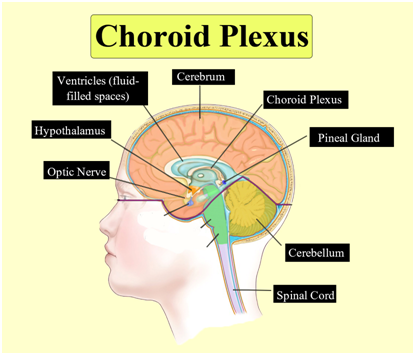
Anterior choroid plexus is present on the roof of the diencephalon. A human brain is grossly divided into forebrain, midbrain and hindbrain. The forebrain is further divisible into the cerebrum, olfactory lobes and diencephalon. The anterior portion of the diencephalon is vascular and folded to form the anterior choroid plexus. Thus, the roof of the diencephalon is where the anterior choroid plexus is located. Choroid plexus is a mesh of capillaries in the walls of ventricles. The capillaries are covered by ependymal tissue that forms the cerebrospinal fluid from body plasma by filtration and secretion.
Additional Information:
-The human brain is protected by three meninges from outer to inner- dura mater, arachnoid mater and pia mater. Dura mater is a tough membrane with close association to the inside of the skull. Arachnoid mater, just as its name suggests, has a web-like structure. While the innermost membrane i.e pia mater is thin, delicate and also highly vasculated with blood vessels.
-The space between pia mater and arachnoid mater is known as subarachnoid space. It is filled with cerebrospinal or CSF fluid. This fluid is highly important as it reduces the weight of the brain from 1.4 kg to 0.18 kg by adding to its buoyancy of brain
-CSF is produced by the choroid plexus which lines the ventricles of the brain. The ventricles are hollow spaces interconnected with each other and filled with fluid. Thus, forming a ventricular system.
-It consists of two lateral ventricles, third and fourth ventricle.
- CSF formed in choroid plexuses of each lateral ventricle flows into the third ventricle. It then flows to the fourth ventricle via midbrain through cerebral aqueduct. After the addition of more CSF by the fourth ventricle,it enters subarachnoid space.
So, the correct answer is ‘Roof of the diencephalon.
Note:
-The lateral ventricles project into each cerebral hemisphere.
-The third ventricle is unpaired, located in between cerebral hemispheres.
- The fourth ventricle lies between the brainstem and cerebellum.
- Ependymal tissue has cells with hair-like projections which form secretory epithelium. The cells have the ability to produce CSF and release into the cavities of ventricles.
Complete answer:
Anterior choroid plexus is present on the roof of the diencephalon. A human brain is grossly divided into forebrain, midbrain and hindbrain. The forebrain is further divisible into the cerebrum, olfactory lobes and diencephalon. The anterior portion of the diencephalon is vascular and folded to form the anterior choroid plexus. Thus, the roof of the diencephalon is where the anterior choroid plexus is located. Choroid plexus is a mesh of capillaries in the walls of ventricles. The capillaries are covered by ependymal tissue that forms the cerebrospinal fluid from body plasma by filtration and secretion.
Additional Information:
-The human brain is protected by three meninges from outer to inner- dura mater, arachnoid mater and pia mater. Dura mater is a tough membrane with close association to the inside of the skull. Arachnoid mater, just as its name suggests, has a web-like structure. While the innermost membrane i.e pia mater is thin, delicate and also highly vasculated with blood vessels.
-The space between pia mater and arachnoid mater is known as subarachnoid space. It is filled with cerebrospinal or CSF fluid. This fluid is highly important as it reduces the weight of the brain from 1.4 kg to 0.18 kg by adding to its buoyancy of brain
-CSF is produced by the choroid plexus which lines the ventricles of the brain. The ventricles are hollow spaces interconnected with each other and filled with fluid. Thus, forming a ventricular system.
-It consists of two lateral ventricles, third and fourth ventricle.
- CSF formed in choroid plexuses of each lateral ventricle flows into the third ventricle. It then flows to the fourth ventricle via midbrain through cerebral aqueduct. After the addition of more CSF by the fourth ventricle,it enters subarachnoid space.
So, the correct answer is ‘Roof of the diencephalon.
Note:
-The lateral ventricles project into each cerebral hemisphere.
-The third ventricle is unpaired, located in between cerebral hemispheres.
- The fourth ventricle lies between the brainstem and cerebellum.
- Ependymal tissue has cells with hair-like projections which form secretory epithelium. The cells have the ability to produce CSF and release into the cavities of ventricles.
Recently Updated Pages
Master Class 11 Social Science: Engaging Questions & Answers for Success

Master Class 11 English: Engaging Questions & Answers for Success
Master Class 11 Maths: Engaging Questions & Answers for Success
Master Class 11 Chemistry: Engaging Questions & Answers for Success
Master Class 11 Biology: Engaging Questions & Answers for Success
Master Class 11 Physics: Engaging Questions & Answers for Success
Trending doubts
One Metric ton is equal to kg A 10000 B 1000 C 100 class 11 physics CBSE
Difference Between Prokaryotic Cells and Eukaryotic Cells
How many of the following diseases can be studied with class 11 biology CBSE
Draw a diagram of a plant cell and label at least eight class 11 biology CBSE
Two of the body parts which do not appear in MRI are class 11 biology CBSE
10 examples of friction in our daily life