




Why is the angle of dip $90^{\circ}$ at the magnetic pole?
Answer
 Verified
565.5k+ views
Hint: The Earth behaves like a big bar magnet in which the magnetic lines emerge from the north pole and go to the south pole to form closed lines. The magnetic declination is the angle made between the geographical north and the magnetic north.
Complete step-by-step answer:
When a magnet is suspended freely in presence of an external magnetic field, it aligns itself with the field lines. And we know that the magnetic field lines of the Earth are not parallel to its surface, when a compass needle is suspended freely, it will make a certain angle with the horizontal component of the Earth’s magnetic field, which is called the magnetic dip or the angle of dip or magnetic declination. From the magnetic north pole to the magnetic south pole, it varies from $-90^{\circ}$ to $+90^{\circ}$.
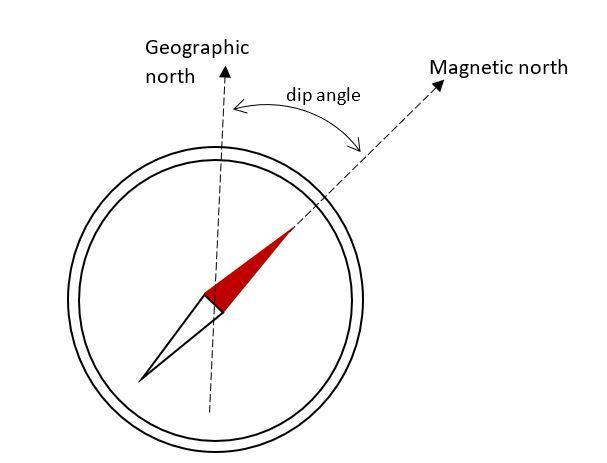
The magnetic dip at the equator is zero degrees as the magnetic lines are parallel to the surface there and are perpendicular to the surface at the poles. So the angle of dip becomes 90 degree at the magnetic pole
Additional Information
Contour lines which connect the point of equal declination are known as the isogonic lines and the lines which connect the locations having zero declination are called the agonic lines.
Magnetic declination varies from place to place and also with the passage of time. The dip angle is also affected by the presence of eternal magnetic fields at a location, like in forests and due to the mineral beds below ground.
With time, the magnetic declination at a given location also changes and the change is very slow, almost 2 – 2.5 degrees in a hundred years. This change also depends on the location, for some point near poles, the change is around one degree every three years.
Note: The dip angle is also called the magnetic dip, magnetic declination. The magnetic north may also be confused with the geographic north, but it's partially true. As at many locations, both may be the same based on the dip angle.
Complete step-by-step answer:
When a magnet is suspended freely in presence of an external magnetic field, it aligns itself with the field lines. And we know that the magnetic field lines of the Earth are not parallel to its surface, when a compass needle is suspended freely, it will make a certain angle with the horizontal component of the Earth’s magnetic field, which is called the magnetic dip or the angle of dip or magnetic declination. From the magnetic north pole to the magnetic south pole, it varies from $-90^{\circ}$ to $+90^{\circ}$.
The magnetic dip at the equator is zero degrees as the magnetic lines are parallel to the surface there and are perpendicular to the surface at the poles. So the angle of dip becomes 90 degree at the magnetic pole
Additional Information
Contour lines which connect the point of equal declination are known as the isogonic lines and the lines which connect the locations having zero declination are called the agonic lines.
Magnetic declination varies from place to place and also with the passage of time. The dip angle is also affected by the presence of eternal magnetic fields at a location, like in forests and due to the mineral beds below ground.
With time, the magnetic declination at a given location also changes and the change is very slow, almost 2 – 2.5 degrees in a hundred years. This change also depends on the location, for some point near poles, the change is around one degree every three years.
Note: The dip angle is also called the magnetic dip, magnetic declination. The magnetic north may also be confused with the geographic north, but it's partially true. As at many locations, both may be the same based on the dip angle.
Recently Updated Pages
Which of the following graphs shows the variation of class 12 physics CBSE

Draw a labelled diagram of the human male reproductive class 12 biology CBSE
Describe the experiment to compare the emf of two cells class 12 physics CBSE
What is standard hydrogen electrode
What is conventional current and electric current class 12 physics CBSE
2Bromopentane is treated with an alcoholic KOH solution class 12 chemistry CBSE
Trending doubts
Draw a labelled sketch of the human eye class 12 physics CBSE
Which are the Top 10 Largest Countries of the World?
Differentiate between homogeneous and heterogeneous class 12 chemistry CBSE
Draw ray diagrams each showing i myopic eye and ii class 12 physics CBSE
Which is the correct genotypic ratio of mendel dihybrid class 12 biology CBSE
What is the Full Form of PVC, PET, HDPE, LDPE, PP and PS ?