




Ambulacral grooves are absent in the living forms of the class
(a)Crinoidea
(b)Ophiuroidea
(c)Asteroids
(d)Echinodermata
Answer
 Verified
642k+ views
Hint: organisms belong to this class have pentaradial body symmetry. The excretory system is replaced by a water vascular system in the organism of this class.
Complete answer:
Ambulacral grooves are absent in the living forms of the class Ophiuroidea. These are replaced by ossicles in the animals belonging to the class Ophiuroidea. Ambulacral grooves extend from the mouth to the end of each ray or arm of the animal. In each ambulacral groove of every arm, four rows of hollow tube fees that can be extended or withdrawn are present. The ambulacral groove is found in the phylum Echinodermata or class Asteroidea, Edrioasteroidea, and Crinoidea.
Additional Information: -The ambulacral groove has many cilia and hydraulically driven tube feet to manipulate captured food down the groove. Through the groove, the food is brought down to the mouth via arms. The mouth is situated at the tegmen which is positioned at the base of the arms.
-The Ophiuroidea possesses a skeleton of calcite made up of calcium carbonate. An internal skeleton of calcium carbonate plates known as vertebral ossicles supports the animal body.
-These vertebrae are controlled by muscles and are connected through the ball in the socket.
-Ossicles are found in various forms and also in different arrangements in sea urchins, starfish, brittle stars, sea cucumbers, and crinoids.
So, the correct answer is ‘Ophiuroidea’
Note: -In Echinodermata, the larval forms show bilateral symmetry whereas the adult forms show radial symmetry.
-They are triploblastic animals having true coelom.
-Ossicles are found embedded in the dermis of the body wall of echinoderms. They provide rigidity and protection to the animal and also form part of the endoskeleton.
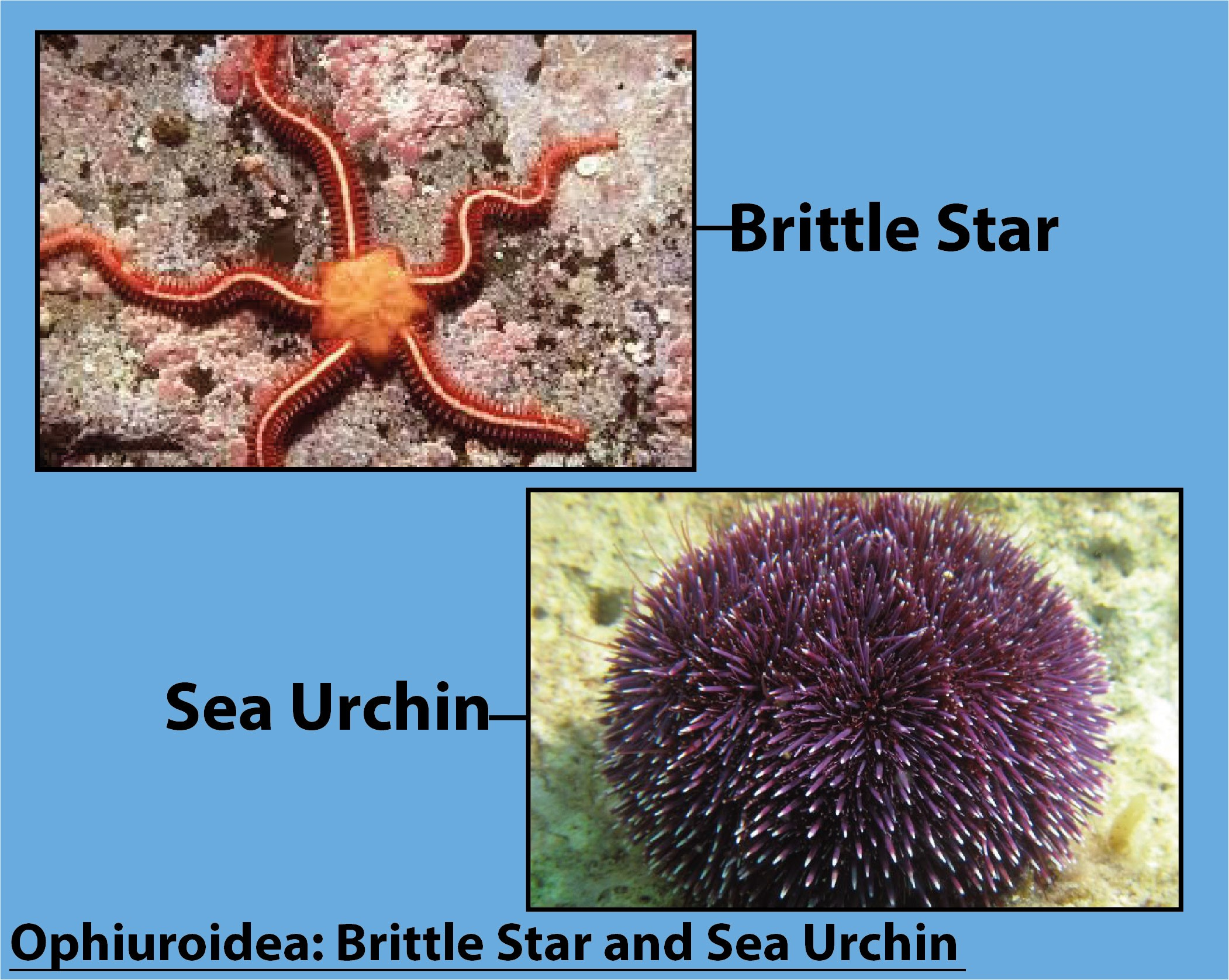
Complete answer:
Ambulacral grooves are absent in the living forms of the class Ophiuroidea. These are replaced by ossicles in the animals belonging to the class Ophiuroidea. Ambulacral grooves extend from the mouth to the end of each ray or arm of the animal. In each ambulacral groove of every arm, four rows of hollow tube fees that can be extended or withdrawn are present. The ambulacral groove is found in the phylum Echinodermata or class Asteroidea, Edrioasteroidea, and Crinoidea.
Additional Information: -The ambulacral groove has many cilia and hydraulically driven tube feet to manipulate captured food down the groove. Through the groove, the food is brought down to the mouth via arms. The mouth is situated at the tegmen which is positioned at the base of the arms.
-The Ophiuroidea possesses a skeleton of calcite made up of calcium carbonate. An internal skeleton of calcium carbonate plates known as vertebral ossicles supports the animal body.
-These vertebrae are controlled by muscles and are connected through the ball in the socket.
-Ossicles are found in various forms and also in different arrangements in sea urchins, starfish, brittle stars, sea cucumbers, and crinoids.
So, the correct answer is ‘Ophiuroidea’
Note: -In Echinodermata, the larval forms show bilateral symmetry whereas the adult forms show radial symmetry.
-They are triploblastic animals having true coelom.
-Ossicles are found embedded in the dermis of the body wall of echinoderms. They provide rigidity and protection to the animal and also form part of the endoskeleton.
Recently Updated Pages
Which will be the least stable resonating structure class 11 chemistry CBSE

How many 5 digit telephone numbers can be construc-class-11-maths-CBSE
How do you find the angle of the resultant vector class 11 physics CBSE
Draw labelled diagram of the following i Gram seed class 11 biology CBSE
1 Quintal is equal to a 110 kg b 10 kg c 100kg d 1000 class 11 physics CBSE
What is the need and importance of classification class 11 biology CBSE
Trending doubts
Find the value of the expression given below sin 30circ class 11 maths CBSE
One Metric ton is equal to kg A 10000 B 1000 C 100 class 11 physics CBSE
10 examples of friction in our daily life
Draw a diagram of a plant cell and label at least eight class 11 biology CBSE
Difference between physical and chemical change class 11 chemistry CBSE
Proton was discovered by A Thomson B Rutherford C Chadwick class 11 chemistry CBSE