




All congruent figures are similar, but the similar figures are not congruent. Is this statement true or false?
(a) False
(b) Both A and C
(c) True
(d) Not applicable
Answer
 Verified
666k+ views
Hint: Concept of congruence and similarity between any two figures should be known. Congruence can be defined as “Both the figures are having the same shape, same size, everything to be equal”, whereas similarity means “same size, same ratios, same angle but different in size”.
Complete step-by-step answer:
Congruence basically means that two objects have the same size and shape. Although congruent objects are identical, their orientation and physical appearance will differ in 3D (3-dimensional) plane. It can be better understood by seeing the figure given below.
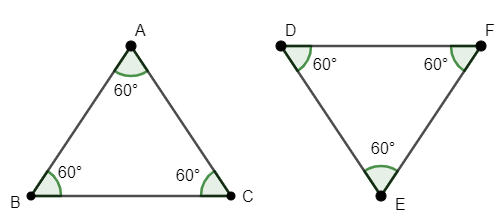
As we can see, the shape, size angle are the same in both triangles ABC and DEF but the triangle DEF is inverted compared to triangle ABC.
Now, talking about similarity, it is defined as two objects or figures having the same shape but not same size. For example, two circles will be the same in shape because they are circles but will be having different radius. Figure can be seen below for better understanding:
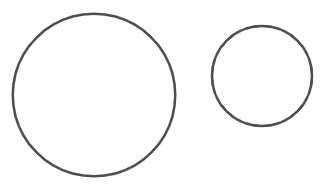
This both circles are considered to be similar but not congruent.
There are some rules to test similarity between 2 objects:
i. AA: If two angles are equal.
ii. SSS: If 3 corresponding sides are equal in ratio.
iii. SAS: If the ratio of two corresponding sides are equal and their included angle is equal.
Now, we are given the statement that “All congruent figures are similar, but the similar figures are not congruent” which is true by seeing the above explanation.
Hence, option (c) is the correct answer.
Note: Remember these above points because both are somewhat inter-related to each other. Also, there is slight variation in indicating congruence and similarity which is given by:
For congruent triangles: $\Delta ABC\cong \Delta DEF$
For similar triangles: $\Delta ABC\sim \Delta DEF$
So, don’t make mistakes considering congruency as similarity and vice-versa.
Complete step-by-step answer:
Congruence basically means that two objects have the same size and shape. Although congruent objects are identical, their orientation and physical appearance will differ in 3D (3-dimensional) plane. It can be better understood by seeing the figure given below.
As we can see, the shape, size angle are the same in both triangles ABC and DEF but the triangle DEF is inverted compared to triangle ABC.
Now, talking about similarity, it is defined as two objects or figures having the same shape but not same size. For example, two circles will be the same in shape because they are circles but will be having different radius. Figure can be seen below for better understanding:
This both circles are considered to be similar but not congruent.
There are some rules to test similarity between 2 objects:
i. AA: If two angles are equal.
ii. SSS: If 3 corresponding sides are equal in ratio.
iii. SAS: If the ratio of two corresponding sides are equal and their included angle is equal.
Now, we are given the statement that “All congruent figures are similar, but the similar figures are not congruent” which is true by seeing the above explanation.
Hence, option (c) is the correct answer.
Note: Remember these above points because both are somewhat inter-related to each other. Also, there is slight variation in indicating congruence and similarity which is given by:
For congruent triangles: $\Delta ABC\cong \Delta DEF$
For similar triangles: $\Delta ABC\sim \Delta DEF$
So, don’t make mistakes considering congruency as similarity and vice-versa.
Recently Updated Pages
Write any three differences between metals and nonmetals class 10 social science CBSE

Amit standing on a horizontal plane finds a bird flying class 10 maths CBSE
Two circles of radii 5 cm and 3 cm intersect at two class 10 maths CBSE
Solve the following i John and Jivanti together have class 10 maths CBSE
What is the relation between orthocenter circumcentre class 10 maths CBSE
Two plane mirrors are inclined at 70circ A ray incident class 10 physics CBSE
Trending doubts
Explain the Treaty of Vienna of 1815 class 10 social science CBSE
1 GB equals how many MB?
10 examples of evaporation in daily life with explanations
What is the full form of POSCO class 10 social science CBSE
Which is the hottest planet in the Solar system A Earth class 10 social science CBSE
Name any four life processes in living things class 10 biology CBSE