




Air layering is performed in the case of
(a)Jasmine
(b)Grapevine
(c)Gooseberry
(d)Litchi
Answer
 Verified
615.9k+ views
Hint: The plant is a member of the Soapberry family which is an evergreen tree and is a rich source of vitamin C. It is found mainly in the different regions of China.
Complete answer:
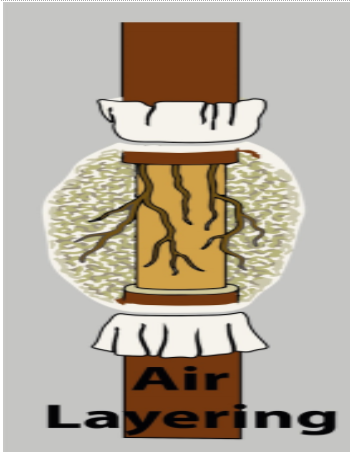
Air layering is the cutting of tree bark and the wound is enclosed in a moisture content moss and then packed with a plastic bag. The rooting hormone is applied to the wound which results in the root growth and then the stem of the plant is removed and planted separately to grow. This usually occurs in the case of Litchi.
Additional Information:
-The plant stem when prepared for planting should be kept in normal conditions, too much sun can cause damage to the plant.
-The moisture should be proper to prevent the roots from drying.
-The layers may take a few weeks to develop into a complete root system.
-The air layering is dependent upon the plant species and its metabolism.
-It is a type of vegetative propagation that is practiced to produce a desirable plant.
-In simple layering, the stem is bent down to the ground, and the area which is to be propagated touches the ground which is then buried in the soil, and from this, a new plant is developed.
-The plants developed by this method are exactly the clones of the parent plant.
So, the correct answer is ‘Litchi’.
Note: The litchi is produced and mainly originated from China during the eleventh century. In 1782, litchi was first described by French naturalist Pierre Sonnerat. It bears a special fruit called an aril having an outer rough and hard layer with a fleshy inner portion. It was found that litchi was similar to the leaves of the Lauraceae family showing convergent evolution.
Complete answer:
Air layering is the cutting of tree bark and the wound is enclosed in a moisture content moss and then packed with a plastic bag. The rooting hormone is applied to the wound which results in the root growth and then the stem of the plant is removed and planted separately to grow. This usually occurs in the case of Litchi.
Additional Information:
-The plant stem when prepared for planting should be kept in normal conditions, too much sun can cause damage to the plant.
-The moisture should be proper to prevent the roots from drying.
-The layers may take a few weeks to develop into a complete root system.
-The air layering is dependent upon the plant species and its metabolism.
-It is a type of vegetative propagation that is practiced to produce a desirable plant.
-In simple layering, the stem is bent down to the ground, and the area which is to be propagated touches the ground which is then buried in the soil, and from this, a new plant is developed.
-The plants developed by this method are exactly the clones of the parent plant.
So, the correct answer is ‘Litchi’.
Note: The litchi is produced and mainly originated from China during the eleventh century. In 1782, litchi was first described by French naturalist Pierre Sonnerat. It bears a special fruit called an aril having an outer rough and hard layer with a fleshy inner portion. It was found that litchi was similar to the leaves of the Lauraceae family showing convergent evolution.
Recently Updated Pages
Master Class 11 Economics: Engaging Questions & Answers for Success

Master Class 11 English: Engaging Questions & Answers for Success
Master Class 11 Maths: Engaging Questions & Answers for Success
Class 11 Question and Answer - Your Ultimate Solutions Guide
Master Class 11 Social Science: Engaging Questions & Answers for Success
Master Class 11 Business Studies: Engaging Questions & Answers for Success
Trending doubts
Differentiate between an exothermic and an endothermic class 11 chemistry CBSE
One Metric ton is equal to kg A 10000 B 1000 C 100 class 11 physics CBSE
There are 720 permutations of the digits 1 2 3 4 5 class 11 maths CBSE
In what year Guru Nanak Dev ji was born A15 April 1469 class 11 social science CBSE
Difference Between Prokaryotic Cells and Eukaryotic Cells
Draw a diagram of a plant cell and label at least eight class 11 biology CBSE