




A young plant receives sunlight from one direction only. What will happen to its shoot and roots?
Answer
 Verified
600k+ views
Hint: On the basis of shoot movement in response to light from one direction (unilateral light), the plant hormone auxin was discovered by Charles Darwin and his son Francis Darwin. The movement of plant parts in response to sunlight is termed as phototropism.
Complete Answer:
When a plant receives sunlight from only one direction, the shoot of that plant bends in the direction of the sunlight. This is because of the hormone auxin which accumulates in the side where sunlight is not present. Accumulation of auxin results in the elongation of that part of the stem where sunlight is not present. This uneven elongation results in the shoot to bend in the direction of the sunlight i.e. positive phototropism.
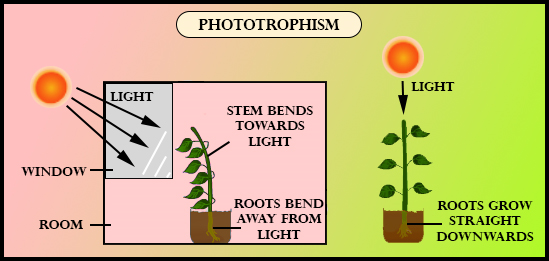
The root of the young plant is not affected by unilateral sunlight as it does not have any photoreceptors present in it. Instead, it grows in the direction of the gravitational force i.e. positive geotropism.
Additional information: Let us learn more about the hormone Auxin.
- The hormone auxin was first isolated from the urine of a human.
- All natural and synthetic compounds with a structure similar to indole-3-acetic acid come under auxin.
- They initiate rooting in stem cutting and promote flowering in pineapples.
- They are responsible for preventing fruit and leaf drop at early stages but promote their drop at older stages.
- They are responsible for the phenomenon that is known as apical dominance in which the apical bud keeps on growing thus causing the lateral buds to not grow.
Note:
- There are 4 other major plant hormones known as cytokinins, gibberellins, abscisic acid (ABA), and ethylene.
- Abscisic acid is also known as the stress hormone as it initiates dormancy and inactivity in stressful conditions to protect the plant.
- Ethylene is a gaseous hormone and is extensively used in the ripening of fruits.
Complete Answer:
When a plant receives sunlight from only one direction, the shoot of that plant bends in the direction of the sunlight. This is because of the hormone auxin which accumulates in the side where sunlight is not present. Accumulation of auxin results in the elongation of that part of the stem where sunlight is not present. This uneven elongation results in the shoot to bend in the direction of the sunlight i.e. positive phototropism.
The root of the young plant is not affected by unilateral sunlight as it does not have any photoreceptors present in it. Instead, it grows in the direction of the gravitational force i.e. positive geotropism.
Additional information: Let us learn more about the hormone Auxin.
- The hormone auxin was first isolated from the urine of a human.
- All natural and synthetic compounds with a structure similar to indole-3-acetic acid come under auxin.
- They initiate rooting in stem cutting and promote flowering in pineapples.
- They are responsible for preventing fruit and leaf drop at early stages but promote their drop at older stages.
- They are responsible for the phenomenon that is known as apical dominance in which the apical bud keeps on growing thus causing the lateral buds to not grow.
Note:
- There are 4 other major plant hormones known as cytokinins, gibberellins, abscisic acid (ABA), and ethylene.
- Abscisic acid is also known as the stress hormone as it initiates dormancy and inactivity in stressful conditions to protect the plant.
- Ethylene is a gaseous hormone and is extensively used in the ripening of fruits.
Recently Updated Pages
Master Class 11 Social Science: Engaging Questions & Answers for Success

Master Class 11 English: Engaging Questions & Answers for Success
Master Class 11 Maths: Engaging Questions & Answers for Success
Master Class 11 Chemistry: Engaging Questions & Answers for Success
Master Class 11 Biology: Engaging Questions & Answers for Success
Master Class 11 Physics: Engaging Questions & Answers for Success
Trending doubts
One Metric ton is equal to kg A 10000 B 1000 C 100 class 11 physics CBSE
Difference Between Prokaryotic Cells and Eukaryotic Cells
How many of the following diseases can be studied with class 11 biology CBSE
Draw a diagram of a plant cell and label at least eight class 11 biology CBSE
Two of the body parts which do not appear in MRI are class 11 biology CBSE
Which gas is abundant in air class 11 chemistry CBSE