




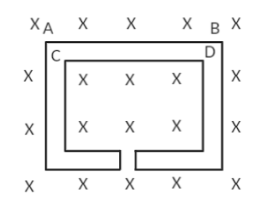
A wire is bent to form the double loop shown as figure. There is a uniform magnetic field directed into the plane of the loop. If the magnitude of this field is decreasing, the current will flow from
A) a to b and c to d
B) b to a and d to c
C) a to b and d to c
D) b to a and c to d
E) answer required
Answer
 Verified
654.3k+ views
Hint: This question can be solved by using Right hand rule and lenz’s law, which gives a clear idea about how the direction of current varies with direction of magnetic field.
Complete step by step answer:
First, we understand the right hand thumb rule and lenz’s law.
As per right hand thumb rule, if you wrap your right hand around the conductor, your right-hand thumb gives the direction of current in the wire and the curled fingers give the direction of the magnetic field. As per Lenz's law, an induced electric current flow in a direction such that the current opposes the change that induced it.
First, we consider the arm AB and apply the right hand thumb rule. As per Lenz’s law, since the magnetic field is inwards, the direction of current is anticlockwise. But as the field decreases the flux also decreases. Hence the magnetic field induced inside AB also in the same direction. Hence again magnetic fields also inside the plane. Now, again apply the right-hand rule for the inner side of AB. Then the current should be in the direction of A to B.
As the field decreases the flux through the loop decreases. By Lenz's Law, to counter this the current in the clockwise direction will flow so that it adds to the decreasing field and hence opposes the decreasing flux. By Lenz's law clockwise current is induced in a closed loop.
For clockwise direction of current, current will flow from a to b and from d to c.
Hence the correct answer is (C)
Note: Lenz’s law also states that when a voltage is created by a change in magnetic flux, the induced voltage must create a current whose magnetic field is in opposition to the change which produces it.
Complete step by step answer:
First, we understand the right hand thumb rule and lenz’s law.
As per right hand thumb rule, if you wrap your right hand around the conductor, your right-hand thumb gives the direction of current in the wire and the curled fingers give the direction of the magnetic field. As per Lenz's law, an induced electric current flow in a direction such that the current opposes the change that induced it.
First, we consider the arm AB and apply the right hand thumb rule. As per Lenz’s law, since the magnetic field is inwards, the direction of current is anticlockwise. But as the field decreases the flux also decreases. Hence the magnetic field induced inside AB also in the same direction. Hence again magnetic fields also inside the plane. Now, again apply the right-hand rule for the inner side of AB. Then the current should be in the direction of A to B.
As the field decreases the flux through the loop decreases. By Lenz's Law, to counter this the current in the clockwise direction will flow so that it adds to the decreasing field and hence opposes the decreasing flux. By Lenz's law clockwise current is induced in a closed loop.
For clockwise direction of current, current will flow from a to b and from d to c.
Hence the correct answer is (C)
Note: Lenz’s law also states that when a voltage is created by a change in magnetic flux, the induced voltage must create a current whose magnetic field is in opposition to the change which produces it.
Recently Updated Pages
Which of the following graphs shows the variation of class 12 physics CBSE

Draw a labelled diagram of the human male reproductive class 12 biology CBSE
Describe the experiment to compare the emf of two cells class 12 physics CBSE
What is standard hydrogen electrode
What is conventional current and electric current class 12 physics CBSE
2Bromopentane is treated with an alcoholic KOH solution class 12 chemistry CBSE
Trending doubts
Draw a labelled sketch of the human eye class 12 physics CBSE
Which are the Top 10 Largest Countries of the World?
Differentiate between homogeneous and heterogeneous class 12 chemistry CBSE
Draw ray diagrams each showing i myopic eye and ii class 12 physics CBSE
Which is the correct genotypic ratio of mendel dihybrid class 12 biology CBSE
What is the Full Form of PVC, PET, HDPE, LDPE, PP and PS ?