




A window of a house is $h$ meter above the ground. From the window, the angles of elevation and depression of the top and bottom of another house situated on the opposite side of the lane are found to be $\alpha $ and $\beta $ respectively. Prove that the height of the house is $h\left( {1 + \tan \alpha \tan \beta } \right)$ meters.
Answer
 Verified
661.2k+ views
Hint:Draw the diagram as per the given data.Now apply the basic trigonometric formulae and correlate the heights of two different houses.
Complete step-by-step answer:
Firstly, let us note down the given data.
The window is situated at a height of $h$ meters from the ground.
From the window, the angles of elevation and depression of the top and bottom of another house situated on the opposite side of the lane are found to be $\alpha $ and $\beta $ respectively.
Let us assume the height of the house is $H$ meters.
Now we need to prove that $H = h\left( {1 + \tan \alpha \tan \beta } \right)$.
According to the given data, we will get the diagram as follows:
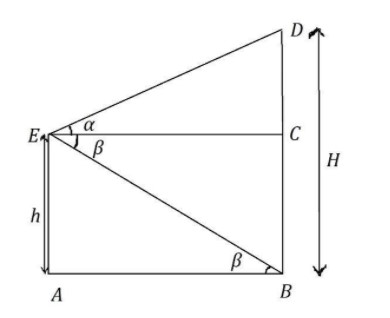
We will find out the length of $EC$ in terms of $H$ and the length of $AB$ in terms of $h$.
And from the diagram, we can conclude that the length of $EC$ and the length of $AB$ will be equal.
So, when we equate those two equations, we will get the value of $H$ in terms of \[h\].
We are going to use some basic formula of trigonometry and that is
$\tan \alpha = \dfrac{{{\text{Opposite}}}}{{Adjacent}}$. We are going to apply this formula in the coming steps.
So, in $\vartriangle DEC$,
$\tan \alpha = \dfrac{{DC}}{{EC}}$
Now, substitute the above value $DC = H - h$.
$
\Rightarrow \tan \alpha = \dfrac{{H - h}}{{EC}} \\
\Rightarrow EC = \dfrac{{H - h}}{{\tan \alpha }} \\
$
So, our first part is done.
Now, let us find the length of $AB$ in terms of $h$.
So, in $\vartriangle EBA$,
$\tan \alpha = \dfrac{{EA}}{{AB}}$
Now, substitute the value that $EA = h$.
$
\Rightarrow \tan \alpha = \dfrac{h}{{AB}} \\
\Rightarrow AB = \dfrac{h}{{\tan \beta }} \\
$
As we have discussed above,
Let us equate the values of $EC$ and $AB$ as their lengths are equal.
$ \Rightarrow EC = AB$
$ \Rightarrow \dfrac{{H - h}}{{\tan \alpha }} = \dfrac{h}{{\tan \beta }}$
Simplify the above equation to get the value of $H$ in terms of \[h\].
\[
\Rightarrow H - h = \dfrac{{h \times \tan \alpha }}{{\tan \beta }} \\
\Rightarrow H = \dfrac{{h \times \tan \alpha }}{{\tan \beta }} + h \\
\Rightarrow H = \dfrac{{h \times \tan \alpha + h\tan \beta }}{{\tan \beta }} \\
\Rightarrow H = \dfrac{{h\left( {\tan \alpha + \tan \beta } \right)}}{{\tan \beta }} \\
\]
We know that the reciprocal of $\tan \theta $ is $\cot \theta $. Using this in the above equation we get,
\[ \Rightarrow H = h\left( {1 + \tan \alpha \cot \beta } \right)\]
Hence, we proved that the height of the other building is \[h\left( {1 + \tan \alpha \cot \beta } \right)\] meters.
Note:Select one of the triangles from the diagram and that selection must be useful for the future. In this way correlate all the unknown terms to form the equations with unknown values of variables. When we solve the equations, we will get the solution.Students should know the formula of trigonometric ratios,reciprocal of trigonometric functions and identities for solving these types of questions.
Complete step-by-step answer:
Firstly, let us note down the given data.
The window is situated at a height of $h$ meters from the ground.
From the window, the angles of elevation and depression of the top and bottom of another house situated on the opposite side of the lane are found to be $\alpha $ and $\beta $ respectively.
Let us assume the height of the house is $H$ meters.
Now we need to prove that $H = h\left( {1 + \tan \alpha \tan \beta } \right)$.
According to the given data, we will get the diagram as follows:
We will find out the length of $EC$ in terms of $H$ and the length of $AB$ in terms of $h$.
And from the diagram, we can conclude that the length of $EC$ and the length of $AB$ will be equal.
So, when we equate those two equations, we will get the value of $H$ in terms of \[h\].
We are going to use some basic formula of trigonometry and that is
$\tan \alpha = \dfrac{{{\text{Opposite}}}}{{Adjacent}}$. We are going to apply this formula in the coming steps.
So, in $\vartriangle DEC$,
$\tan \alpha = \dfrac{{DC}}{{EC}}$
Now, substitute the above value $DC = H - h$.
$
\Rightarrow \tan \alpha = \dfrac{{H - h}}{{EC}} \\
\Rightarrow EC = \dfrac{{H - h}}{{\tan \alpha }} \\
$
So, our first part is done.
Now, let us find the length of $AB$ in terms of $h$.
So, in $\vartriangle EBA$,
$\tan \alpha = \dfrac{{EA}}{{AB}}$
Now, substitute the value that $EA = h$.
$
\Rightarrow \tan \alpha = \dfrac{h}{{AB}} \\
\Rightarrow AB = \dfrac{h}{{\tan \beta }} \\
$
As we have discussed above,
Let us equate the values of $EC$ and $AB$ as their lengths are equal.
$ \Rightarrow EC = AB$
$ \Rightarrow \dfrac{{H - h}}{{\tan \alpha }} = \dfrac{h}{{\tan \beta }}$
Simplify the above equation to get the value of $H$ in terms of \[h\].
\[
\Rightarrow H - h = \dfrac{{h \times \tan \alpha }}{{\tan \beta }} \\
\Rightarrow H = \dfrac{{h \times \tan \alpha }}{{\tan \beta }} + h \\
\Rightarrow H = \dfrac{{h \times \tan \alpha + h\tan \beta }}{{\tan \beta }} \\
\Rightarrow H = \dfrac{{h\left( {\tan \alpha + \tan \beta } \right)}}{{\tan \beta }} \\
\]
We know that the reciprocal of $\tan \theta $ is $\cot \theta $. Using this in the above equation we get,
\[ \Rightarrow H = h\left( {1 + \tan \alpha \cot \beta } \right)\]
Hence, we proved that the height of the other building is \[h\left( {1 + \tan \alpha \cot \beta } \right)\] meters.
Note:Select one of the triangles from the diagram and that selection must be useful for the future. In this way correlate all the unknown terms to form the equations with unknown values of variables. When we solve the equations, we will get the solution.Students should know the formula of trigonometric ratios,reciprocal of trigonometric functions and identities for solving these types of questions.
Recently Updated Pages
If x a + bt + ct2 where x is in meters and t is in class 11 physics CBSE

A car covers the first half distance between two places class 11 physics CBSE
The resultant of two vectors overrightarrow P and overrightarrow class 11 physics CBSE
Find the value of cos 135 class 11 maths CBSE
A mass M is held in place by an applied force F and class 11 physics CBSE
A solution of glucose in water is labelled as 10 dfracwv class 11 chemistry CBSE
Trending doubts
One Metric ton is equal to kg A 10000 B 1000 C 100 class 11 physics CBSE
Find the value of the expression given below sin 30circ class 11 maths CBSE
Draw a diagram of nephron and explain its structur class 11 biology CBSE
10 examples of friction in our daily life
Proton was discovered by A Thomson B Rutherford C Chadwick class 11 chemistry CBSE
Bond order ofO2 O2+ O2 and O22 is in order A O2 langle class 11 chemistry CBSE