




(a). What is the least distance of distinct vision for a normal human eye?
(b). With the help of a labeled diagram, give the principle and magnifying power of an astronomical telescope when the final image is formed at least distance of distinct vision.
Answer
 Verified
663k+ views
- Hint: In this question we will understand the concept behind the least distinct vision of a normal human eye and we will also give the principle and magnifying power of an astronomical telescope with the help of a diagram. Hence, we will be learning almost everything about these topics which will help us in approaching our answer.
Complete step-by-step answer:
Normal or health vision of eyes that experts consider is to be 20/20 vision. This simply means that we can see clearly about 20 feet away from that distance. And for the normal human eye the least distance of distinct vision is 25cm.
In the astronomical telescope there are the uses of two positive lenses: the objective which forms an image at its focal length and eyepiece of a distant object. It acts as a simple magnifier by which the image formed by the objective is viewed. The sum of the focal length of the objective and eyepiece is equal to its length. Its angular magnification gives an inverted image. An astronomical telescope is an instrument or an optical instrument by which we can see the magnified image of the distant heavenly bodies. For example, starts, planets, satellites, galaxies, etc.
Principle of astronomical telescope says that it works on the principle that when an object is placed at a large distance which is to be magnified from the objective lens of the telescope an image which is virtual, erect and magnified is formed at the least distance from the eyes which is distinct vision and it is held close to the eyepiece.
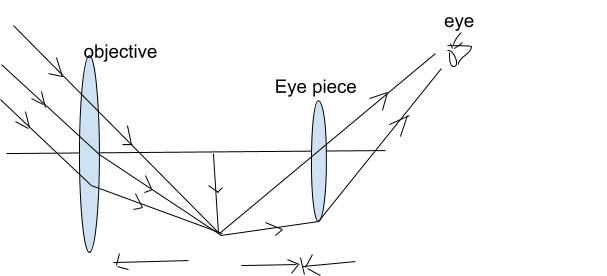
Note: For terrestrial viewing, astronomical telescopes can be used. Definite inconvenience is watching the image upside down. Starts can be viewed upside down. Length of the astronomical telescope is the inconvenience for the terrestrial viewing.
Complete step-by-step answer:
Normal or health vision of eyes that experts consider is to be 20/20 vision. This simply means that we can see clearly about 20 feet away from that distance. And for the normal human eye the least distance of distinct vision is 25cm.
In the astronomical telescope there are the uses of two positive lenses: the objective which forms an image at its focal length and eyepiece of a distant object. It acts as a simple magnifier by which the image formed by the objective is viewed. The sum of the focal length of the objective and eyepiece is equal to its length. Its angular magnification gives an inverted image. An astronomical telescope is an instrument or an optical instrument by which we can see the magnified image of the distant heavenly bodies. For example, starts, planets, satellites, galaxies, etc.
Principle of astronomical telescope says that it works on the principle that when an object is placed at a large distance which is to be magnified from the objective lens of the telescope an image which is virtual, erect and magnified is formed at the least distance from the eyes which is distinct vision and it is held close to the eyepiece.
Note: For terrestrial viewing, astronomical telescopes can be used. Definite inconvenience is watching the image upside down. Starts can be viewed upside down. Length of the astronomical telescope is the inconvenience for the terrestrial viewing.
Recently Updated Pages
Which of the following graphs shows the variation of class 12 physics CBSE

Draw a labelled diagram of the human male reproductive class 12 biology CBSE
Describe the experiment to compare the emf of two cells class 12 physics CBSE
What is standard hydrogen electrode
What is conventional current and electric current class 12 physics CBSE
2Bromopentane is treated with an alcoholic KOH solution class 12 chemistry CBSE
Trending doubts
Draw a labelled sketch of the human eye class 12 physics CBSE
Which are the Top 10 Largest Countries of the World?
Differentiate between homogeneous and heterogeneous class 12 chemistry CBSE
Draw ray diagrams each showing i myopic eye and ii class 12 physics CBSE
Which is the correct genotypic ratio of mendel dihybrid class 12 biology CBSE
What is the Full Form of PVC, PET, HDPE, LDPE, PP and PS ?