




(a) What is the aim of this experiment?
(b) What change do you observe in the thermometer reading?
(c) In your opinion, where did this heat come from?
(d) What precaution should we take while doing this experiment?
Answer
 Verified
597.9k+ views
Hint: The experiment explains that the energy is required in the form of what for the germination of the seeds. There are several factors like respiration, heat, moisture, energy that are required in this experiment.
Complete answer:
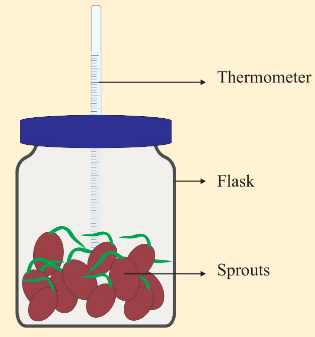
(a) The aim of this experiment is to observe the process of respiration which releases heat energy for the process to continue and then results in the fermentation of seeds.
(b) During this process, the rise in temperature is observed thus leading to the rise in the level of mercury in the thermometer. This results in the rising of the thermometer reading.
(c) The process of respiration in the plants requires the breakdown of glucose molecules, these molecules when breaking down release energy in the form of the heat energy. Thus the process of respiration results in the release of heat energy.
(d) The important precaution that must be taken while performing this experiment is that the seeds must be kept moist. The process of respiration and germination of seeds will occur only when the seeds are moist. If due to some conditions the seeds are dry instead of moist then the process of respiration will not take place and hence the experiment will not be possible and will not be having accurate results.
Note:
With the help of germination by which an organism grows from a seed. The growth of seedlings from the seed is the most common form of germination. Developed seeds (sprouts) can even be eaten crudely or can consume subsequent to cooking. The seeds are sports germinate and giving out the shoot is known as sprouting. The plants that are already established produce new leaves or buds, or develop new parts experiencing further growth.
Complete answer:
(a) The aim of this experiment is to observe the process of respiration which releases heat energy for the process to continue and then results in the fermentation of seeds.
(b) During this process, the rise in temperature is observed thus leading to the rise in the level of mercury in the thermometer. This results in the rising of the thermometer reading.
(c) The process of respiration in the plants requires the breakdown of glucose molecules, these molecules when breaking down release energy in the form of the heat energy. Thus the process of respiration results in the release of heat energy.
(d) The important precaution that must be taken while performing this experiment is that the seeds must be kept moist. The process of respiration and germination of seeds will occur only when the seeds are moist. If due to some conditions the seeds are dry instead of moist then the process of respiration will not take place and hence the experiment will not be possible and will not be having accurate results.
Note:
With the help of germination by which an organism grows from a seed. The growth of seedlings from the seed is the most common form of germination. Developed seeds (sprouts) can even be eaten crudely or can consume subsequent to cooking. The seeds are sports germinate and giving out the shoot is known as sprouting. The plants that are already established produce new leaves or buds, or develop new parts experiencing further growth.
Recently Updated Pages
Which will be the least stable resonating structure class 11 chemistry CBSE

How many 5 digit telephone numbers can be construc-class-11-maths-CBSE
How do you find the angle of the resultant vector class 11 physics CBSE
Draw labelled diagram of the following i Gram seed class 11 biology CBSE
1 Quintal is equal to a 110 kg b 10 kg c 100kg d 1000 class 11 physics CBSE
What is the need and importance of classification class 11 biology CBSE
Trending doubts
Find the value of the expression given below sin 30circ class 11 maths CBSE
The teeth used for biting and cutting food are called class 11 biology CBSE
Bond order ofO2 O2+ O2 and O22 is in order A O2 langle class 11 chemistry CBSE
Frogs heart when taken out of the body continues to class 11 biology CBSE
Can anyone list 10 advantages and disadvantages of friction
Draw a diagram of a plant cell and label at least eight class 11 biology CBSE