



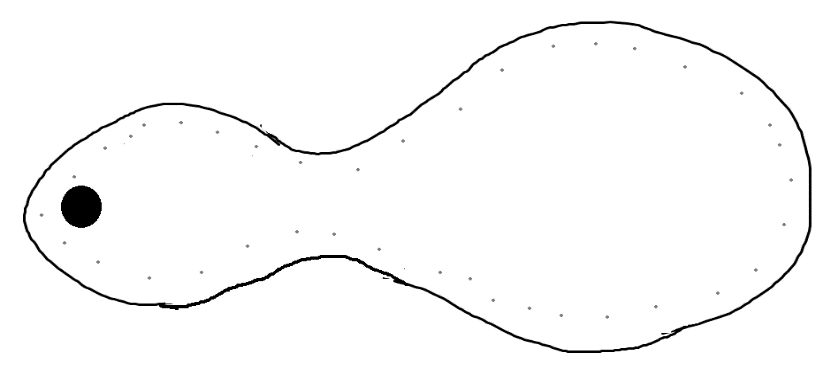
A student drew the following diagram upon observing a permanent slide of binary fission in Amoeba. Identify the fault in the diagram.
Answer
 Verified
537.6k+ views
Hint: We have studied earlier that Amoeba is a unicellular protozoan that reproduces asexually through binary fission. Binary fission is a method of asexual reproduction, in which a single parent cell divides equally giving rise to two identical daughter cells capable of growing up to the size of parent cell. During binary fission the genetic material (nucleus) of the parent cell divides equally which is followed by cytokinesis.
Complete answer:
First we will discuss the steps involved in binary fission.
1. The genetic material, DNA, is compactly packed.
2. Replication of DNA, ribosomes, and plastids occurs.
3. The size of the cell increases as it prepares for dividing and the two strands of DNA move to the opposite sides.
4. New cell wall starts developing or constriction of cytoplasm occurs beginning the separation of the parent cell.
5. The cell wall is formed dividing the two daughter cells equally.
6. The two daughter cells separate as different individuals.
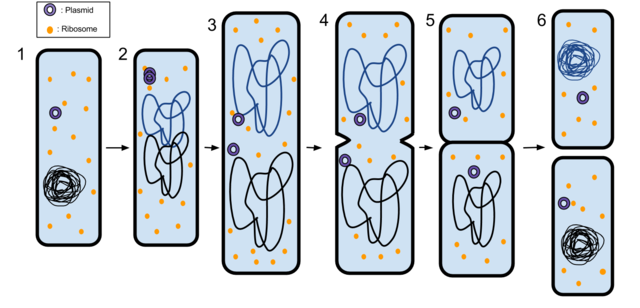
Now, we can say that during binary fission in Amoeba the nucleus divides into two and moves towards opposite sides. This is followed by the constriction of cytoplasm resulting in the formation of two daughter cells (cytokinesis).
The given diagram depicts constriction of cytoplasm before replication of the nucleus, which is wrong as the cell divides only after nuclear division has taken place.
Note:
Many organisms including bacteria, Amoeba, Paramecium etc. reproduce asexually through binary fission. In this first the nucleus division takes place followed by the division of cytoplasm.
Complete answer:
First we will discuss the steps involved in binary fission.
1. The genetic material, DNA, is compactly packed.
2. Replication of DNA, ribosomes, and plastids occurs.
3. The size of the cell increases as it prepares for dividing and the two strands of DNA move to the opposite sides.
4. New cell wall starts developing or constriction of cytoplasm occurs beginning the separation of the parent cell.
5. The cell wall is formed dividing the two daughter cells equally.
6. The two daughter cells separate as different individuals.
Now, we can say that during binary fission in Amoeba the nucleus divides into two and moves towards opposite sides. This is followed by the constriction of cytoplasm resulting in the formation of two daughter cells (cytokinesis).
The given diagram depicts constriction of cytoplasm before replication of the nucleus, which is wrong as the cell divides only after nuclear division has taken place.
Note:
Many organisms including bacteria, Amoeba, Paramecium etc. reproduce asexually through binary fission. In this first the nucleus division takes place followed by the division of cytoplasm.
Recently Updated Pages
Three beakers labelled as A B and C each containing 25 mL of water were taken A small amount of NaOH anhydrous CuSO4 and NaCl were added to the beakers A B and C respectively It was observed that there was an increase in the temperature of the solutions contained in beakers A and B whereas in case of beaker C the temperature of the solution falls Which one of the following statements isarecorrect i In beakers A and B exothermic process has occurred ii In beakers A and B endothermic process has occurred iii In beaker C exothermic process has occurred iv In beaker C endothermic process has occurred

Master Class 9 Social Science: Engaging Questions & Answers for Success
Master Class 9 Science: Engaging Questions & Answers for Success
Master Class 9 Maths: Engaging Questions & Answers for Success
Master Class 9 General Knowledge: Engaging Questions & Answers for Success
Class 9 Question and Answer - Your Ultimate Solutions Guide
Three beakers labelled as A B and C each containing 25 mL of water were taken A small amount of NaOH anhydrous CuSO4 and NaCl were added to the beakers A B and C respectively It was observed that there was an increase in the temperature of the solutions contained in beakers A and B whereas in case of beaker C the temperature of the solution falls Which one of the following statements isarecorrect i In beakers A and B exothermic process has occurred ii In beakers A and B endothermic process has occurred iii In beaker C exothermic process has occurred iv In beaker C endothermic process has occurred
Master Class 9 Social Science: Engaging Questions & Answers for Success
Master Class 9 Science: Engaging Questions & Answers for Success
Trending doubts
Find the sum of series 1 + 2 + 3 + 4 + 5 + + 100 class 9 maths CBSE
Fill the blanks with the suitable prepositions 1 The class 9 english CBSE
Difference Between Plant Cell and Animal Cell
What is pollution? How many types of pollution? Define it
Name 10 Living and Non living things class 9 biology CBSE
Which are the Top 10 Largest States of India?