




A step-down transformer is used to light a 12 V lamp from a 240V mains supply. The lamp lights at normal brightness. The primary coil has 600 turns. How many turns are in the secondary coil?
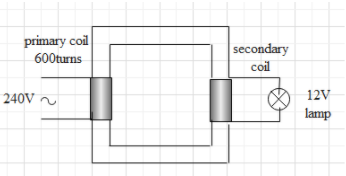
A. 12
B. 20
C. 30
D. 50
Answer
 Verified
617.1k+ views
Hint: Study the types of transformers. The transformer works on Faraday’s principle of mutual induction where emf is induced in the secondary coil through the voltage or current flowing through the primary coil. Derive the formulas involving step -down transformers. put the given values in the obtained expression to find the answer.
Complete answer:
A transformer is a passive electrical device which transfers one electrical circuit to another. It consists of two electrically isolated coils and works Faraday's principle of mutual inductance. It transforms electrical energy to the magnetic energy on the primary side and again from magnetic energy to the electrical energy on the secondary side.
A step-down transformer can be defined as an object which transforms the high voltage and low current to low voltage and high current. The number of turns of wire in the coil on the primary side is high and the number of turns of wire in the coil on the secondary side is less.
The input voltage or the primary voltage of the transformer is ${{V}_{p}}=240V$
It is used to light a 12V lamp.
The output voltage or the secondary voltage is ${{V}_{s}}=12V$
The number of turns in the primary coil is ${{N}_{p}}=600$
Let, the number of turns in the secondary coil is ${{N}_{s}}$
The relation of the input and output voltage with the number of turns in the primary and secondary can be expressed as
$\dfrac{{{N}_{s}}}{{{N}_{p}}}=\dfrac{{{V}_{s}}}{{{V}_{p}}}$
Putting the given values,
$\begin{align}
& \dfrac{{{N}_{s}}}{600}=\dfrac{12}{240} \\
& {{N}_{s}}=\dfrac{12\times 600}{240} \\
& {{N}_{s}}=30 \\
\end{align}$
So, the number of turns in the secondary coil is 30.
The correct option is (C).
Note:
From the above relations we can see that in a step-down transformer voltage will always decrease as voltage and current are inversely proportional.
Again, if the transformer is assumed to be 100 percent efficient the input power and the output power will be equal. So, the wattage will neither increase or decrease.
Complete answer:
A transformer is a passive electrical device which transfers one electrical circuit to another. It consists of two electrically isolated coils and works Faraday's principle of mutual inductance. It transforms electrical energy to the magnetic energy on the primary side and again from magnetic energy to the electrical energy on the secondary side.
A step-down transformer can be defined as an object which transforms the high voltage and low current to low voltage and high current. The number of turns of wire in the coil on the primary side is high and the number of turns of wire in the coil on the secondary side is less.
The input voltage or the primary voltage of the transformer is ${{V}_{p}}=240V$
It is used to light a 12V lamp.
The output voltage or the secondary voltage is ${{V}_{s}}=12V$
The number of turns in the primary coil is ${{N}_{p}}=600$
Let, the number of turns in the secondary coil is ${{N}_{s}}$
The relation of the input and output voltage with the number of turns in the primary and secondary can be expressed as
$\dfrac{{{N}_{s}}}{{{N}_{p}}}=\dfrac{{{V}_{s}}}{{{V}_{p}}}$
Putting the given values,
$\begin{align}
& \dfrac{{{N}_{s}}}{600}=\dfrac{12}{240} \\
& {{N}_{s}}=\dfrac{12\times 600}{240} \\
& {{N}_{s}}=30 \\
\end{align}$
So, the number of turns in the secondary coil is 30.
The correct option is (C).
Note:
From the above relations we can see that in a step-down transformer voltage will always decrease as voltage and current are inversely proportional.
Again, if the transformer is assumed to be 100 percent efficient the input power and the output power will be equal. So, the wattage will neither increase or decrease.
Recently Updated Pages
Master Class 12 Economics: Engaging Questions & Answers for Success

Master Class 12 English: Engaging Questions & Answers for Success
Master Class 12 Social Science: Engaging Questions & Answers for Success
Master Class 12 Maths: Engaging Questions & Answers for Success
Master Class 12 Physics: Engaging Questions & Answers for Success
Master Class 9 General Knowledge: Engaging Questions & Answers for Success
Trending doubts
One Metric ton is equal to kg A 10000 B 1000 C 100 class 11 physics CBSE
Difference Between Prokaryotic Cells and Eukaryotic Cells
Find the value of the expression given below sin 30circ class 11 maths CBSE
Two of the body parts which do not appear in MRI are class 11 biology CBSE
Draw a diagram of nephron and explain its structur class 11 biology CBSE
10 examples of friction in our daily life