




A solid iron cuboidal block of dimensions \[4.4m\times 2.6m\times 1m\] is recast into a hollow cylindrical pipe of an internal radius 30 cm and thickness 5 cm. Find the length of the pipe.
(a) 112 m
(b) 110 m
(c) 114 m
(d) 116 m
Answer
 Verified
626.4k+ views
Hint: The volume of any object before and after the recast always remains the same. So, first, we need to find the volume of the cuboid using the formula \[V=L\times B\times H\] and then compare it with the volume of the pipe (Cylinder) which is \[V=\pi {{r}^{2}}H\] to find the height of the cylinder.
Complete step-by-step solution:
We have iron cuboidal of dimensions \[4.4m\times 2.6m\times 1m.\]
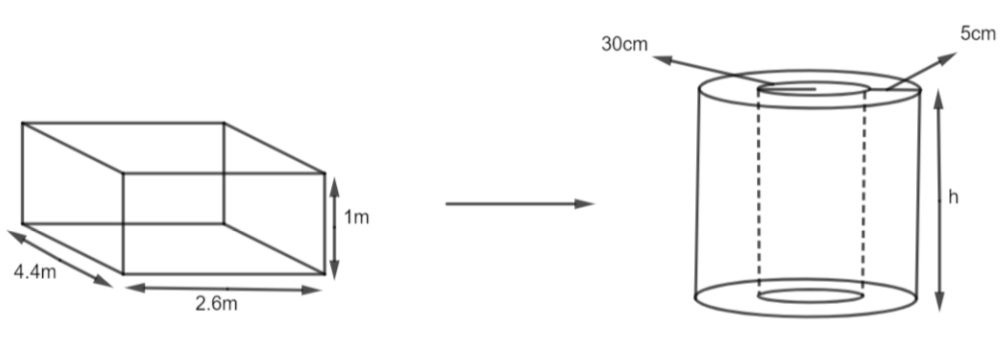
As we all know that the volume remains fixed, so we can find the volume of the cuboidal block and compare it with the volume of the cylinder. We have the dimensions as \[4.4m\times 2.6m\times 1m\]
Therefore, the volume of the cuboid is
\[V=L\times B\times H\]
\[\Rightarrow V=4.4\times 2.6\times 1\]
\[\Rightarrow V=11.44{{m}^{3}}\]
So, we get the volume of the cuboidal block as \[11.44{{m}^{3}}.\]
Now, in the question, we are given that the cylinder is hollow inside. So,
The volume of Cylinder = Volume of Outer Cylindrical part – Volume of Inner Cylindrical part
We have inner radius, r = 30 cm = 0.3 m and thickness, d = 5 cm = 0.05 m.
So, Outer Radius, R = Inner Radius + Thickness
\[R=r+d\]
\[\Rightarrow R=0.3+0.05\]
\[\Rightarrow R=0.35m\]
Now, we get the volume of the cylinder as
\[\text{Volume of cylinder}=\pi {{R}^{2}}H-\pi {{r}^{2}}H\]
Here, the height H is the same for the outer and inner parts.
\[\Rightarrow \text{Volume of cylinder}=\dfrac{22}{7}\times {{\left( 0.35 \right)}^{2}}\times H-\dfrac{22}{7}{{\left( 0.3 \right)}^{2}}\times H\]
\[\Rightarrow \text{Volume of cylinder}=\dfrac{22}{7}\left[ {{\left( 0.35 \right)}^{2}}-{{\left( 0.3 \right)}^{2}} \right]H\]
Now, to find the height, we will compare the volume of the hollow cylinder with the volume of the cuboidal box. So, we get,
\[11.44=\dfrac{22}{7}\left[ {{\left( 0.35 \right)}^{2}}-{{\left( 0.3 \right)}^{2}} \right]H\]
\[\Rightarrow 11.44=\dfrac{22}{7}\left[ 0.0325 \right]H\]
Now, we will solve for H, we get,
\[H=\dfrac{11.44\times 7}{22\times 0.0325}\]
\[\Rightarrow H=\dfrac{80.08}{0.715}\]
\[\Rightarrow H=112m\]
Therefore, we get the height of the cylinder as 112m.
Hence, option (a) is the right answer.
Note: As the cylinder is hollow inside, so we cannot compare the volume of the cuboidal block with the volume of the cylinder with radius r = 0.3m that is, \[11.44=\pi \times {{\left( 0.3 \right)}^{2}}\times H,\] this leads us to the wrong answer. For easy calculation of \[{{\left( 0.35 \right)}^{2}}-{{0.3}^{2}},\] use \[{{a}^{2}}-{{b}^{2}}=\left( a+b \right)\left( a-b \right).\]
\[{{0.35}^{2}}-{{0.3}^{2}}=\left( 0.35+0.3 \right)\left( 0.35-0.3 \right)\]
\[\Rightarrow {{0.35}^{2}}-{{0.3}^{2}}=0.65\times 0.005\]
\[\Rightarrow {{0.35}^{2}}-{{0.3}^{2}}=0.0325\]
Complete step-by-step solution:
We have iron cuboidal of dimensions \[4.4m\times 2.6m\times 1m.\]
As we all know that the volume remains fixed, so we can find the volume of the cuboidal block and compare it with the volume of the cylinder. We have the dimensions as \[4.4m\times 2.6m\times 1m\]
Therefore, the volume of the cuboid is
\[V=L\times B\times H\]
\[\Rightarrow V=4.4\times 2.6\times 1\]
\[\Rightarrow V=11.44{{m}^{3}}\]
So, we get the volume of the cuboidal block as \[11.44{{m}^{3}}.\]
Now, in the question, we are given that the cylinder is hollow inside. So,
The volume of Cylinder = Volume of Outer Cylindrical part – Volume of Inner Cylindrical part
We have inner radius, r = 30 cm = 0.3 m and thickness, d = 5 cm = 0.05 m.
So, Outer Radius, R = Inner Radius + Thickness
\[R=r+d\]
\[\Rightarrow R=0.3+0.05\]
\[\Rightarrow R=0.35m\]
Now, we get the volume of the cylinder as
\[\text{Volume of cylinder}=\pi {{R}^{2}}H-\pi {{r}^{2}}H\]
Here, the height H is the same for the outer and inner parts.
\[\Rightarrow \text{Volume of cylinder}=\dfrac{22}{7}\times {{\left( 0.35 \right)}^{2}}\times H-\dfrac{22}{7}{{\left( 0.3 \right)}^{2}}\times H\]
\[\Rightarrow \text{Volume of cylinder}=\dfrac{22}{7}\left[ {{\left( 0.35 \right)}^{2}}-{{\left( 0.3 \right)}^{2}} \right]H\]
Now, to find the height, we will compare the volume of the hollow cylinder with the volume of the cuboidal box. So, we get,
\[11.44=\dfrac{22}{7}\left[ {{\left( 0.35 \right)}^{2}}-{{\left( 0.3 \right)}^{2}} \right]H\]
\[\Rightarrow 11.44=\dfrac{22}{7}\left[ 0.0325 \right]H\]
Now, we will solve for H, we get,
\[H=\dfrac{11.44\times 7}{22\times 0.0325}\]
\[\Rightarrow H=\dfrac{80.08}{0.715}\]
\[\Rightarrow H=112m\]
Therefore, we get the height of the cylinder as 112m.
Hence, option (a) is the right answer.
Note: As the cylinder is hollow inside, so we cannot compare the volume of the cuboidal block with the volume of the cylinder with radius r = 0.3m that is, \[11.44=\pi \times {{\left( 0.3 \right)}^{2}}\times H,\] this leads us to the wrong answer. For easy calculation of \[{{\left( 0.35 \right)}^{2}}-{{0.3}^{2}},\] use \[{{a}^{2}}-{{b}^{2}}=\left( a+b \right)\left( a-b \right).\]
\[{{0.35}^{2}}-{{0.3}^{2}}=\left( 0.35+0.3 \right)\left( 0.35-0.3 \right)\]
\[\Rightarrow {{0.35}^{2}}-{{0.3}^{2}}=0.65\times 0.005\]
\[\Rightarrow {{0.35}^{2}}-{{0.3}^{2}}=0.0325\]
Recently Updated Pages
Master Class 12 Economics: Engaging Questions & Answers for Success

Master Class 12 English: Engaging Questions & Answers for Success
Master Class 12 Social Science: Engaging Questions & Answers for Success
Master Class 12 Maths: Engaging Questions & Answers for Success
Master Class 12 Physics: Engaging Questions & Answers for Success
Master Class 9 General Knowledge: Engaging Questions & Answers for Success
Trending doubts
Explain the Treaty of Vienna of 1815 class 10 social science CBSE
Why is it 530 pm in india when it is 1200 afternoon class 10 social science CBSE
What is the full form of POSCO class 10 social science CBSE
Define Potential, Developed, Stock and Reserved resources
The speaker of the Lok Sabha is elected by the APresident class 10 social science CBSE
Complete the sentence with the most appropriate word class 10 english CBSE