




A rectangle is to have an area of 16 square inches. How do you find its dimensions so that the distance from one corner to the midpoint of a nonadjacent side is a minimum?
Answer
 Verified
615.3k+ views
Hint: To solve the above question, we should know about the rectangle. A rectangle is a 2D shape in geometry, having 4 sides and 4 corners. Its two sides meet at right angles. It has 4 angles, each measuring 90 degrees. The sides of a rectangle have the same lengths and are parallel. The area of the rectangle is $\left( length\times breadth \right)$ and the perimeter of the rectangle is $2\left( length+breadth \right)$.
Complete step-by-step solution:
We have given that the area of the rectangle is $16{{m}^{2}}$.
We can write is also as:
$\begin{align}
& \Rightarrow Area=\left( length\times breadth \right) \\
& \Rightarrow 16=length\times breadth \\
\end{align}$
Now by using question we will draw a diagram of the line cutting through the rectangle and use the Pythagorean Theorem which is as:
${{\left( Hypotenuse \right)}^{2}}={{\left( length \right)}^{2}}\times {{\left( breadth \right)}^{2}}$
Let $l$ be the length of the rectangle and $w$ be the breadth of the rectangle
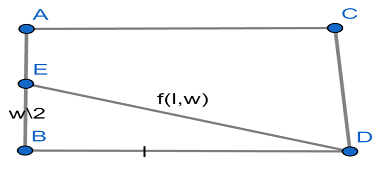
Now we will find the length of hypotenuse say $f\left( l,w \right)$, we get
$\Rightarrow f\left( l,w \right)=\sqrt{{{l}^{2}}+{{\left( \dfrac{w}{2} \right)}^{2}}}$
Now by using the area equation \[16=length\times breadth\]we will make $f\left( l,w \right)$ into single variable
$\begin{align}
& \Rightarrow 16=\left( length\times breadth \right) \\
& \Rightarrow l=\dfrac{16}{w} \\
\end{align}$
Now substitute $l$ by $\dfrac{16}{w}$ in $f\left( l,w \right)=\sqrt{{{l}^{2}}+{{\left( \dfrac{w}{2} \right)}^{2}}}$, we get
$\begin{align}
& \Rightarrow f\left( l,w \right)=\sqrt{{{l}^{2}}+{{\left( \dfrac{w}{2} \right)}^{2}}} \\
& \Rightarrow f\left( w \right)=\sqrt{{{\left( \dfrac{16}{w} \right)}^{2}}+{{\left( \dfrac{w}{2} \right)}^{2}}} \\
\end{align}$
Now solving the above equation we get
\[\begin{align}
& \Rightarrow f\left( w \right)=\sqrt{\dfrac{256}{{{w}^{2}}}+\dfrac{{{w}^{2}}}{4}} \\
& \Rightarrow f\left( w \right)=\sqrt{\dfrac{1024+{{w}^{4}}}{4{{w}^{2}}}} \\
& \Rightarrow f\left( w \right)=\dfrac{\sqrt{{{w}^{4}}+1024}}{2w} \\
\end{align}\]
So by the above equation the value $w$ exists between $0< w< \infty $.
Since we have to find the minimum value of $w$ so for this find the derivative of $f\left( w \right)$.\[\Rightarrow f\left( w \right)=\dfrac{\sqrt{{{w}^{4}}+1024}}{2w}\]
Now by using quotient rule $\dfrac{d\left( u.v \right)}{dx}=\dfrac{v\dfrac{du}{dx}-u\dfrac{dv}{dx}}{{{v}^{2}}}$ on above equation we get
\[\begin{align}
& \Rightarrow f\grave{\ }\left( w \right)=\dfrac{\dfrac{4{{w}^{3}}\left( 2w \right)}{2\left( \sqrt{{{w}^{4}}+1024} \right)}-2\sqrt{{{w}^{4}}+1024}}{4{{w}^{2}}} \\
& \Rightarrow f\grave{\ }\left( w \right)=\dfrac{\dfrac{4{{w}^{4}}}{\sqrt{{{w}^{4}}+1024}}-\dfrac{2\left( {{w}^{4}}+1024 \right)}{\sqrt{{{w}^{4}}+1024}}}{4{{w}^{2}}} \\
& \Rightarrow f\grave{\ }\left( w \right)=\dfrac{2{{w}^{4}}-2048}{4{{w}^{2}}\sqrt{{{w}^{2}}+1024}} \\
\end{align}\]
Now by more simplifying, we get
\[\Rightarrow f\grave{\ }\left( w \right)=\dfrac{{{w}^{4}}-1024}{2{{w}^{2}}\sqrt{{{w}^{4}}+1024}}\]
Now set the above equation equals to zero, we get
$\begin{align}
& \Rightarrow \dfrac{{{w}^{4}}-1024}{2{{w}^{2}}\sqrt{{{w}^{4}}+1024}}=0 \\
& \Rightarrow {{w}^{4}}-1024=0 \\
& \\
\end{align}$
Now add $1024$ on both sides, we get
$\begin{align}
& \Rightarrow {{w}^{4}}=1024 \\
& \Rightarrow w=\sqrt[4]{1024} \\
& \Rightarrow w=4\sqrt{2} \\
\end{align}$
Therefore the derivative of $f\left( w \right)$ does not exist when $w=0$.
Now we have to find the extrema, first find the function values for the endpoints of the domain, $0$ and $\infty $, and for the critical value, $4\sqrt{2}$ .
Since $0$ and $\infty $cannot putted into $f\left( w \right)$
Therefore, $w=4\sqrt{2}$ is the only critical point on the interval $\left( 0,\infty \right)$, and it is relatively minimum and it is the smallest breadth value that fits the parameter.
Note: We can go wrong by creating the Pythagorean formula, here I created by using$\dfrac{w}{2}$ and $l$, which means that$w=4\sqrt{2}$ is the side being bisected. Also make sure the quotient rule $\dfrac{d\left( u.v \right)}{dx}=\dfrac{v\dfrac{du}{dx}-u\dfrac{dv}{dx}}{{{v}^{2}}}$ which we used is also correct.
Complete step-by-step solution:
We have given that the area of the rectangle is $16{{m}^{2}}$.
We can write is also as:
$\begin{align}
& \Rightarrow Area=\left( length\times breadth \right) \\
& \Rightarrow 16=length\times breadth \\
\end{align}$
Now by using question we will draw a diagram of the line cutting through the rectangle and use the Pythagorean Theorem which is as:
${{\left( Hypotenuse \right)}^{2}}={{\left( length \right)}^{2}}\times {{\left( breadth \right)}^{2}}$
Let $l$ be the length of the rectangle and $w$ be the breadth of the rectangle
Now we will find the length of hypotenuse say $f\left( l,w \right)$, we get
$\Rightarrow f\left( l,w \right)=\sqrt{{{l}^{2}}+{{\left( \dfrac{w}{2} \right)}^{2}}}$
Now by using the area equation \[16=length\times breadth\]we will make $f\left( l,w \right)$ into single variable
$\begin{align}
& \Rightarrow 16=\left( length\times breadth \right) \\
& \Rightarrow l=\dfrac{16}{w} \\
\end{align}$
Now substitute $l$ by $\dfrac{16}{w}$ in $f\left( l,w \right)=\sqrt{{{l}^{2}}+{{\left( \dfrac{w}{2} \right)}^{2}}}$, we get
$\begin{align}
& \Rightarrow f\left( l,w \right)=\sqrt{{{l}^{2}}+{{\left( \dfrac{w}{2} \right)}^{2}}} \\
& \Rightarrow f\left( w \right)=\sqrt{{{\left( \dfrac{16}{w} \right)}^{2}}+{{\left( \dfrac{w}{2} \right)}^{2}}} \\
\end{align}$
Now solving the above equation we get
\[\begin{align}
& \Rightarrow f\left( w \right)=\sqrt{\dfrac{256}{{{w}^{2}}}+\dfrac{{{w}^{2}}}{4}} \\
& \Rightarrow f\left( w \right)=\sqrt{\dfrac{1024+{{w}^{4}}}{4{{w}^{2}}}} \\
& \Rightarrow f\left( w \right)=\dfrac{\sqrt{{{w}^{4}}+1024}}{2w} \\
\end{align}\]
So by the above equation the value $w$ exists between $0< w< \infty $.
Since we have to find the minimum value of $w$ so for this find the derivative of $f\left( w \right)$.\[\Rightarrow f\left( w \right)=\dfrac{\sqrt{{{w}^{4}}+1024}}{2w}\]
Now by using quotient rule $\dfrac{d\left( u.v \right)}{dx}=\dfrac{v\dfrac{du}{dx}-u\dfrac{dv}{dx}}{{{v}^{2}}}$ on above equation we get
\[\begin{align}
& \Rightarrow f\grave{\ }\left( w \right)=\dfrac{\dfrac{4{{w}^{3}}\left( 2w \right)}{2\left( \sqrt{{{w}^{4}}+1024} \right)}-2\sqrt{{{w}^{4}}+1024}}{4{{w}^{2}}} \\
& \Rightarrow f\grave{\ }\left( w \right)=\dfrac{\dfrac{4{{w}^{4}}}{\sqrt{{{w}^{4}}+1024}}-\dfrac{2\left( {{w}^{4}}+1024 \right)}{\sqrt{{{w}^{4}}+1024}}}{4{{w}^{2}}} \\
& \Rightarrow f\grave{\ }\left( w \right)=\dfrac{2{{w}^{4}}-2048}{4{{w}^{2}}\sqrt{{{w}^{2}}+1024}} \\
\end{align}\]
Now by more simplifying, we get
\[\Rightarrow f\grave{\ }\left( w \right)=\dfrac{{{w}^{4}}-1024}{2{{w}^{2}}\sqrt{{{w}^{4}}+1024}}\]
Now set the above equation equals to zero, we get
$\begin{align}
& \Rightarrow \dfrac{{{w}^{4}}-1024}{2{{w}^{2}}\sqrt{{{w}^{4}}+1024}}=0 \\
& \Rightarrow {{w}^{4}}-1024=0 \\
& \\
\end{align}$
Now add $1024$ on both sides, we get
$\begin{align}
& \Rightarrow {{w}^{4}}=1024 \\
& \Rightarrow w=\sqrt[4]{1024} \\
& \Rightarrow w=4\sqrt{2} \\
\end{align}$
Therefore the derivative of $f\left( w \right)$ does not exist when $w=0$.
Now we have to find the extrema, first find the function values for the endpoints of the domain, $0$ and $\infty $, and for the critical value, $4\sqrt{2}$ .
Since $0$ and $\infty $cannot putted into $f\left( w \right)$
Therefore, $w=4\sqrt{2}$ is the only critical point on the interval $\left( 0,\infty \right)$, and it is relatively minimum and it is the smallest breadth value that fits the parameter.
Note: We can go wrong by creating the Pythagorean formula, here I created by using$\dfrac{w}{2}$ and $l$, which means that$w=4\sqrt{2}$ is the side being bisected. Also make sure the quotient rule $\dfrac{d\left( u.v \right)}{dx}=\dfrac{v\dfrac{du}{dx}-u\dfrac{dv}{dx}}{{{v}^{2}}}$ which we used is also correct.
Recently Updated Pages
Which of the following graphs shows the variation of class 12 physics CBSE

Draw a labelled diagram of the human male reproductive class 12 biology CBSE
Describe the experiment to compare the emf of two cells class 12 physics CBSE
What is standard hydrogen electrode
What is conventional current and electric current class 12 physics CBSE
2Bromopentane is treated with an alcoholic KOH solution class 12 chemistry CBSE
Trending doubts
Draw a labelled sketch of the human eye class 12 physics CBSE
Which are the Top 10 Largest Countries of the World?
Differentiate between homogeneous and heterogeneous class 12 chemistry CBSE
Draw ray diagrams each showing i myopic eye and ii class 12 physics CBSE
Which is the correct genotypic ratio of mendel dihybrid class 12 biology CBSE
What is the Full Form of PVC, PET, HDPE, LDPE, PP and PS ?