




A play top is in the form of a hemisphere surmounted on a cone. The diameter of the hemisphere is $3.6cm$. The total height of the play top is $4.2cm$. Find its total surface area.
$
a)\,11.88\pi c{m^2} \\
b)\,1.88\pi c{m^2} \\
c)\,31.88\pi c{m^2} \\
d)\,none\,\,of\,these \\
$
Answer
 Verified
618k+ views
Hint:The model consists of one hemispherical top and one cone that are joined together. The required dimensions of like diameter and height are given. So, the surface area of these individual shapes can be calculated.The total surface area of the figure will be equal to the sum of the curved surface area of the cone and curved surface area of the hemisphere only.
Complete step-by-step answer:
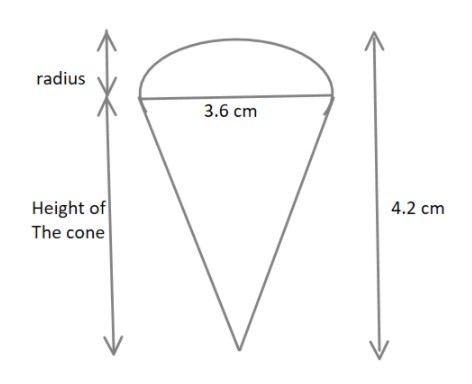
It is given that a play top is in the form of a hemisphere surmounted on a cone.
The diameter of the hemisphere is $3.6cm$.
Since the hemisphere and the cone are evenly joined, the diameter of the bases will be the same.
The total height of the play top is also given and is equal to $4.2cm$. The height is actually the sum of the radius of the hemisphere and height of the cone.
The radius $r$ of the hemisphere$ = \dfrac{{Diameter}}{2}$
$r = \dfrac{{3.6}}{2} = 1.8cm\,\,\,\,\,\,\,\,\,\, \to \left( 1 \right)$
Also, we need to calculate the height of the cone.
$
Total\,height = Height\,of\,cone + r \\
Height\,of\,cone(h) = 4.2 - 1.8 = 2.4cm\,\,\,\,\,\,\,\,\,\,\,\,\,\, \to \left( 2 \right) \\
$
Since we have the height as well as the radius of the cone so we can calculate length the curved region that is hypotenuse using Pythagoras Theorem,
$
{(height)^2} + {(radius)^2} = {(hypotenuse)^2} \\
{(h)^2} + {(r)^2} = {(l)^2} \\
l = \sqrt {{h^2} + {r^2}} \\
l = \sqrt {{{2.4}^2} + {{1.8}^2}} = \sqrt {5.76 + 3.24} \\
l = \sqrt 9 \\
l = 3\,\,\,\,\,\,\,\,\,\,\, \to \left( 3 \right) \\
$
So the surface area of the body will be the area of the body exposed since the hemisphere and cone are joined together, the area of their bases will not be included in the total surface area of the play top.
$
\therefore Total\,surface\,area = Curved\,surface\,area\,of\,cone + Curved\,surface\,area\,of\,hemisphere \\
$
Substituting the values from equations (1) , (2) and (3) we get,
$
Total\,surface\,area = \pi rl + 2\pi {r^2} \\
Total\,surface\,area = \pi (1.8)(3) + 2\pi (1.8)(1.8) \\
Total\,surface\,area = 5.4\pi + 6.48\pi \\
Total\,surface\,area = 11.88\pi c{m^2} \\
$
So, the correct answer is “Option A”.
Note:The student should understand the difference between the surface area of independent shapes and the surface area when these shapes are combined.And also should remember the formulas of curved surface areas of cone, hemisphere and other 3D shapes to solve these types of questions.
Complete step-by-step answer:
It is given that a play top is in the form of a hemisphere surmounted on a cone.
The diameter of the hemisphere is $3.6cm$.
Since the hemisphere and the cone are evenly joined, the diameter of the bases will be the same.
The total height of the play top is also given and is equal to $4.2cm$. The height is actually the sum of the radius of the hemisphere and height of the cone.
The radius $r$ of the hemisphere$ = \dfrac{{Diameter}}{2}$
$r = \dfrac{{3.6}}{2} = 1.8cm\,\,\,\,\,\,\,\,\,\, \to \left( 1 \right)$
Also, we need to calculate the height of the cone.
$
Total\,height = Height\,of\,cone + r \\
Height\,of\,cone(h) = 4.2 - 1.8 = 2.4cm\,\,\,\,\,\,\,\,\,\,\,\,\,\, \to \left( 2 \right) \\
$
Since we have the height as well as the radius of the cone so we can calculate length the curved region that is hypotenuse using Pythagoras Theorem,
$
{(height)^2} + {(radius)^2} = {(hypotenuse)^2} \\
{(h)^2} + {(r)^2} = {(l)^2} \\
l = \sqrt {{h^2} + {r^2}} \\
l = \sqrt {{{2.4}^2} + {{1.8}^2}} = \sqrt {5.76 + 3.24} \\
l = \sqrt 9 \\
l = 3\,\,\,\,\,\,\,\,\,\,\, \to \left( 3 \right) \\
$
So the surface area of the body will be the area of the body exposed since the hemisphere and cone are joined together, the area of their bases will not be included in the total surface area of the play top.
$
\therefore Total\,surface\,area = Curved\,surface\,area\,of\,cone + Curved\,surface\,area\,of\,hemisphere \\
$
Substituting the values from equations (1) , (2) and (3) we get,
$
Total\,surface\,area = \pi rl + 2\pi {r^2} \\
Total\,surface\,area = \pi (1.8)(3) + 2\pi (1.8)(1.8) \\
Total\,surface\,area = 5.4\pi + 6.48\pi \\
Total\,surface\,area = 11.88\pi c{m^2} \\
$
So, the correct answer is “Option A”.
Note:The student should understand the difference between the surface area of independent shapes and the surface area when these shapes are combined.And also should remember the formulas of curved surface areas of cone, hemisphere and other 3D shapes to solve these types of questions.
Recently Updated Pages
Master Class 11 Social Science: Engaging Questions & Answers for Success

Master Class 11 English: Engaging Questions & Answers for Success
Master Class 11 Maths: Engaging Questions & Answers for Success
Master Class 11 Chemistry: Engaging Questions & Answers for Success
Master Class 11 Biology: Engaging Questions & Answers for Success
Master Class 11 Physics: Engaging Questions & Answers for Success
Trending doubts
Differentiate between an exothermic and an endothermic class 11 chemistry CBSE
One Metric ton is equal to kg A 10000 B 1000 C 100 class 11 physics CBSE
Difference Between Prokaryotic Cells and Eukaryotic Cells
There are 720 permutations of the digits 1 2 3 4 5 class 11 maths CBSE
Draw a diagram of a plant cell and label at least eight class 11 biology CBSE
Two of the body parts which do not appear in MRI are class 11 biology CBSE