




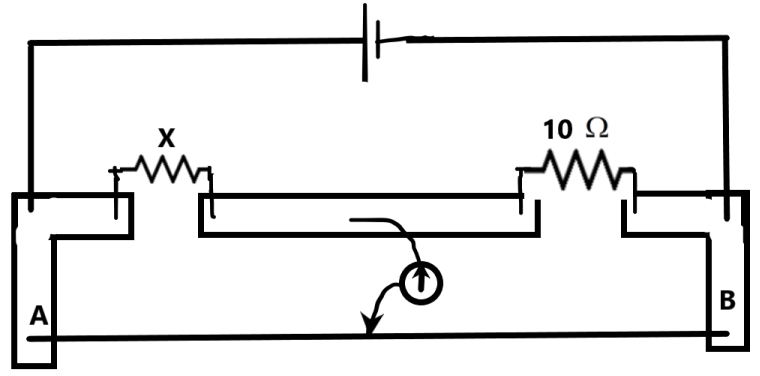
A meter bridge is set-up as shown, to determine an unknown resistance X using a standard 10\[\Omega \] resistor. The galvanometer shows null when tapping the key is at the 52 cm mark. The end corrections are 1 cm and 2 cm respectively for the ends A and B. The determined value of ‘X’ is –
A) 10.2\[\Omega \]
B) 10.6\[\Omega \]
C) 10.8\[\Omega \]
D) 11.1\[\Omega \]
Answer
 Verified
594k+ views
Hint: We need to understand the working principle in the meter-bridge in order to find the unknown resistance connected to the gap as we can see in the figure. The relation between the balancing length is required to solve this problem easily.
Complete answer:
We are given a situation in which a meter bridge is set up so as to find the resistance of an unknown resistance X as we can see in the figure. We know that the meter bridge works on Wheatstone's principle. According to the principle, the resistance between two equipotential points no longer causes any change in the circuit. i.e., the wire connecting the point B (or A) to the null point will not affect the circuit.
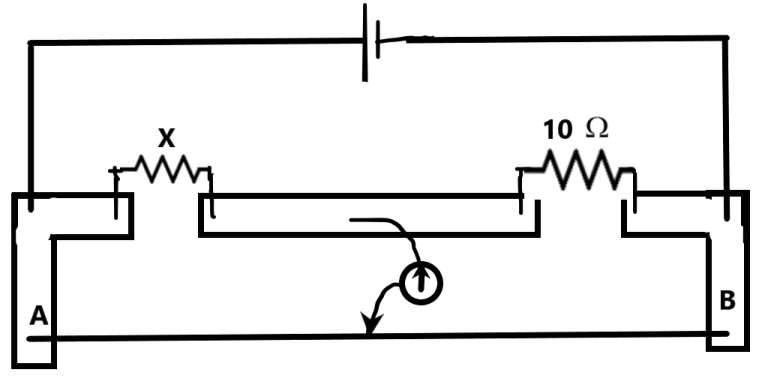
We know that this principle is further simplified in terms of the length of the wire and the balancing length. The relation between the lengths of the wire from point A to null point and from B to null point is given as the ratio of the resistance as –
\[\begin{align}
& \dfrac{X}{Y}=\dfrac{l}{100-l} \\
& \Rightarrow \dfrac{X}{10\Omega }=\dfrac{52+1}{100-(52-2)} \\
& \Rightarrow \dfrac{X}{10\Omega }=\dfrac{53}{50} \\
& \Rightarrow X=\dfrac{53}{50}\times 10\Omega \\
& \therefore X=10.6\Omega \\
\end{align}\]
This is the required resistance of the unknown resistance which balances the meter bridge conditions at 52 cm.
The correct answer is option B.
Note:
The corrections on the length of the meter bridge wire are already given in the problem which should be added to the total length so as to get the correct resistance as the meter bridge is highly sensitive to the length of the wire used in the meter bridge.
Complete answer:
We are given a situation in which a meter bridge is set up so as to find the resistance of an unknown resistance X as we can see in the figure. We know that the meter bridge works on Wheatstone's principle. According to the principle, the resistance between two equipotential points no longer causes any change in the circuit. i.e., the wire connecting the point B (or A) to the null point will not affect the circuit.
We know that this principle is further simplified in terms of the length of the wire and the balancing length. The relation between the lengths of the wire from point A to null point and from B to null point is given as the ratio of the resistance as –
\[\begin{align}
& \dfrac{X}{Y}=\dfrac{l}{100-l} \\
& \Rightarrow \dfrac{X}{10\Omega }=\dfrac{52+1}{100-(52-2)} \\
& \Rightarrow \dfrac{X}{10\Omega }=\dfrac{53}{50} \\
& \Rightarrow X=\dfrac{53}{50}\times 10\Omega \\
& \therefore X=10.6\Omega \\
\end{align}\]
This is the required resistance of the unknown resistance which balances the meter bridge conditions at 52 cm.
The correct answer is option B.
Note:
The corrections on the length of the meter bridge wire are already given in the problem which should be added to the total length so as to get the correct resistance as the meter bridge is highly sensitive to the length of the wire used in the meter bridge.
Recently Updated Pages
Master Class 11 English: Engaging Questions & Answers for Success

Master Class 11 Social Science: Engaging Questions & Answers for Success
Master Class 11 Maths: Engaging Questions & Answers for Success
Master Class 11 Biology: Engaging Questions & Answers for Success
Master Class 11 Physics: Engaging Questions & Answers for Success
Master Class 11 Chemistry: Engaging Questions & Answers for Success
Trending doubts
One Metric ton is equal to kg A 10000 B 1000 C 100 class 11 physics CBSE
Difference Between Prokaryotic Cells and Eukaryotic Cells
Find the value of the expression given below sin 30circ class 11 maths CBSE
Difference between physical and chemical change class 11 chemistry CBSE
Two of the body parts which do not appear in MRI are class 11 biology CBSE
Draw a diagram of a plant cell and label at least eight class 11 biology CBSE