




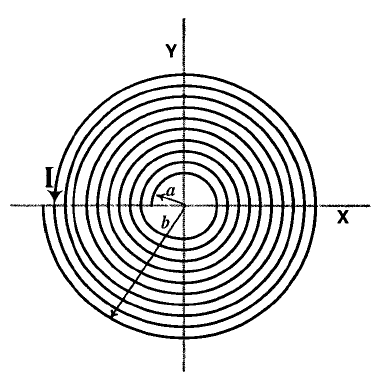
A long insulated copper wire is closely wound as a spiral of 'N' turns. The spiral has an inner radius ‘a' and an outer radius ′b′. The spiral lies in the X−Y plane and a steady current 'I' flows through the wire. The Z-component of the magnetic field at the center of the spiral is :
Answer
 Verified
623.7k+ views
Hint: In this question, first we assume an elementary ring of radius r and thickness ‘dr’ and then find the number of turns in this elementary ring . After this we will find the magnetic field at the centre O. To find the magnetic field due to the whole spiral, we will integrate it from a to b.
Complete answer:
Let us consider an elementary ring of radius r and thickness dr in which current I is flowing.
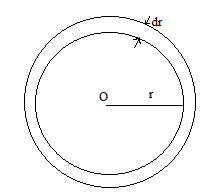
Number of turns in this elementary ring dN =$\dfrac{N}{{b - a}}dr$
We know that magnetic field at the centre of a ring is given by:
B=$\dfrac{{{\mu _0}NI}}{{2r}}$
Where,
${\mu _0}$ is permeability of free space.
N is the number of terms.
I is currently flowing.
r is the radius of the ring.
Thus magnetic field at the centre O due to this ring dB=$\dfrac{{{\mu _0}dNI}}{{2r}}$
Putting the value of dN, we get:
dB=$\dfrac{{{\mu _0}NIdr}}{{2(b - a)r}}$
To get the net magnetic field at the centre of the spiral , we will integrate the above equation from ‘a’ to ‘b’.
$\int\limits_0^B {dB} $ =$\int\limits_a^b {\dfrac{{{\mu _0}NIdr}}{{2(b - a)r}}} = \dfrac{{{\mu _0}NI}}{{2(b - a)}}\int\limits_a^b {\dfrac{{dr}}{r}} = \dfrac{{{\mu _0}NI}}{{2(b - a)}}\left[ {\ln r} \right]_a^b$
$ \Rightarrow B = \dfrac{{{\mu _0}NI}}{{2(b - a)}}\ln \dfrac{b}{a}$
Therefore, the required magnetic field is $ \Rightarrow B = \dfrac{{{\mu _0}NI}}{{2(b - a)}}\ln \dfrac{b}{a}$
Note:
In this question, you should know how to calculate the magnetic field in the centre of the circular wire. The direction of the magnetic field in this case is given by right hand thumb rule. You should know the Biot-savart law which is used to calculate the magnetic field. The magnitude of magnetic field is given by:
$dB = \dfrac{{{\mu _0}}}{{4\pi }}\dfrac{{Idl\sin \theta }}{{{r^2}}}$
Complete answer:
Let us consider an elementary ring of radius r and thickness dr in which current I is flowing.
Number of turns in this elementary ring dN =$\dfrac{N}{{b - a}}dr$
We know that magnetic field at the centre of a ring is given by:
B=$\dfrac{{{\mu _0}NI}}{{2r}}$
Where,
${\mu _0}$ is permeability of free space.
N is the number of terms.
I is currently flowing.
r is the radius of the ring.
Thus magnetic field at the centre O due to this ring dB=$\dfrac{{{\mu _0}dNI}}{{2r}}$
Putting the value of dN, we get:
dB=$\dfrac{{{\mu _0}NIdr}}{{2(b - a)r}}$
To get the net magnetic field at the centre of the spiral , we will integrate the above equation from ‘a’ to ‘b’.
$\int\limits_0^B {dB} $ =$\int\limits_a^b {\dfrac{{{\mu _0}NIdr}}{{2(b - a)r}}} = \dfrac{{{\mu _0}NI}}{{2(b - a)}}\int\limits_a^b {\dfrac{{dr}}{r}} = \dfrac{{{\mu _0}NI}}{{2(b - a)}}\left[ {\ln r} \right]_a^b$
$ \Rightarrow B = \dfrac{{{\mu _0}NI}}{{2(b - a)}}\ln \dfrac{b}{a}$
Therefore, the required magnetic field is $ \Rightarrow B = \dfrac{{{\mu _0}NI}}{{2(b - a)}}\ln \dfrac{b}{a}$
Note:
In this question, you should know how to calculate the magnetic field in the centre of the circular wire. The direction of the magnetic field in this case is given by right hand thumb rule. You should know the Biot-savart law which is used to calculate the magnetic field. The magnitude of magnetic field is given by:
$dB = \dfrac{{{\mu _0}}}{{4\pi }}\dfrac{{Idl\sin \theta }}{{{r^2}}}$
Recently Updated Pages
Master Class 12 Economics: Engaging Questions & Answers for Success

Master Class 12 English: Engaging Questions & Answers for Success
Master Class 12 Social Science: Engaging Questions & Answers for Success
Master Class 12 Maths: Engaging Questions & Answers for Success
Master Class 12 Physics: Engaging Questions & Answers for Success
Master Class 9 General Knowledge: Engaging Questions & Answers for Success
Trending doubts
Draw ray diagrams each showing i myopic eye and ii class 12 physics CBSE
The ratio of E to B in electromagnetic waves is equal class 12 physics CBSE
Sulphuric acid is known as the king of acids State class 12 chemistry CBSE
Which of the following is referred to as the Evil Quartet class 12 biology CBSE
Derive an expression for the electric field intensity class 12 physics CBSE
Percentage of photosynthetically active radiation PAR class 12 biology CBSE