




When a lighted candle is held in front of a thick plane glass mirror, several images are seen, out of which the second image is the brightest. Give reason.
Answer
 Verified
549.9k+ views
Hint: A plane mirror has a reflecting surface that is smooth (planar). The angle of reflection equals the angle of incidence for light rays striking a plane mirror. The angle of incidence is the angle formed by the incident ray and the normal of the surface (an imaginary line perpendicular to the surface).
Complete answer:
When a beam of light from a lit candle strikes the surface of a dense plane glass mirror, a small portion of the light (nearly 4% ) is reflected, creating a faint virtual image, while the majority of the light (nearly 96%) is refracted within the glass, forming a second image. The silvered surface within the glass now closely reflects this ray back.
This ray is then partly refracted in air, resulting in the formation of a new virtual image. Because of the intense reflection of light on the silver rim, this picture is the darkest.When we look at the reflection of a candle flame in a dense plane glass mirror, we see multiple dim images as well as one vivid one.
Partial reflection and partial refraction at the two surfaces of the glass plate or dense mirror cause this. And the strength of partly reflected light is lower than that of light that is actually reflecting at the plane mirror's surface. As a result, the second picture is the brightest.
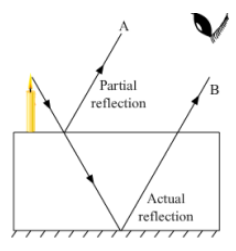
Note: A plane mirror reflects objects in front of it, but these reflections tend to be behind the plane in which the mirror is located. A straight line drawn from one part of an object to the corresponding part of its image forms a right angle with the plane mirror's surface and is bisected by it. A plane mirror's reflection is often virtual (meaning the light rays do not originate from the image), upright, and the same shape and size as the object it is representing. A virtual image is a representation of an object produced at the position where light rays tend to originate.
Complete answer:
When a beam of light from a lit candle strikes the surface of a dense plane glass mirror, a small portion of the light (nearly 4% ) is reflected, creating a faint virtual image, while the majority of the light (nearly 96%) is refracted within the glass, forming a second image. The silvered surface within the glass now closely reflects this ray back.
This ray is then partly refracted in air, resulting in the formation of a new virtual image. Because of the intense reflection of light on the silver rim, this picture is the darkest.When we look at the reflection of a candle flame in a dense plane glass mirror, we see multiple dim images as well as one vivid one.
Partial reflection and partial refraction at the two surfaces of the glass plate or dense mirror cause this. And the strength of partly reflected light is lower than that of light that is actually reflecting at the plane mirror's surface. As a result, the second picture is the brightest.
Note: A plane mirror reflects objects in front of it, but these reflections tend to be behind the plane in which the mirror is located. A straight line drawn from one part of an object to the corresponding part of its image forms a right angle with the plane mirror's surface and is bisected by it. A plane mirror's reflection is often virtual (meaning the light rays do not originate from the image), upright, and the same shape and size as the object it is representing. A virtual image is a representation of an object produced at the position where light rays tend to originate.
Recently Updated Pages
Master Class 12 Economics: Engaging Questions & Answers for Success

Master Class 12 English: Engaging Questions & Answers for Success
Master Class 12 Social Science: Engaging Questions & Answers for Success
Master Class 12 Maths: Engaging Questions & Answers for Success
Master Class 12 Physics: Engaging Questions & Answers for Success
Master Class 10 English: Engaging Questions & Answers for Success
Trending doubts
Explain the Treaty of Vienna of 1815 class 10 social science CBSE
Who Won 36 Oscar Awards? Record Holder Revealed
Why is it 530 pm in india when it is 1200 afternoon class 10 social science CBSE
What is the full form of POSCO class 10 social science CBSE
Define Potential, Developed, Stock and Reserved resources
The speaker of the Lok Sabha is elected by the APresident class 10 social science CBSE