




A larvivorous fish is
(a) Gambusia
(b) Solea
(c) Anabas
(d) Diodon
Answer
 Verified
610.2k+ views
Hint: Western mosquitofish are freshwater fish species, often generally known, if ambiguously, as mere mosquitofish or by their generic name. Since the fish consumes mosquito larvae, the name 'mosquitofish' was given and has been used more than any other fish for the biological control of mosquitoes.
Complete step by step answer:
Gambusia is a large genus in the Poeciliidae family (order Cyprinodontiformes) of viviparous fish. There are over 40 species in Gambusia, most of which are found mainly in freshwater environments, although some species may be found in brackish or saltwater environments as well. Cuban Gambusia is the type species.
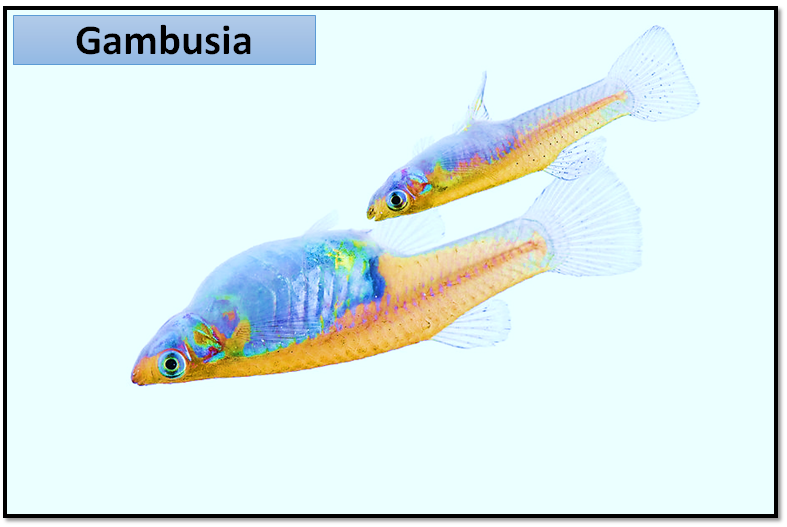
Gambusia is a large genus of freshwater fish, although there are several species found in saltwater or brackish environments. Gambusia affinis and Gambusia holbrooki are two species. They will feed on the larvae of mosquitoes and, thus, are called mosquitofish.
They are only rarely kept in aquariums due to their relative lack of color.
Additional information: The common sole, the Dover sole, or the black sole, is a flatfish species in the Soleidae family. It lives on the sandy or muddy seabed of the North Atlantic and the Mediterranean Sea, where it is mostly semi-submersible. The upper side is greyish-brown, while the lower side is white. Anabas is a genus of climbing gourmands native to southern and eastern Asia. In the wild, the species of Anabas grow up to 30 cm in length. They live in both brackish and freshwater. Fish of the genus Diodon have two-root, movable spines (derived from modified scales) distributed over their bodies. Beak-like jaws used to crush their hard-shelled prey (crustaceans and mollusks) .
So, the correct answer is ‘Gambusia’.
Note: Mosquitofish (Gambusia holbrooki) is an edible tropical fish considered to be one of the most dangerous invasive species on a global scale, according to the International Union for the Conservation of Nature (IUCN).
Complete step by step answer:
Gambusia is a large genus in the Poeciliidae family (order Cyprinodontiformes) of viviparous fish. There are over 40 species in Gambusia, most of which are found mainly in freshwater environments, although some species may be found in brackish or saltwater environments as well. Cuban Gambusia is the type species.
Gambusia is a large genus of freshwater fish, although there are several species found in saltwater or brackish environments. Gambusia affinis and Gambusia holbrooki are two species. They will feed on the larvae of mosquitoes and, thus, are called mosquitofish.
They are only rarely kept in aquariums due to their relative lack of color.
Additional information: The common sole, the Dover sole, or the black sole, is a flatfish species in the Soleidae family. It lives on the sandy or muddy seabed of the North Atlantic and the Mediterranean Sea, where it is mostly semi-submersible. The upper side is greyish-brown, while the lower side is white. Anabas is a genus of climbing gourmands native to southern and eastern Asia. In the wild, the species of Anabas grow up to 30 cm in length. They live in both brackish and freshwater. Fish of the genus Diodon have two-root, movable spines (derived from modified scales) distributed over their bodies. Beak-like jaws used to crush their hard-shelled prey (crustaceans and mollusks) .
So, the correct answer is ‘Gambusia’.
Note: Mosquitofish (Gambusia holbrooki) is an edible tropical fish considered to be one of the most dangerous invasive species on a global scale, according to the International Union for the Conservation of Nature (IUCN).
Recently Updated Pages
Master Class 11 Social Science: Engaging Questions & Answers for Success

Master Class 11 English: Engaging Questions & Answers for Success
Master Class 11 Maths: Engaging Questions & Answers for Success
Master Class 11 Chemistry: Engaging Questions & Answers for Success
Master Class 11 Biology: Engaging Questions & Answers for Success
Master Class 11 Physics: Engaging Questions & Answers for Success
Trending doubts
One Metric ton is equal to kg A 10000 B 1000 C 100 class 11 physics CBSE
Difference Between Prokaryotic Cells and Eukaryotic Cells
How many of the following diseases can be studied with class 11 biology CBSE
Two of the body parts which do not appear in MRI are class 11 biology CBSE
Which of the following enzymes is used for carboxylation class 11 biology CBSE
Explain zero factorial class 11 maths CBSE