




A freely falling body:
A. Is weightless
B. Has double the weight, which it actually possesses
C. Is likely to gain weight as it moves towards the earth
D. None of the above
Answer
 Verified
589.8k+ views
Hint: Weight of the body is determined by the normal force or the reaction force. Apply Newton’s second law on the freely falling body and determine the reaction force. For the freely falling body, the acceleration produced in the body is the acceleration due to gravity.
Complete answer:
To answer this question, let’s consider the situation where the body is at rest on the ground. We determine the weight of the body by measuring the normal force or reaction force provided by the ground. The apparent weight of the body when it is moving upward or downward is different from its original weight and it is determined by the normal force provided by the base on which the body is situated.
Now, let’s consider the body falling freely in the air. Let’s apply Newton's second law of motion on the body by referring to the following figure.
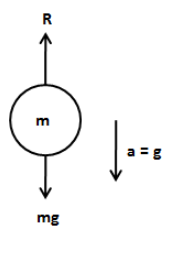
In the above figure, mg is the weight of the body and R is the reaction force. The reaction force determines the weight of the body.
Applying Newton’s second law, we get,
\[R - mg = ma\]
But we know that only the gravitational force is acting on the body and therefore, the acceleration of the body is the acceleration due to gravity. Therefore, substituting g for a in the above equation, we get,
\[R - mg = mg\]
\[ \therefore R = 0\]
Thus, the reaction force on the body is zero and so as the weight of the body. Therefore, we can infer that the freely falling body is weightless.
So, the correct answer is option A.
Note: The reaction force and the normal force are not the same kind of forces. When we place a book on the table, the force provided by the table on the book is the normal force. Now, the reaction force is the term from Newton’s third law. The earth exerts a force on the body and the body also exerts the force on the earth. This force exerted by the body on the earth is the reaction force. When the reaction force is zero, the body feels weightless while moving downwards.
Complete answer:
To answer this question, let’s consider the situation where the body is at rest on the ground. We determine the weight of the body by measuring the normal force or reaction force provided by the ground. The apparent weight of the body when it is moving upward or downward is different from its original weight and it is determined by the normal force provided by the base on which the body is situated.
Now, let’s consider the body falling freely in the air. Let’s apply Newton's second law of motion on the body by referring to the following figure.
In the above figure, mg is the weight of the body and R is the reaction force. The reaction force determines the weight of the body.
Applying Newton’s second law, we get,
\[R - mg = ma\]
But we know that only the gravitational force is acting on the body and therefore, the acceleration of the body is the acceleration due to gravity. Therefore, substituting g for a in the above equation, we get,
\[R - mg = mg\]
\[ \therefore R = 0\]
Thus, the reaction force on the body is zero and so as the weight of the body. Therefore, we can infer that the freely falling body is weightless.
So, the correct answer is option A.
Note: The reaction force and the normal force are not the same kind of forces. When we place a book on the table, the force provided by the table on the book is the normal force. Now, the reaction force is the term from Newton’s third law. The earth exerts a force on the body and the body also exerts the force on the earth. This force exerted by the body on the earth is the reaction force. When the reaction force is zero, the body feels weightless while moving downwards.
Recently Updated Pages
Master Class 11 Social Science: Engaging Questions & Answers for Success

Master Class 11 English: Engaging Questions & Answers for Success
Master Class 11 Maths: Engaging Questions & Answers for Success
Master Class 11 Chemistry: Engaging Questions & Answers for Success
Master Class 11 Biology: Engaging Questions & Answers for Success
Master Class 11 Physics: Engaging Questions & Answers for Success
Trending doubts
Differentiate between an exothermic and an endothermic class 11 chemistry CBSE
One Metric ton is equal to kg A 10000 B 1000 C 100 class 11 physics CBSE
Difference Between Prokaryotic Cells and Eukaryotic Cells
There are 720 permutations of the digits 1 2 3 4 5 class 11 maths CBSE
Draw a diagram of a plant cell and label at least eight class 11 biology CBSE
Which chemical is known as king of chemicals A H 2 class 11 chemistry CBSE