




A detritivorous animal of economic importance is
(a)Caterpillar larva
(b)Leech
(c)Earthworm
(d)Giriraja fowl
Answer
 Verified
641.4k+ views
Hint: Detritivores are animals that feed on dead and decaying matter and are part of the detritus food chain. Detritivores are crucial for ecosystems because they are responsible for breaking down organic matter into inorganic simpler substances thus recycling those elements.
Complete answer:
A detritivorous animal of economic importance is the Earthworm which is also known as ‘friends of the farmers’ because of how it benefits the soil for crops. Earthworms make burrows in the soil as they move and this results in the soil becoming porous. This helps in respiration and penetration of the plant roots. The earthworms also increase the fertility of the soil by a process known as vermicomposting as organic compounds are broken into simple inorganic compounds which are absorbed by growing plants. Earthworms belong to the phylum Annelida and their characteristic is that their body is divided into segments or metameres.
Additional Information: The process of decomposition includes:
Fragmentation: It is the process of breaking down detritus into smaller particles by decomposers.
Leaching: In leaching, inorganic nutrients seep down into the soil horizon and get precipitated as unavailable salts.
Catabolism: The process of breaking down detritus into even smaller inorganic substances with the help of fungal and bacterial enzymes is known as catabolism.
Humification: The process of formation of humus which is a dark-colored amorphous substance resistant to microbial action is known as humification.
Mineralization: The further degradation of humus to release inorganic nutrients is known as mineralization.
So, the correct option is ‘Earthworm’.
Note: -Detritus is the raw matter for the detritus food chain and consists of dead and decomposing matter like dead bodies of animals, leaves, etc.
-Decomposition occurs faster in warm and moist conditions as compared to colder and anaerobic conditions.
-Soil rich in lignin and chitin is decomposed slower than soil rich in nitrogen and sugars.
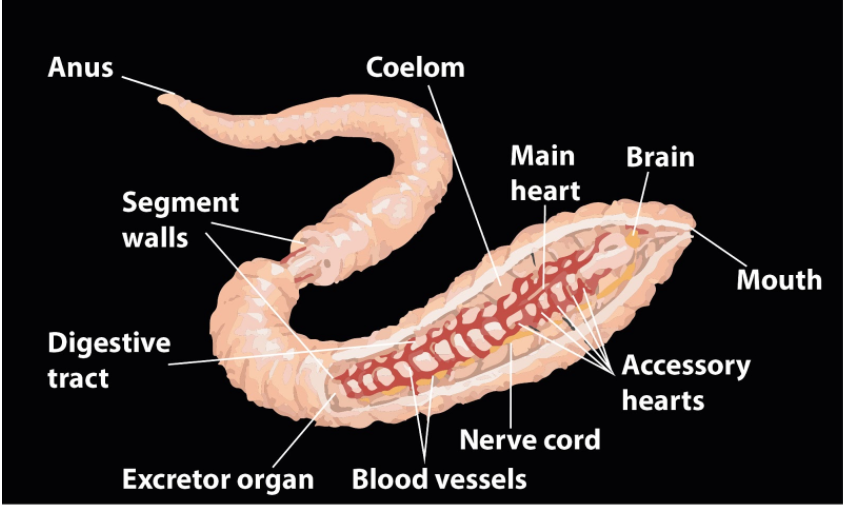
Complete answer:
A detritivorous animal of economic importance is the Earthworm which is also known as ‘friends of the farmers’ because of how it benefits the soil for crops. Earthworms make burrows in the soil as they move and this results in the soil becoming porous. This helps in respiration and penetration of the plant roots. The earthworms also increase the fertility of the soil by a process known as vermicomposting as organic compounds are broken into simple inorganic compounds which are absorbed by growing plants. Earthworms belong to the phylum Annelida and their characteristic is that their body is divided into segments or metameres.
Additional Information: The process of decomposition includes:
Fragmentation: It is the process of breaking down detritus into smaller particles by decomposers.
Leaching: In leaching, inorganic nutrients seep down into the soil horizon and get precipitated as unavailable salts.
Catabolism: The process of breaking down detritus into even smaller inorganic substances with the help of fungal and bacterial enzymes is known as catabolism.
Humification: The process of formation of humus which is a dark-colored amorphous substance resistant to microbial action is known as humification.
Mineralization: The further degradation of humus to release inorganic nutrients is known as mineralization.
So, the correct option is ‘Earthworm’.
Note: -Detritus is the raw matter for the detritus food chain and consists of dead and decomposing matter like dead bodies of animals, leaves, etc.
-Decomposition occurs faster in warm and moist conditions as compared to colder and anaerobic conditions.
-Soil rich in lignin and chitin is decomposed slower than soil rich in nitrogen and sugars.
Recently Updated Pages
Which will be the least stable resonating structure class 11 chemistry CBSE

How many 5 digit telephone numbers can be construc-class-11-maths-CBSE
How do you find the angle of the resultant vector class 11 physics CBSE
Draw labelled diagram of the following i Gram seed class 11 biology CBSE
1 Quintal is equal to a 110 kg b 10 kg c 100kg d 1000 class 11 physics CBSE
What is the need and importance of classification class 11 biology CBSE
Trending doubts
Find the value of the expression given below sin 30circ class 11 maths CBSE
One Metric ton is equal to kg A 10000 B 1000 C 100 class 11 physics CBSE
10 examples of friction in our daily life
Draw a diagram of a plant cell and label at least eight class 11 biology CBSE
Difference between physical and chemical change class 11 chemistry CBSE
Proton was discovered by A Thomson B Rutherford C Chadwick class 11 chemistry CBSE