




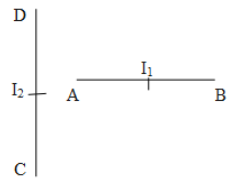
A current ${{I}_{1}}$ caring wire AB is placed near another long CD carrying current ${{I}_{2}}$. If wire AB is free to move, it will have:
A. rotational motion only
B. translational motion only
C. rotational as well as translational motion
D. neither rotational nor translational motion.
Answer
 Verified
617.1k+ views
Hint: When a current is flowing through a conductor a magnetic force is developed around the conductor. When an external free moving charge or current carrying conductor will come into contact with this magnetic field the conductor will experience a certain amount of force. Due to this force, the free body will undergo some sort of motion.
Complete answer:
Ina straight current carrying conductor a magnetic field is developed around the conductor which is assumed to be in a circular path around the conductor.
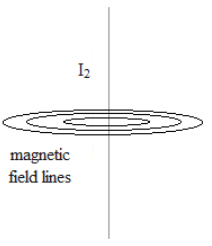
The magnetic field developed around the conductor is by Biot-savart's law.
According to Biot-savart's law, the magnetic field is given
\[d\vec{B}={{\mu }_{0}}\dfrac{Idl\sin \theta }{4\pi {{r}^{2}}}\]
So as derived from Biot-savart's law the magnetic field around the conductor CD is,
\[d\vec{B}={{\mu }_{0}}\dfrac{{{I}_{2}}}{2\pi r}\]
The intensity of this magnetic field decreases as we move away from the conductor. So the magnitude of the magnetic field decreases along the wire AB due to wire CD.
On each element (small element) of wire AB, the force experienced will be equal to ${{I}_{1}}Bdr$
As a result of which the wire AB will perform both translational and rotational motions. The translation motion will be due to the reason that all forces acting in upward direction and rotation will be due to all forces being different in magnitudes.
So the correct option is option C.
Note:
When there is a change in the electric or magnetic field along a conductor some amount of emf is induced in the conductor. This emf is termed as induced emf. This emf opposes the changes occurring and due to that induced is in the opposite direction of the force-producing it.
Complete answer:
Ina straight current carrying conductor a magnetic field is developed around the conductor which is assumed to be in a circular path around the conductor.
The magnetic field developed around the conductor is by Biot-savart's law.
According to Biot-savart's law, the magnetic field is given
\[d\vec{B}={{\mu }_{0}}\dfrac{Idl\sin \theta }{4\pi {{r}^{2}}}\]
So as derived from Biot-savart's law the magnetic field around the conductor CD is,
\[d\vec{B}={{\mu }_{0}}\dfrac{{{I}_{2}}}{2\pi r}\]
The intensity of this magnetic field decreases as we move away from the conductor. So the magnitude of the magnetic field decreases along the wire AB due to wire CD.
On each element (small element) of wire AB, the force experienced will be equal to ${{I}_{1}}Bdr$
As a result of which the wire AB will perform both translational and rotational motions. The translation motion will be due to the reason that all forces acting in upward direction and rotation will be due to all forces being different in magnitudes.
So the correct option is option C.
Note:
When there is a change in the electric or magnetic field along a conductor some amount of emf is induced in the conductor. This emf is termed as induced emf. This emf opposes the changes occurring and due to that induced is in the opposite direction of the force-producing it.
Recently Updated Pages
Master Class 12 Economics: Engaging Questions & Answers for Success

Master Class 12 English: Engaging Questions & Answers for Success
Master Class 12 Social Science: Engaging Questions & Answers for Success
Master Class 12 Maths: Engaging Questions & Answers for Success
Master Class 12 Physics: Engaging Questions & Answers for Success
Master Class 11 Social Science: Engaging Questions & Answers for Success
Trending doubts
One Metric ton is equal to kg A 10000 B 1000 C 100 class 11 physics CBSE
Difference Between Prokaryotic Cells and Eukaryotic Cells
Find the value of the expression given below sin 30circ class 11 maths CBSE
Two of the body parts which do not appear in MRI are class 11 biology CBSE
Draw a diagram of nephron and explain its structur class 11 biology CBSE
10 examples of friction in our daily life