




A charged particle of mass m and charge q is moved from\[x=0\] by an electric field \[\overrightarrow{E}=\left( {{E}_{0}}-\alpha x \right)\overset{\wedge }{\mathop{i}}\,\] where $\alpha$ is the positive constant and x is the displacement of the particle in time t along x-axis. Find the distance moved by a particle when it is again brought to rest and the acceleration of the particle at that instant. Describe the motion of the particle.
Answer
 Verified
651k+ views
Hint: Here we have given a charged particle which is moved by an electric field and we have to find the distance and the moved by a particle to bring it to rest. And we also have to find the acceleration at that point. For that, we can use the formula of force which is experienced by a charged in an electric field, and by using the same formula we can describe the motion of the particle.
Formula used:
\[\begin{align}
& F=qE \\
& F=ma \\
\end{align}\]
Complete step-by-step solution
Here a charged particle is given of mass m and charge q is moved from rest by an electric field \[\overrightarrow{E}=\left( {{E}_{0}}-\alpha x \right)\overset{\wedge }{\mathop{i}}\,\]where $\alpha$ is the positive constant and x is the displacement of the particle in time t along x-axis. And \[{{E}_{0}}\] is the electric field at \[x=0\]. A diagram for this can be given as follows
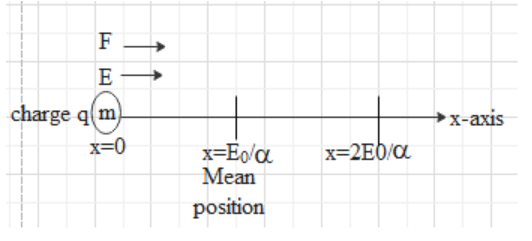
In the above diagram F is the force and we will further discuss the other positions of the x.
Now we know that the force experienced by an electric charge is given as a product of charge and the electric field, i.e.
\[F=qE\]
Now substituting the given value of E, we get
\[\begin{align}
& F=q\left( {{E}_{0}}-\alpha x \right)\text{ }..............\text{(i)} \\
& \Rightarrow F=q{{E}_{0}}-q\alpha x \\
& \Rightarrow F={{F}_{0}}-q\alpha x \\
& \Rightarrow F-{{F}_{0}}=-q\alpha x \\
\end{align}\]
Here \[{{F}_{0}}\] is the force experienced by the charge when it is at \[x=0\]. As F and \[{{F}_{0}}\] are both forces at different x, so we can write
\[\begin{align}
& F'=F-{{F}_{0}} \\
& \Rightarrow F'=-q\alpha x \\
\end{align}\]
Now from the above equation, we say that F’ is directly proportional to the displacement x
\[F'\propto -x\]
$\alpha$ is a positive constant. This proportionality is for the simple harmonic motion. Hence the motion of the charge will be oscillatory.
For SHM the mean position is where the object is consider to be at rest and so the force at that point will be zero, which gives us
\[\begin{align}
& q\left( {{E}_{0}}-\alpha x \right)=0 \\
& \Rightarrow \left( {{E}_{0}}-\alpha x \right)=0 \\
& \Rightarrow \alpha x={{E}_{0}} \\
& \Rightarrow x=\dfrac{{{E}_{0}}}{\alpha } \\
\end{align}\]
Now the distance the charge will cover to back to rest or its mean position is twice the mean position. If we say x’ is the distance which the charged particle has to cover to back its mean position, then
\[\begin{align}
& x'=2x \\
& \Rightarrow x'=2\left( \dfrac{{{E}_{0}}}{\alpha } \right) \\
\end{align}\]
Now we now that force is given as product of mass and acceleration. It is given that the charged particle has mass m and if a is the acceleration then we can rewrite the equation (i) as
\[ma=q\left( {{E}_{0}}-\alpha x \right)\]
We have to find acceleration when charged particle covers distance x’, so substituting value of x’ in the place of x in the above equation we get
\[\begin{align}
& ma=q\left( {{E}_{0}}-\alpha \left( \dfrac{2{{E}_{0}}}{\alpha } \right) \right) \\
& \Rightarrow ma=q\left( {{E}_{0}}-2{{E}_{0}} \right) \\
& \Rightarrow ma=-q{{E}_{0}} \\
& \Rightarrow a=-\dfrac{q}{m}{{E}_{0}} \\
\end{align}\]
Negative sign indicates that acceleration is decreasing with distance.
Hence the distance moved by a particle when it is again brought to rest is \[\dfrac{2{{E}_{0}}}{\alpha }\] and the acceleration of the particle at that instant is \[-\dfrac{q}{m}{{E}_{0}}\].
And the particle has oscillatory motion from \[x=0\text{ to }x=\dfrac{2{{E}_{0}}}{\alpha }\].
Note: Every simple harmonic motion is oscillatory motion but it is not necessary that each oscillatory motion is simple harmonic. It was not given that \[{{E}_{0}}\] is the electric field at point \[x=0\] but if we substitute the value of x as zero in the equation given for the electric field then we will get the electric field at \[x=0\] which is \[{{E}_{0}}\].
Formula used:
\[\begin{align}
& F=qE \\
& F=ma \\
\end{align}\]
Complete step-by-step solution
Here a charged particle is given of mass m and charge q is moved from rest by an electric field \[\overrightarrow{E}=\left( {{E}_{0}}-\alpha x \right)\overset{\wedge }{\mathop{i}}\,\]where $\alpha$ is the positive constant and x is the displacement of the particle in time t along x-axis. And \[{{E}_{0}}\] is the electric field at \[x=0\]. A diagram for this can be given as follows
In the above diagram F is the force and we will further discuss the other positions of the x.
Now we know that the force experienced by an electric charge is given as a product of charge and the electric field, i.e.
\[F=qE\]
Now substituting the given value of E, we get
\[\begin{align}
& F=q\left( {{E}_{0}}-\alpha x \right)\text{ }..............\text{(i)} \\
& \Rightarrow F=q{{E}_{0}}-q\alpha x \\
& \Rightarrow F={{F}_{0}}-q\alpha x \\
& \Rightarrow F-{{F}_{0}}=-q\alpha x \\
\end{align}\]
Here \[{{F}_{0}}\] is the force experienced by the charge when it is at \[x=0\]. As F and \[{{F}_{0}}\] are both forces at different x, so we can write
\[\begin{align}
& F'=F-{{F}_{0}} \\
& \Rightarrow F'=-q\alpha x \\
\end{align}\]
Now from the above equation, we say that F’ is directly proportional to the displacement x
\[F'\propto -x\]
$\alpha$ is a positive constant. This proportionality is for the simple harmonic motion. Hence the motion of the charge will be oscillatory.
For SHM the mean position is where the object is consider to be at rest and so the force at that point will be zero, which gives us
\[\begin{align}
& q\left( {{E}_{0}}-\alpha x \right)=0 \\
& \Rightarrow \left( {{E}_{0}}-\alpha x \right)=0 \\
& \Rightarrow \alpha x={{E}_{0}} \\
& \Rightarrow x=\dfrac{{{E}_{0}}}{\alpha } \\
\end{align}\]
Now the distance the charge will cover to back to rest or its mean position is twice the mean position. If we say x’ is the distance which the charged particle has to cover to back its mean position, then
\[\begin{align}
& x'=2x \\
& \Rightarrow x'=2\left( \dfrac{{{E}_{0}}}{\alpha } \right) \\
\end{align}\]
Now we now that force is given as product of mass and acceleration. It is given that the charged particle has mass m and if a is the acceleration then we can rewrite the equation (i) as
\[ma=q\left( {{E}_{0}}-\alpha x \right)\]
We have to find acceleration when charged particle covers distance x’, so substituting value of x’ in the place of x in the above equation we get
\[\begin{align}
& ma=q\left( {{E}_{0}}-\alpha \left( \dfrac{2{{E}_{0}}}{\alpha } \right) \right) \\
& \Rightarrow ma=q\left( {{E}_{0}}-2{{E}_{0}} \right) \\
& \Rightarrow ma=-q{{E}_{0}} \\
& \Rightarrow a=-\dfrac{q}{m}{{E}_{0}} \\
\end{align}\]
Negative sign indicates that acceleration is decreasing with distance.
Hence the distance moved by a particle when it is again brought to rest is \[\dfrac{2{{E}_{0}}}{\alpha }\] and the acceleration of the particle at that instant is \[-\dfrac{q}{m}{{E}_{0}}\].
And the particle has oscillatory motion from \[x=0\text{ to }x=\dfrac{2{{E}_{0}}}{\alpha }\].
Note: Every simple harmonic motion is oscillatory motion but it is not necessary that each oscillatory motion is simple harmonic. It was not given that \[{{E}_{0}}\] is the electric field at point \[x=0\] but if we substitute the value of x as zero in the equation given for the electric field then we will get the electric field at \[x=0\] which is \[{{E}_{0}}\].
Recently Updated Pages
Which of the following graphs shows the variation of class 12 physics CBSE

Draw a labelled diagram of the human male reproductive class 12 biology CBSE
Describe the experiment to compare the emf of two cells class 12 physics CBSE
What is standard hydrogen electrode
What is conventional current and electric current class 12 physics CBSE
2Bromopentane is treated with an alcoholic KOH solution class 12 chemistry CBSE
Trending doubts
Draw a labelled sketch of the human eye class 12 physics CBSE
Which are the Top 10 Largest Countries of the World?
Differentiate between homogeneous and heterogeneous class 12 chemistry CBSE
Draw ray diagrams each showing i myopic eye and ii class 12 physics CBSE
Which is the correct genotypic ratio of mendel dihybrid class 12 biology CBSE
What is the Full Form of PVC, PET, HDPE, LDPE, PP and PS ?