




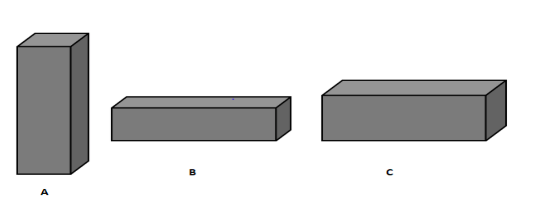
A brick is kept in three different ways on a table, as shown in the figure. The pressure exerted by the brick on the table will be
A. maximum position in A
B. maximum position in B
C. maximum position in C
D. equal in all cases
Answer
 Verified
634.2k+ views
Hint:We know that pressure is defined as the force applied perpendicular to an object's surface per unit area. It is a scalar quantity. The unit of pressure is Pascal (Pa).
The mathematical formula for pressure:
${\rm{P}}\;{\rm{ = }}\;\dfrac{{\rm{F}}}{{\rm{A}}}$
Where P is Pressure, F is applied force, and A represents an area of cross-section.
Complete step by step answer:
From the above definition, it is clear that pressure acts as a force per unit area. When we apply a brick A force, the pressure exerted by the brick is more on the table because the area is minimum. Still, in the case of B, when we apply pressure on brick B, it exerts less pressure as comparative to A because the surface area of brick is more; at last, when we applied force on brick C, it exerts very- very less pressure as comparative both A and B brick because the surface area of brick C increases double.
Therefore, the pressure exerted by the brick on the table maximum at position A.
Hence the correct option is (A).
Note:As pressure is the scalar quantity, it has no direction. When we apply pressure to a solid, it will be distributed over the object's area and become less. Also, the negative gradient of pressure is called force density. Another unit of pressure is ${\rm{N/}}{{\rm{m}}^2}$.
The mathematical formula for pressure:
${\rm{P}}\;{\rm{ = }}\;\dfrac{{\rm{F}}}{{\rm{A}}}$
Where P is Pressure, F is applied force, and A represents an area of cross-section.
Complete step by step answer:
From the above definition, it is clear that pressure acts as a force per unit area. When we apply a brick A force, the pressure exerted by the brick is more on the table because the area is minimum. Still, in the case of B, when we apply pressure on brick B, it exerts less pressure as comparative to A because the surface area of brick is more; at last, when we applied force on brick C, it exerts very- very less pressure as comparative both A and B brick because the surface area of brick C increases double.
Therefore, the pressure exerted by the brick on the table maximum at position A.
Hence the correct option is (A).
Note:As pressure is the scalar quantity, it has no direction. When we apply pressure to a solid, it will be distributed over the object's area and become less. Also, the negative gradient of pressure is called force density. Another unit of pressure is ${\rm{N/}}{{\rm{m}}^2}$.
Recently Updated Pages
Basicity of sulphurous acid and sulphuric acid are

Master Class 11 English: Engaging Questions & Answers for Success
Master Class 11 Physics: Engaging Questions & Answers for Success
Master Class 11 Computer Science: Engaging Questions & Answers for Success
Master Class 11 Chemistry: Engaging Questions & Answers for Success
Master Class 11 Social Science: Engaging Questions & Answers for Success
Trending doubts
Difference Between Prokaryotic Cells and Eukaryotic Cells
Two of the body parts which do not appear in MRI are class 11 biology CBSE
One Metric ton is equal to kg A 10000 B 1000 C 100 class 11 physics CBSE
10 examples of friction in our daily life
Draw a diagram of nephron and explain its structur class 11 biology CBSE
What will happen if the mucus is not secreted by the class 11 biology CBSE