




A body of mass M is kept on a rough horizontal surface (friction coefficient\[\mu \]). A person is trying to pull the body by applying a horizontal force but the body is not moving. The force by the horizontal surface on the surface of the body is F, where
\[A.\,F=Mg\]
\[B.\,F=\mu MgF\]
\[C.\,Mg\le f\le Mg\sqrt{1+{{\mu }^{2}}}\]
\[D.\,Mg\ge f\ge Mg\sqrt{1+{{\mu }^{2}}}\]
Answer
 Verified
589.5k+ views
Hint: The question is based on the concept of the force acting on the body. So we will make use of the free body diagram to solve this type of question. We will solve the given problem using the formulae of the forces acting on the body, such as the normal force and the frictional force.
Formula used:
\[\begin{align}
& N=mg \\
& {{f}_{s}}=\mu N \\
\end{align}\]
Complete step by step solution:
The free body diagram of the mass M kept on a rough horizontal surface is given as follows.
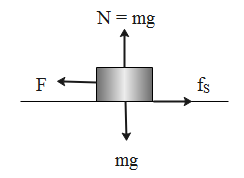
The normal force acting on the body is given as follows.
\[N=ma\]
Where m is the mass of the body and a is the acceleration of the body.
The frictional force acting on the body is given as follows.
\[{{f}_{s}}=\mu N\]
Where \[\mu \] is the coefficient of friction and N is the normal force acting on the body.
From the free body diagram of the mass M kept on a rough horizontal surface, it’s clear that the horizontal forces acting on the body is the resultant of the force and the frictional force.
\[\begin{align}
& f=\sqrt{{{(Mg)}^{2}}+{{(\mu Mg)}^{2}}} \\
& f=Mg\sqrt{1+{{\mu }^{2}}} \\
\end{align}\]
This force will be lying between that of the normal force and the frictional force. Thus, this can be expressed in the mathematical form as follows.
\[Mg\le f\le Mg\sqrt{1+{{\mu }^{2}}}\]
\[\therefore \] The force by the horizontal surface on the surface of the body is F, where \[Mg\le f\le Mg\sqrt{1+{{\mu }^{2}}}\].
As, the force, \[Mg\le f\le Mg\sqrt{1+{{\mu }^{2}}}\]
So, the correct answer is “Option C”.
Note: Using a free body diagram makes it easy to solve this type of question by understanding the forces acting on the body and the directions of the force. The units of the parameters should be taken care of.
Formula used:
\[\begin{align}
& N=mg \\
& {{f}_{s}}=\mu N \\
\end{align}\]
Complete step by step solution:
The free body diagram of the mass M kept on a rough horizontal surface is given as follows.
The normal force acting on the body is given as follows.
\[N=ma\]
Where m is the mass of the body and a is the acceleration of the body.
The frictional force acting on the body is given as follows.
\[{{f}_{s}}=\mu N\]
Where \[\mu \] is the coefficient of friction and N is the normal force acting on the body.
From the free body diagram of the mass M kept on a rough horizontal surface, it’s clear that the horizontal forces acting on the body is the resultant of the force and the frictional force.
\[\begin{align}
& f=\sqrt{{{(Mg)}^{2}}+{{(\mu Mg)}^{2}}} \\
& f=Mg\sqrt{1+{{\mu }^{2}}} \\
\end{align}\]
This force will be lying between that of the normal force and the frictional force. Thus, this can be expressed in the mathematical form as follows.
\[Mg\le f\le Mg\sqrt{1+{{\mu }^{2}}}\]
\[\therefore \] The force by the horizontal surface on the surface of the body is F, where \[Mg\le f\le Mg\sqrt{1+{{\mu }^{2}}}\].
As, the force, \[Mg\le f\le Mg\sqrt{1+{{\mu }^{2}}}\]
So, the correct answer is “Option C”.
Note: Using a free body diagram makes it easy to solve this type of question by understanding the forces acting on the body and the directions of the force. The units of the parameters should be taken care of.
Recently Updated Pages
Master Class 11 Social Science: Engaging Questions & Answers for Success

Master Class 11 Physics: Engaging Questions & Answers for Success
Master Class 11 Maths: Engaging Questions & Answers for Success
Master Class 11 Economics: Engaging Questions & Answers for Success
Master Class 11 Computer Science: Engaging Questions & Answers for Success
Master Class 11 Chemistry: Engaging Questions & Answers for Success
Trending doubts
One Metric ton is equal to kg A 10000 B 1000 C 100 class 11 physics CBSE
There are 720 permutations of the digits 1 2 3 4 5 class 11 maths CBSE
1 Quintal is equal to a 110 kg b 10 kg c 100kg d 1000 class 11 physics CBSE
State and prove Bernoullis theorem class 11 physics CBSE
Difference Between Prokaryotic Cells and Eukaryotic Cells
Which among the following are examples of coming together class 11 social science CBSE