




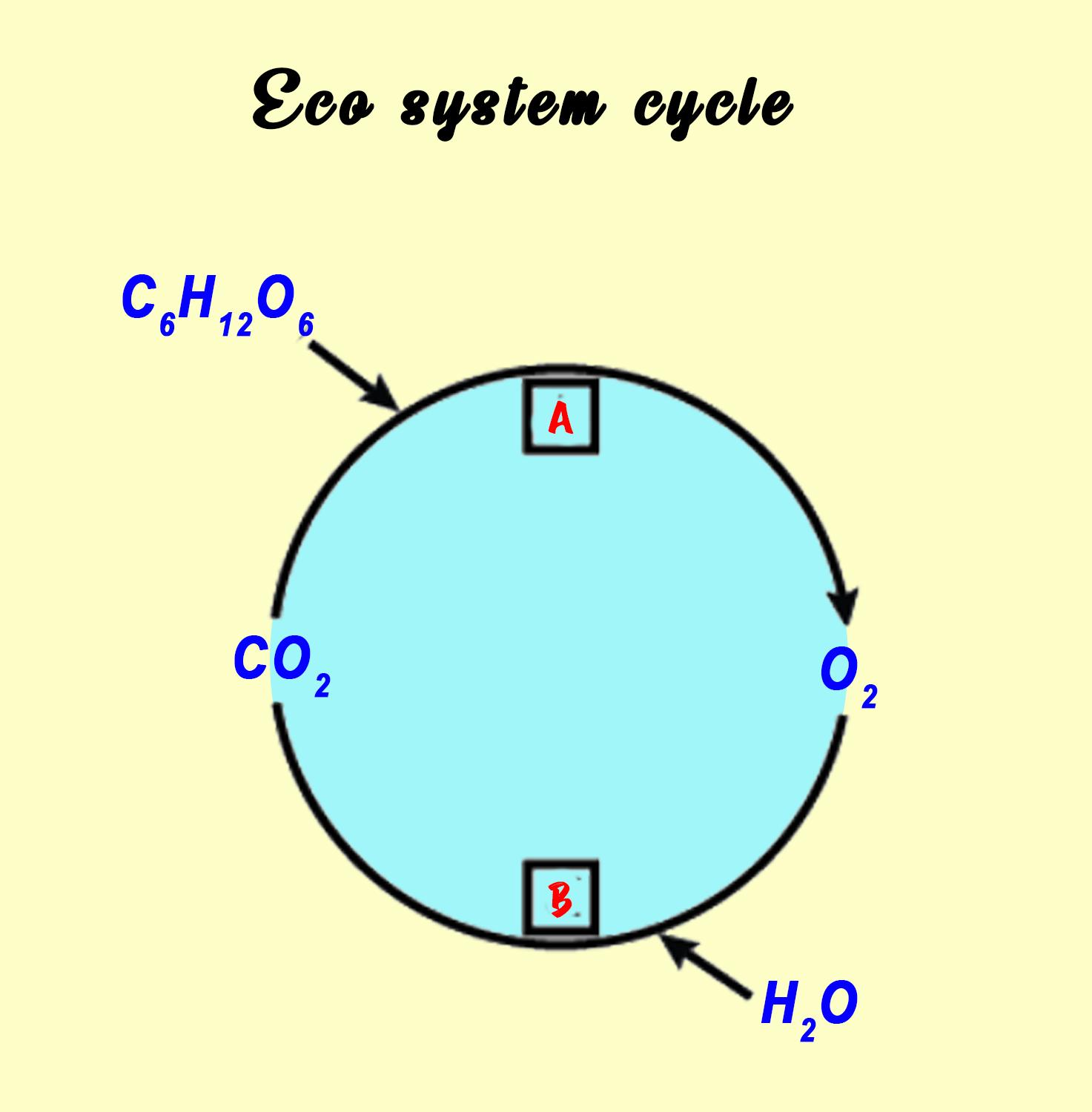
A and B are the different biotic factors of the ecosystem. Complete the cycle by naming them
Answer
 Verified
635.1k+ views
Hint: plants produce carbohydrates and release oxygen using carbon dioxide. Herbivores, carnivores, and omnivores breath in oxygen and exhale carbon dioxide.
Complete answer:
Plants are the primary producers in an ecosystem. They produce carbohydrates and release oxygen into the atmosphere by the process of photosynthesis.
Green plants in presence of sunlight and chlorophyll using water and carbon dioxide to produce carbohydrates and oxygen. This process is called photosynthesis.
The food produced by the plants is consumed by the organisms present in the second trophic level of the food chain which includes herbivores and omnivores.
They utilize oxygen released by the plants for respiration and release carbon dioxide. This released carbon dioxide is again utilized by the plants for photosynthesis. This cycle continues as long as produces and consumers present on the earth
In the ecosystem cycle, A represents consumers i.e, herbivores, carnivores, and omnivores. B represents producers i.e, plants.
Additional information:
Along with plants some of the microorganisms also perform photosynthesis. For example, blue-green algae are also called cyanobacteria.
It also contains a pigment that is responsible for photosynthesis that is present in plants called chlorophyll.
During the process of photosynthesis, oxygen is released from the reduction of water molecules. The release of oxygen during photosynthesis depends on the hydrogen donor.
If the hydrogen donor is a water molecule the organism releases oxygen
The complete equation of photosynthesis is:
${ 6Co }_{ 2 }+{ 12H }_{ 2 }O\xrightarrow { sunlight } { C }_{ 6 }{ H }_{ 12 }{ O }_{ 6 }+{ 6H }_{ 2 }O+{ 6O }_{ 2 }$
Note:
-There are four trophic levels in the ecosystem.
-Plants occupy the first trophic level, herbivores, carnivores occupy the second, third, fourth, and fifth trophic levels respectively.
Complete answer:
Plants are the primary producers in an ecosystem. They produce carbohydrates and release oxygen into the atmosphere by the process of photosynthesis.
Green plants in presence of sunlight and chlorophyll using water and carbon dioxide to produce carbohydrates and oxygen. This process is called photosynthesis.
The food produced by the plants is consumed by the organisms present in the second trophic level of the food chain which includes herbivores and omnivores.
They utilize oxygen released by the plants for respiration and release carbon dioxide. This released carbon dioxide is again utilized by the plants for photosynthesis. This cycle continues as long as produces and consumers present on the earth
In the ecosystem cycle, A represents consumers i.e, herbivores, carnivores, and omnivores. B represents producers i.e, plants.
Additional information:
Along with plants some of the microorganisms also perform photosynthesis. For example, blue-green algae are also called cyanobacteria.
It also contains a pigment that is responsible for photosynthesis that is present in plants called chlorophyll.
During the process of photosynthesis, oxygen is released from the reduction of water molecules. The release of oxygen during photosynthesis depends on the hydrogen donor.
If the hydrogen donor is a water molecule the organism releases oxygen
The complete equation of photosynthesis is:
${ 6Co }_{ 2 }+{ 12H }_{ 2 }O\xrightarrow { sunlight } { C }_{ 6 }{ H }_{ 12 }{ O }_{ 6 }+{ 6H }_{ 2 }O+{ 6O }_{ 2 }$
Note:
-There are four trophic levels in the ecosystem.
-Plants occupy the first trophic level, herbivores, carnivores occupy the second, third, fourth, and fifth trophic levels respectively.
Recently Updated Pages
Which of the following graphs shows the variation of class 12 physics CBSE

Draw a labelled diagram of the human male reproductive class 12 biology CBSE
Describe the experiment to compare the emf of two cells class 12 physics CBSE
What is standard hydrogen electrode
What is conventional current and electric current class 12 physics CBSE
2Bromopentane is treated with an alcoholic KOH solution class 12 chemistry CBSE
Trending doubts
Draw a labelled sketch of the human eye class 12 physics CBSE
Which are the Top 10 Largest Countries of the World?
Differentiate between homogeneous and heterogeneous class 12 chemistry CBSE
Draw ray diagrams each showing i myopic eye and ii class 12 physics CBSE
Which is the correct genotypic ratio of mendel dihybrid class 12 biology CBSE
What is the Full Form of PVC, PET, HDPE, LDPE, PP and PS ?