




A 10 kg boy standing in a 40 kg boat floating on water is 20 meters from the shore of the river. If he moves 8 meters on the boat towards the shore, then how far is he from the shore now?
Answer
 Verified
582.9k+ views
Hint: In this question, we need to determine the distance of the boy from the shore when he moved towards the shore by 8 meters. For this, we will follow the concept of momentum.
Complete step by step answer:Let the boy was standing at the farthest end of the boat. As the boat was in the water so, when the boy towards the shore (by 8 meters) then, the boat will also move in the opposite direction of the movement of the boy, i.e., away from the shore.
The following figure depicts the pictorial representation of the scenario.
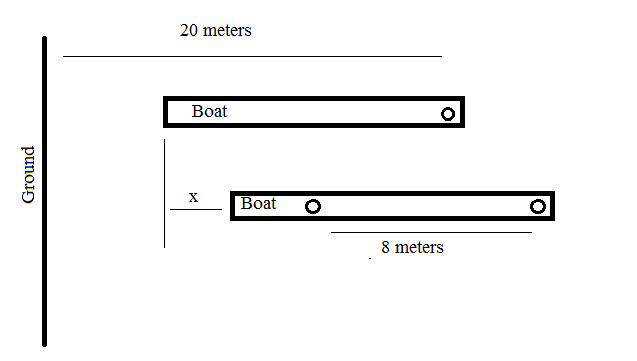
Let the boat moves back by $x$ meters away from the shore.
As the system was at rest initially, so the momentum of the whole system will remain constant. Moreover, there is no additional mass on the boat so the momentum will remain the same.
The product of the mass and the displacement of the body results in the momentum of the body. Mathematically, $M = mr$.
Substitute mass of the boat as 40 kg and the displacement as x meters in the equation $M = mr$.
Here, the momentum of the boat is given as ${m_1}{r_1} = 40x - - - - (i)$
The displacement of the boy with respect to the boat is given as $(8 - x)$ meters.
So, substitute mass of the boy as 10 kg and the displacement of the boy as (8-x) meters in the equation $M = mr$.
Here, the momentum of the boy is given as
$
{m_2}{r_2} = 10 \times \left( {8 - x} \right) \\
= 80 - 10x \\
$
As the momentum is conserved here so,
$
{m_1}{r_1} = {m_2}{r_2} \\
40x = 80 - 10x \\
50x = 80 \\
x = \dfrac{8}{5} \\
= 1.6{\text{ meters}} \\
$
Now, the distance of the boy from the shore is given as
$
d = 20 - \left( {8 - x} \right) \\
= 20 - 8 + 1.6 \\
= 13.6{\text{ meters}} \\
$
Hence, the distance of the boy from the shore is 13.6 meters.
Note:It is interesting to note here that as the boy moves towards the shore then he pushes the boat with his feet away from the shore and so, the boat moves backward.
Complete step by step answer:Let the boy was standing at the farthest end of the boat. As the boat was in the water so, when the boy towards the shore (by 8 meters) then, the boat will also move in the opposite direction of the movement of the boy, i.e., away from the shore.
The following figure depicts the pictorial representation of the scenario.
Let the boat moves back by $x$ meters away from the shore.
As the system was at rest initially, so the momentum of the whole system will remain constant. Moreover, there is no additional mass on the boat so the momentum will remain the same.
The product of the mass and the displacement of the body results in the momentum of the body. Mathematically, $M = mr$.
Substitute mass of the boat as 40 kg and the displacement as x meters in the equation $M = mr$.
Here, the momentum of the boat is given as ${m_1}{r_1} = 40x - - - - (i)$
The displacement of the boy with respect to the boat is given as $(8 - x)$ meters.
So, substitute mass of the boy as 10 kg and the displacement of the boy as (8-x) meters in the equation $M = mr$.
Here, the momentum of the boy is given as
$
{m_2}{r_2} = 10 \times \left( {8 - x} \right) \\
= 80 - 10x \\
$
As the momentum is conserved here so,
$
{m_1}{r_1} = {m_2}{r_2} \\
40x = 80 - 10x \\
50x = 80 \\
x = \dfrac{8}{5} \\
= 1.6{\text{ meters}} \\
$
Now, the distance of the boy from the shore is given as
$
d = 20 - \left( {8 - x} \right) \\
= 20 - 8 + 1.6 \\
= 13.6{\text{ meters}} \\
$
Hence, the distance of the boy from the shore is 13.6 meters.
Note:It is interesting to note here that as the boy moves towards the shore then he pushes the boat with his feet away from the shore and so, the boat moves backward.
Recently Updated Pages
Master Class 11 Computer Science: Engaging Questions & Answers for Success

Master Class 11 Business Studies: Engaging Questions & Answers for Success
Master Class 11 Economics: Engaging Questions & Answers for Success
Master Class 11 English: Engaging Questions & Answers for Success
Master Class 11 Maths: Engaging Questions & Answers for Success
Master Class 11 Biology: Engaging Questions & Answers for Success
Trending doubts
One Metric ton is equal to kg A 10000 B 1000 C 100 class 11 physics CBSE
There are 720 permutations of the digits 1 2 3 4 5 class 11 maths CBSE
Discuss the various forms of bacteria class 11 biology CBSE
Draw a diagram of a plant cell and label at least eight class 11 biology CBSE
State the laws of reflection of light
10 examples of friction in our daily life