



Class 8 Maths Ganita Prakash Part 2 Chapter 2 The Baudhayana-Pythagoras Theorem NCERT Solutions - FREE PDF Download
2.1 Doubling A Square, 2.2 Halving A Square & 2.3 Hypotenuse of an Isosceles Right Triangle
Figure It Out (Pages 39-40)
Question 1. Earlier, we saw a method to create a square with double the area of a given square piece of paper. There is another method to do this in which two identical square papers are cut in the following way.
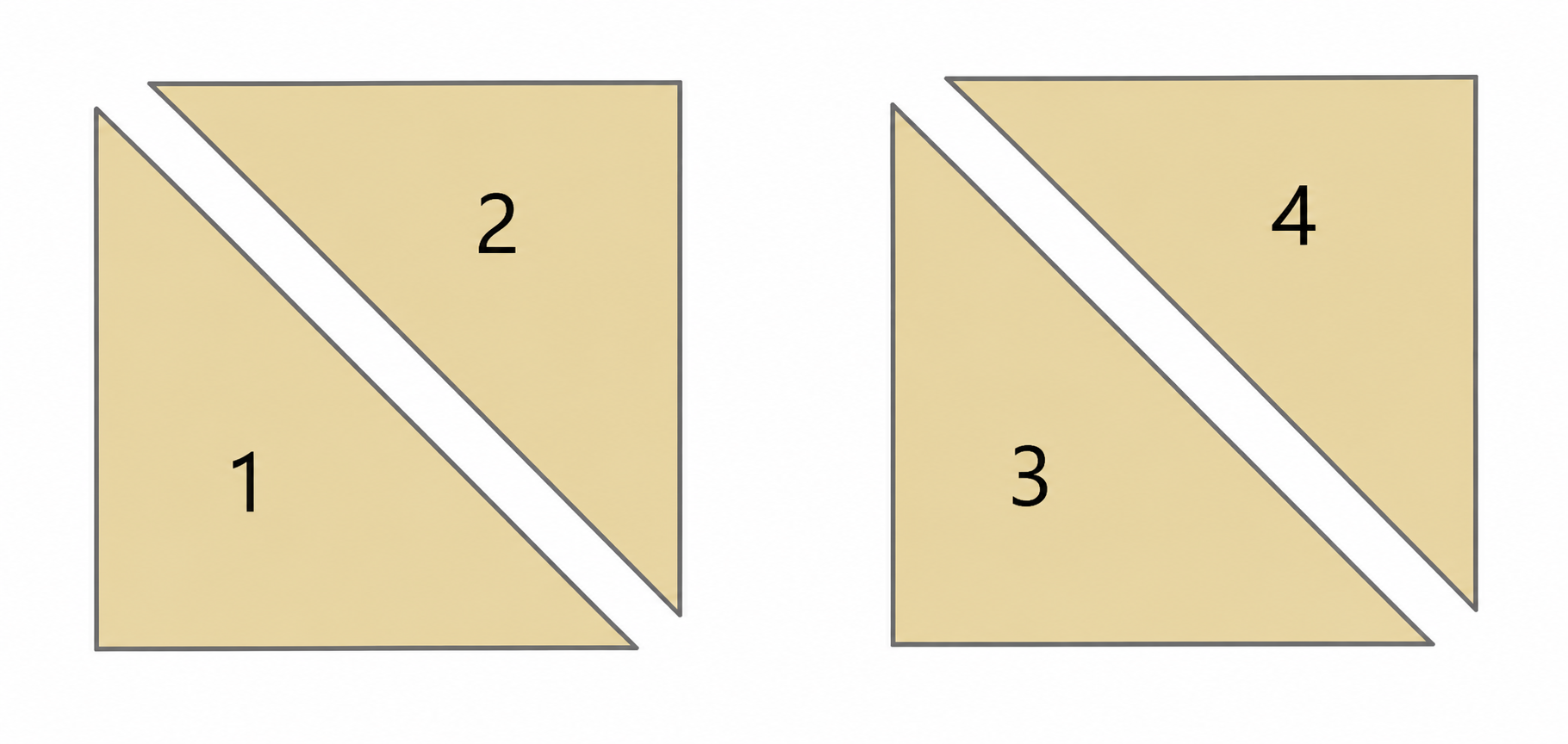
Can you arrange these pieces to create a square with double the area of either square?
Solution:
Take two identical square sheets, each having side a.
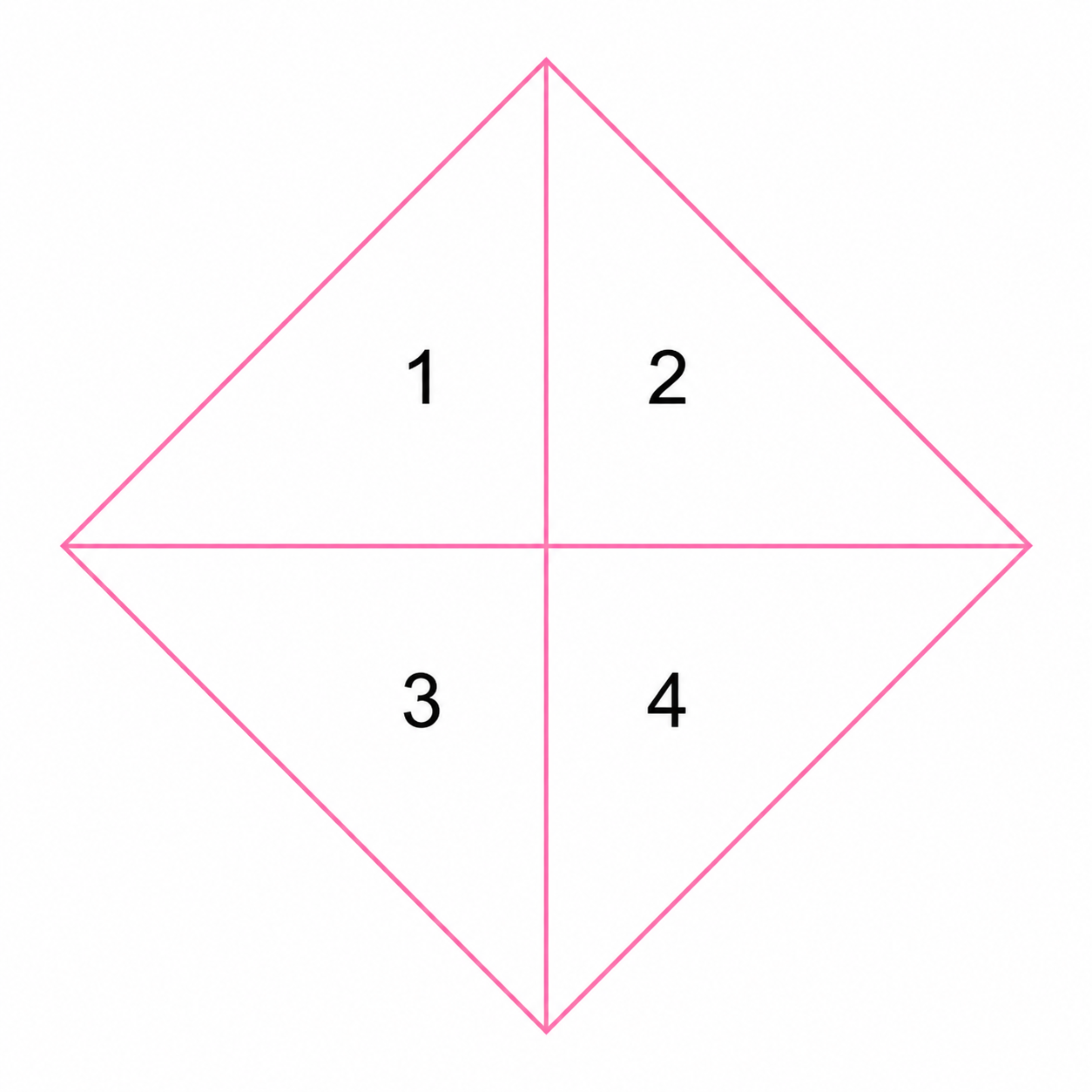
Cut each square along its diagonal. Each square will be divided into two congruent right-angled isosceles triangles.
Thus, the two squares give four identical triangles.
Area of one original square = a²
Area of two original squares = 2a²
Now arrange the four triangles so that their equal sides form the outer boundary of a new square. Since all four triangles together have the same total area as the two original squares, the area of the newly formed square is:
2a²
Therefore, the new square has twice the area of either of the original squares.
Question 2. The length of the two equal sides of an isosceles right triangle is given. Find the length of the hypotenuse. Find bounds on the length of the hypotenuse such that they have at least one digit after the decimal point.
(i) 3
(ii) 4
(iii) 6
(iv) 8
(v) 9
Solution:
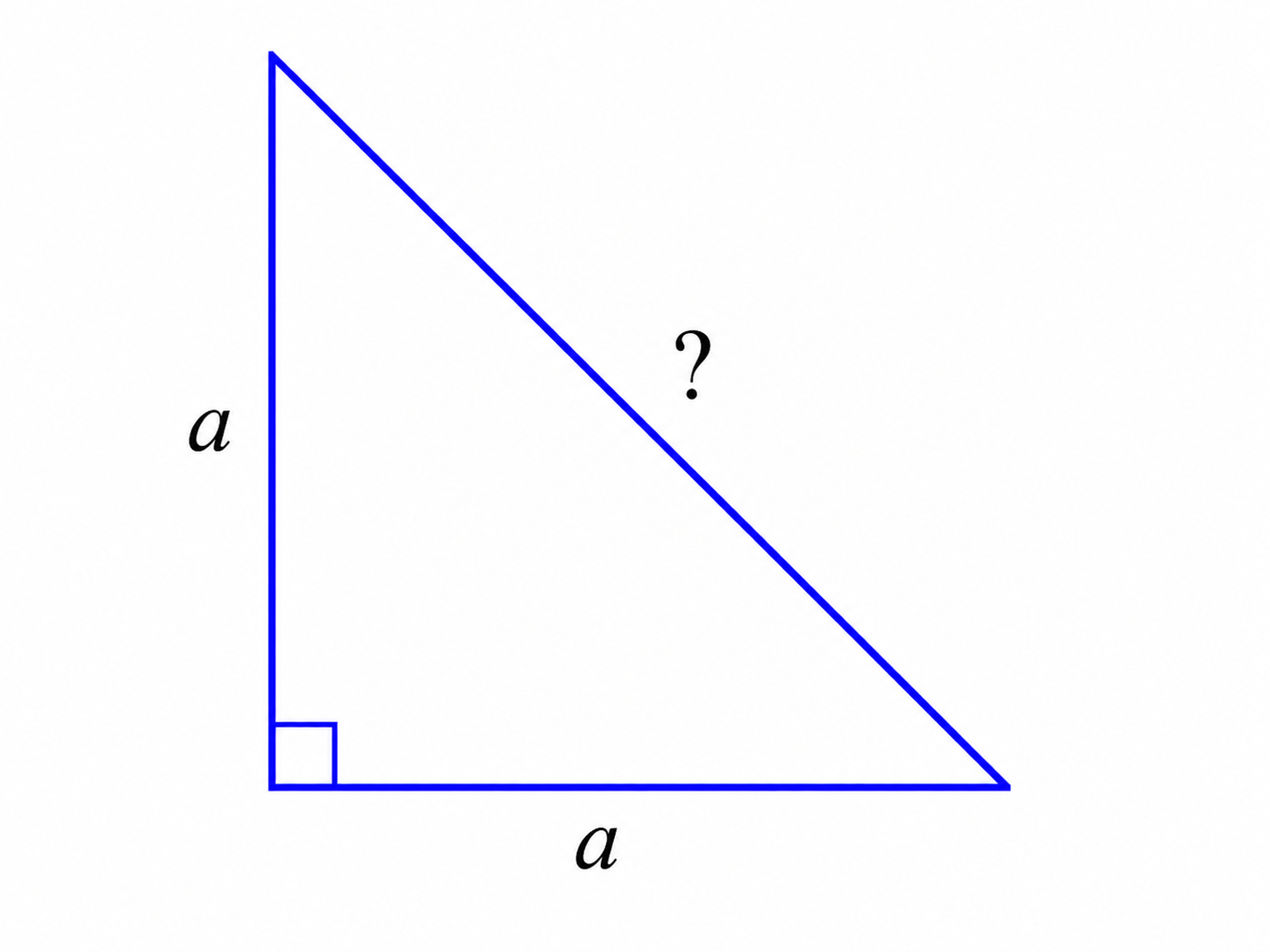
Let the length of each equal side be a.
Using the Baudhayana-Pythagoras Theorem:
Hypotenuse² = a² + a²
Hypotenuse² = 2a²
Hypotenuse = a√2
(i) a = 3
Hypotenuse = 3√2
= √18
Since:
4.2² = 17.64
4.3² = 18.49
Therefore:
4.2 < √18 < 4.3
Hence:
4.2 < 3√2 < 4.3
The hypotenuse is approximately 4.24 units.
(ii) a = 4
Hypotenuse = 4√2
= √32
Since:
5.6² = 31.36
5.7² = 32.49
Therefore:
5.6 < √32 < 5.7
Hence:
5.6 < 4√2 < 5.7
The hypotenuse is approximately 5.66 units.
(iii) a = 6
Hypotenuse = 6√2
= √72
Since:
8.4² = 70.56
8.5² = 72.25
Therefore:
8.4 < √72 < 8.5
Hence:
8.4 < 6√2 < 8.5
The hypotenuse is approximately 8.49 units.
(iv) a = 8
Hypotenuse = 8√2
= √128
Since:
11.3² = 127.69
11.4² = 129.96
Therefore:
11.3 < √128 < 11.4
Hence:
11.3 < 8√2 < 11.4
The hypotenuse is approximately 11.31 units.
(v) a = 9
Hypotenuse = 9√2
= √162
Since:
12.7² = 161.29
12.8² = 163.84
Therefore:
12.7 < √162 < 12.8
Hence:
12.7 < 9√2 < 12.8
The hypotenuse is approximately 12.73 units.
Question 3. The hypotenuse of an isosceles right triangle is 10. What are its other two side lengths?
[Hint: Find the area of the square composed of two such right triangles.]
Solution:
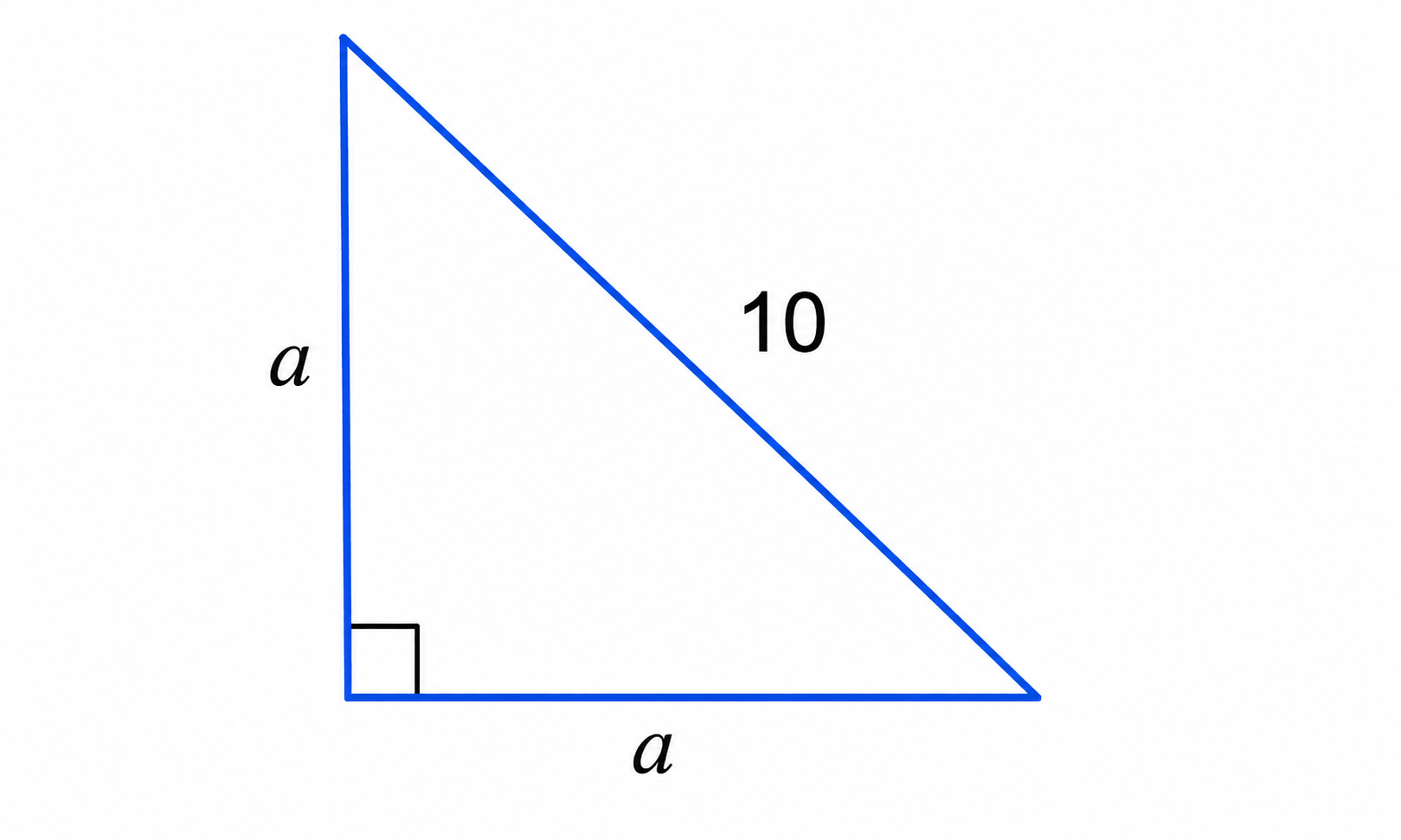
Let each of the two equal sides be a.
Using the Baudhayana-Pythagoras Theorem:
a² + a² = 10²
2a² = 100
a² = 50
a = √50
a = √(25 × 2)
a = 5√2
Therefore, the other two sides are:
5√2 units and 5√2 units
Each side is approximately 7.07 units long.
2.4 Combining Two Different Squares
Figure It Out (Page 47)
Question 1. If a right-angled triangle has shorter sides of lengths 5 cm and 12 cm, then what is the length of its hypotenuse? First, draw the right-angled triangle with these sidelengths and measure the hypotenuse, then check your answer using Baudhayana’s Theorem.
Solution:
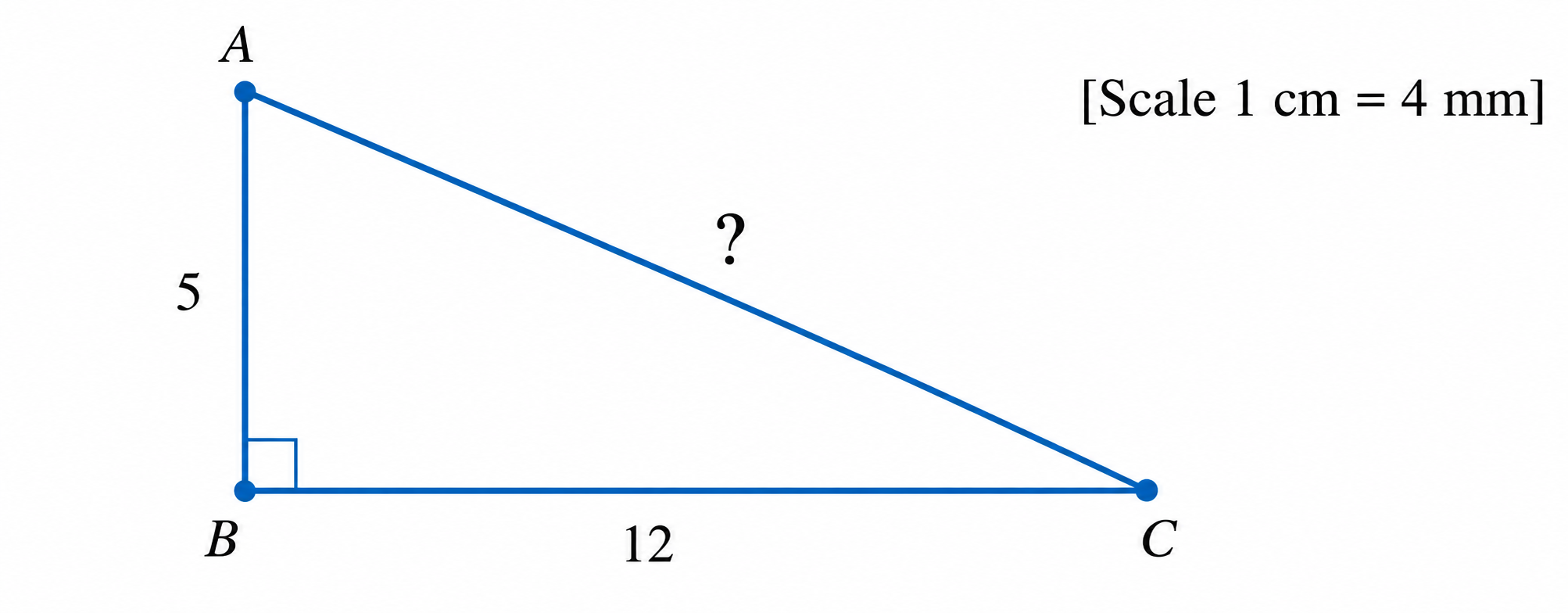
The two shorter sides are:
AB = 5 cm
BC = 12 cm
Let AC be the hypotenuse.
Using Baudhayana’s Theorem:
AC² = AB² + BC²
AC² = 5² + 12²
AC² = 25 + 144
AC² = 169
AC = √169
AC = 13 cm
Therefore, the hypotenuse of the right-angled triangle is 13 cm.
Question 2. If a right-angled triangle has a short side of length 8 cm and a hypotenuse of length 17 cm, what is the length of the third side? Again, try drawing the triangle and measuring, and then check your answer using Baudhayana’s Theorem.
Solution:
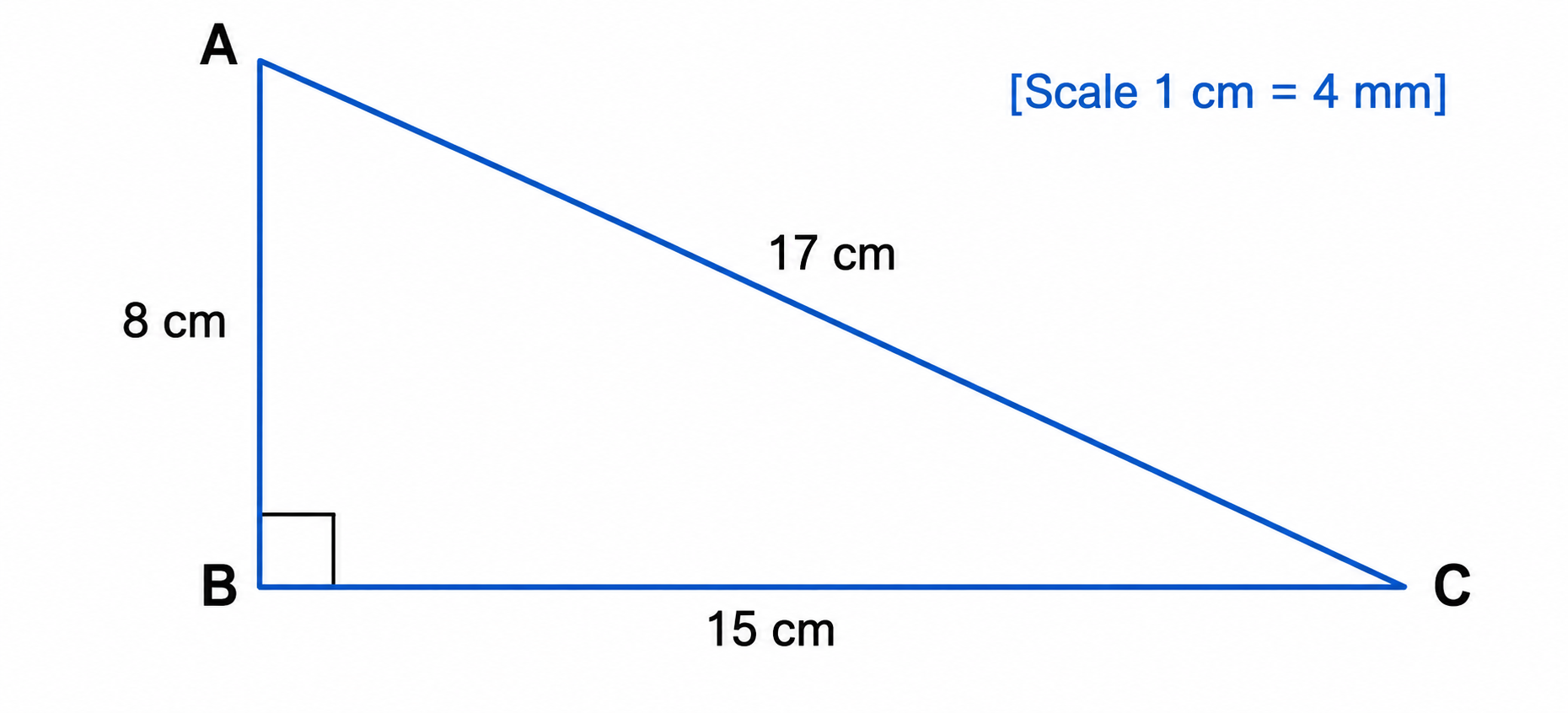
Given:
One shorter side = 8 cm
Hypotenuse = 17 cm
Let the third side be x cm.
Using Baudhayana’s Theorem:
8² + x² = 17²
64 + x² = 289
x² = 289 − 64
x² = 225
x = √225
x = 15 cm
Therefore, the third side of the right-angled triangle is 15 cm.
Verification:
8² + 15² = 64 + 225 = 289 = 17²
Question 3. Using the constructions you have now seen, how would you construct a square whose area is triple the area of a given square? Five times the area of a given square? (Baudhayana’s Sulba-Sutra, Verse 1.10)
Solution:
Let the side of the given square be a.
Its area is:
a²
(a) Construction of a square with triple the area
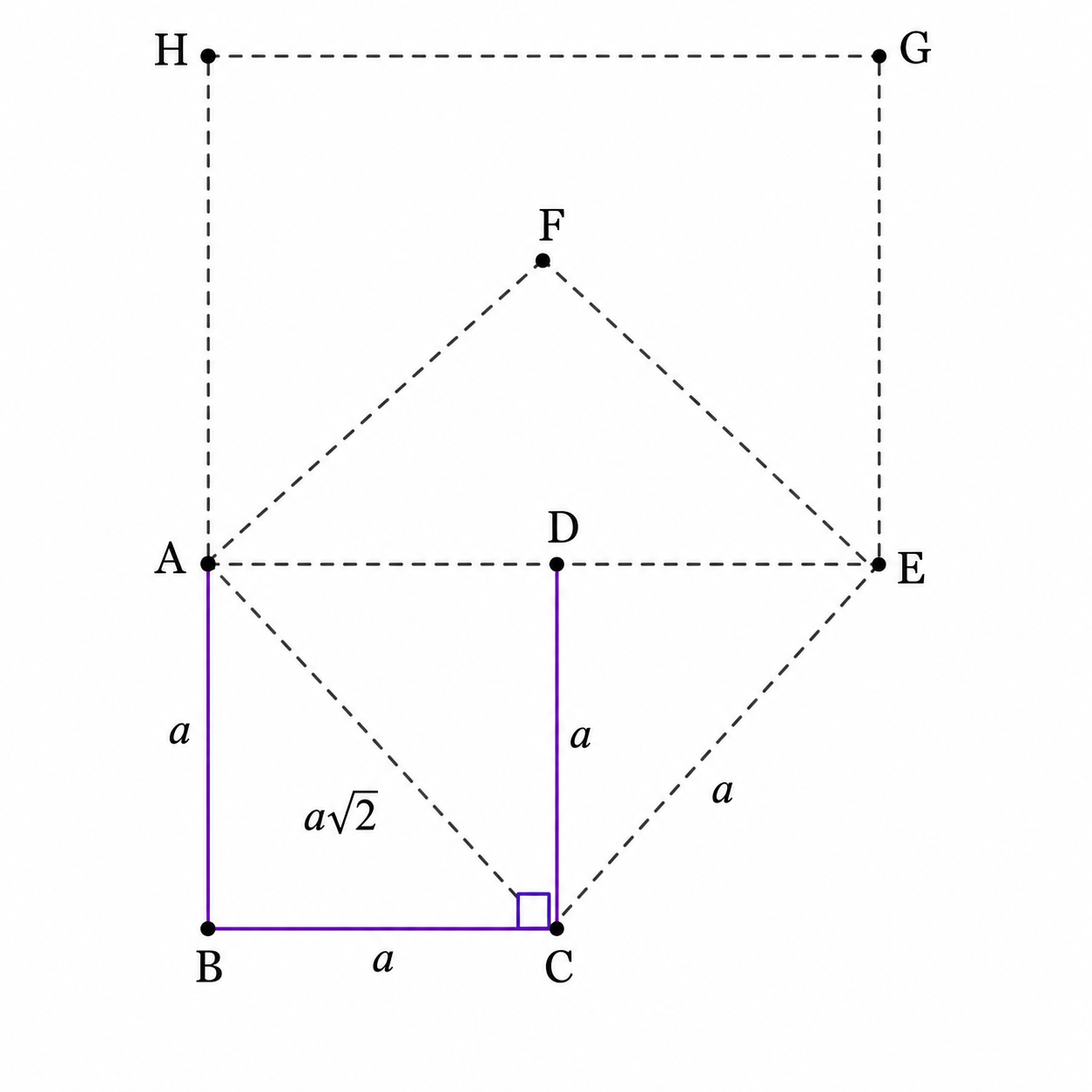
First, construct a square ABCD of side a.
Its diagonal is:
AC = √(a² + a²)
AC = a√2
Now construct a right-angled triangle with perpendicular sides of length a√2 and a.
Let its hypotenuse be AE.
Using Baudhayana’s Theorem:
AE² = (a√2)² + a²
AE² = 2a² + a²
AE² = 3a²
AE = a√3
Now construct a square with a side of√3.
Area of the new square:
= (a√3)²
= 3a²
Therefore, the new square has three times the area of the original square.
(b) Construction of a square with five times the area
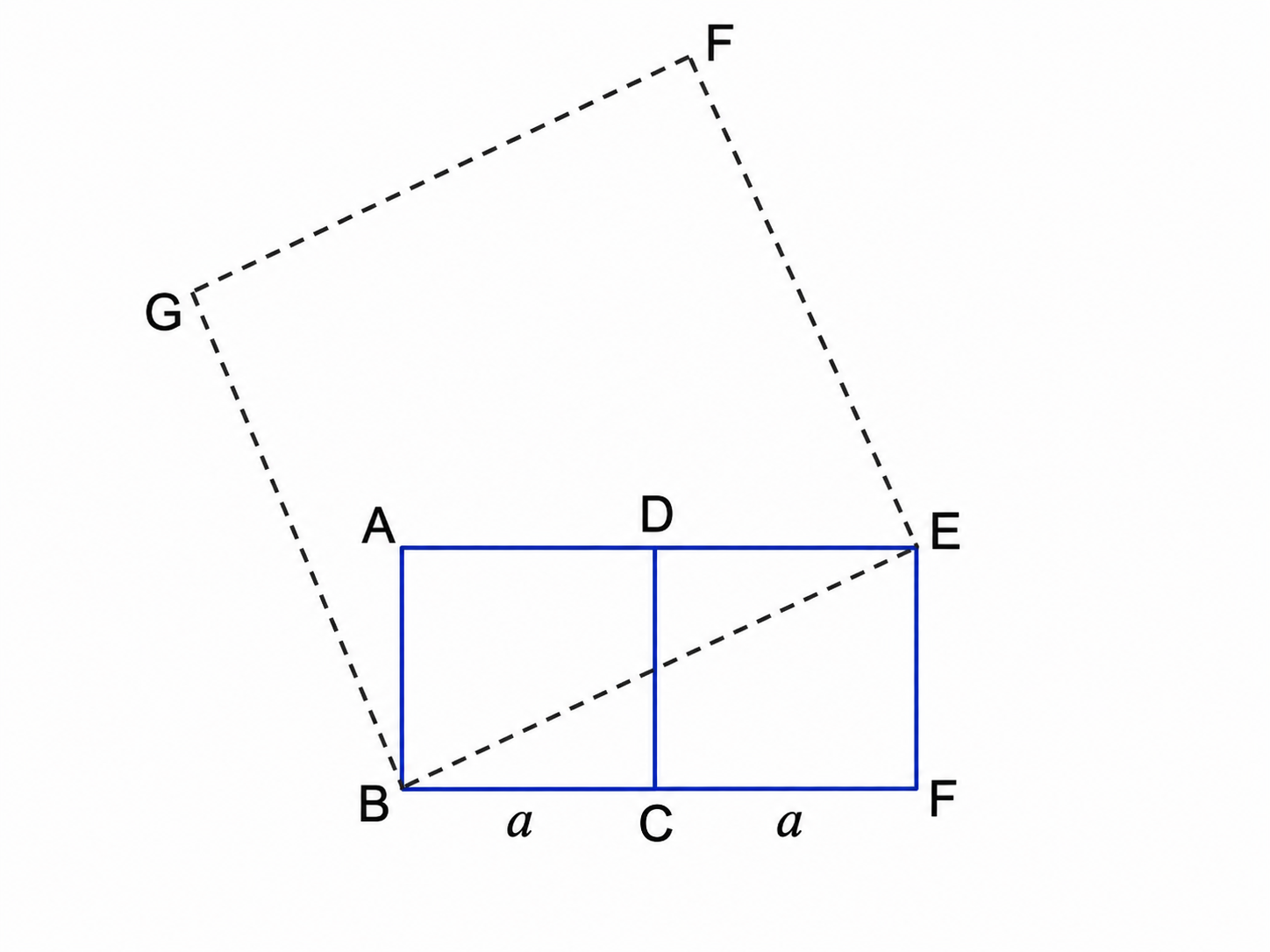
Construct a rectangle whose length is 2a and breadth is a.
Let its diagonal be d.
Using Baudhayana’s Theorem:
d² = (2a)² + a²
d² = 4a² + a²
d² = 5a²
d = a√5
Now construct a square with a side a√5.
Area of the new square:
= (a√5)²
= 5a²
Therefore, the new square has five times the area of the original square.
Question 4. Let a, b, and c denote the lengths of the sides of a right triangle, with c being the length of the hypotenuse. Find the missing side length in each of the following cases:
(i) a = 5, b = 7
(ii) a = 8, b = 12
(iii) a = 9, c = 15
(iv) a = 7, b = 12
(v) a = 1.5, b = 3.5
Solution:
Using Baudhayana’s Theorem:
c² = a² + b²
(i) a = 5, b = 7
c² = 5² + 7²
c² = 25 + 49
c² = 74
c = √74
Therefore, the missing side is √74 units, approximately 8.60 units.
(ii) a = 8, b = 12
c² = 8² + 12²
c² = 64 + 144
c² = 208
c = √208
c = √(16 × 13)
c = 4√13
Therefore, the missing side is 4√13 units, approximately 14.42 units.
(iii) a = 9, c = 15
Using:
c² = a² + b²
15² = 9² + b²
225 = 81 + b²
b² = 225 − 81
b² = 144
b = √144
b = 12
Therefore, the missing side is 12 units.
(iv) a = 7, b = 12
c² = 7² + 12²
c² = 49 + 144
c² = 193
c = √193
Therefore, the missing side is √193 units, approximately 13.89 units.
(v) a = 1.5, b = 3.5
c² = 1.5² + 3.5²
c² = 2.25 + 12.25
c² = 14.5
c = √14.5
Therefore, the missing side is √14.5 units, approximately 3.81 units.
2.5 Right-Triangles Having Integer Sidelengths
Figure It Out (Page 50)
Question 1. Find 5 more Baudhayana triples using this idea.
Solution:
A Baudhayana triple consists of three positive integers a, b and c satisfying:
a² + b² = c²
Using the pattern in which one shorter side is an odd number n, the other shorter side is:
(n² − 1)/2
and the hypotenuse is:
(n² + 1)/2
Five Baudhayana triples are:
1. For n = 7
Other side:
(7² − 1)/2
= (49 − 1)/2
= 24
Hypotenuse:
(7² + 1)/2
= (49 + 1)/2
= 25
Therefore:
24² + 7² = 25²
Triple: (7, 24, 25)
2. For n = 9
Other side:
(9² − 1)/2
= (81 − 1)/2
= 40
Hypotenuse:
(9² + 1)/2
= (81 + 1)/2
= 41
Therefore:
40² + 9² = 41²
Triple: (9, 40, 41)
3. For n = 11
Other side:
(11² − 1)/2
= (121 − 1)/2
= 60
Hypotenuse:
(11² + 1)/2
= (121 + 1)/2
= 61
Therefore:
60² + 11² = 61²
Triple: (11, 60, 61)
4. For n = 13
Other side:
(13² − 1)/2
= (169 − 1)/2
= 84
Hypotenuse:
(13² + 1)/2
= (169 + 1)/2
= 85
Therefore:
84² + 13² = 85²
Triple: (13, 84, 85)
5. For n = 15
Other side:
(15² − 1)/2
= (225 − 1)/2
= 112
Hypotenuse:
(15² + 1)/2
= (225 + 1)/2
= 113
Therefore:
112² + 15² = 113²
Triple: (15, 112, 113)
Hence, five more Baudhayana triples are:
(7, 24, 25)
(9, 40, 41)
(11, 60, 61)
(13, 84, 85)
(15, 112, 113)
Question 2. Does this method yield non-primitive Baudhayana triples?
[Hint: Observe that among the triples generated, one of the smaller sidelengths is one less than the hypotenuse.]
Solution:
A primitive Baudhayana triple is a triple in which the highest common factor of all three numbers is 1.
Consider the triples generated by this method:
(7, 24, 25)
HCF of 7, 24 and 25 = 1
(9, 40, 41)
HCF of 9, 40 and 41 = 1
(11, 60, 61)
HCF of 11, 60 and 61 = 1
In each triple, the longer leg and the hypotenuse are consecutive integers. Consecutive integers have no common factor other than 1.
Also, the odd side cannot share a common factor with both consecutive numbers.
Therefore, the triples obtained through this method are primitive Baudhayana triples.
Hence, this method does not produce non-primitive triples.
Question 3. Are there primitive triples that cannot be obtained through this method? If yes, give examples.
Solution:
Yes, there are primitive Baudhayana triples that cannot be obtained through this method.
In the method discussed earlier, an odd number n is selected and the triple is generated as:
n, (n² − 1)/2, (n² + 1)/2
In every triple produced by this method, one shorter side and the hypotenuse are consecutive integers.
For example:
For n = 7:
(7, 24, 25)
Here, 24 and 25 are consecutive integers.
However, consider the primitive triples:
(8, 15, 17)
8² + 15² = 64 + 225 = 289 = 17²
HCF of 8, 15 and 17 = 1
Therefore, it is a primitive triple. However, neither shorter side is one less than the hypotenuse.
Similarly:
(16, 63, 65)
16² + 63² = 256 + 3969 = 4225 = 65²
HCF of 16, 63 and 65 = 1
Therefore, it is also a primitive triple, but it cannot be generated using the given method.
Another example is:
(20, 21, 29)
20² + 21² = 400 + 441 = 841 = 29²
Thus, primitive triples such as (8, 15, 17), (16, 63, 65) and (20, 21, 29) cannot be obtained through this particular method.
2.6 A Long-Standing Open Problem, 2.7 Further Applications of the Baudhayana-Pythagoras Theorem
Figure It Out (Pages 52-54)
Question 1. Find the diagonal of a square with sidelength 5 cm.
Solution:
Let ABCD be a square with side 5 cm.
The diagonal BD divides the square into two right-angled triangles.
Using Baudhayana’s Theorem:
BD² = 5² + 5²
BD² = 25 + 25
BD² = 50
BD = √50
BD = √(25 × 2)
BD = 5√2 cm
Using √2 ≈ 1.414:
BD ≈ 5 × 1.414
BD ≈ 7.07 cm
Therefore, the diagonal of the square is 5√2 cm, or approximately 7.1 cm.
Question 2. Find the missing sidelengths in the following right triangles:
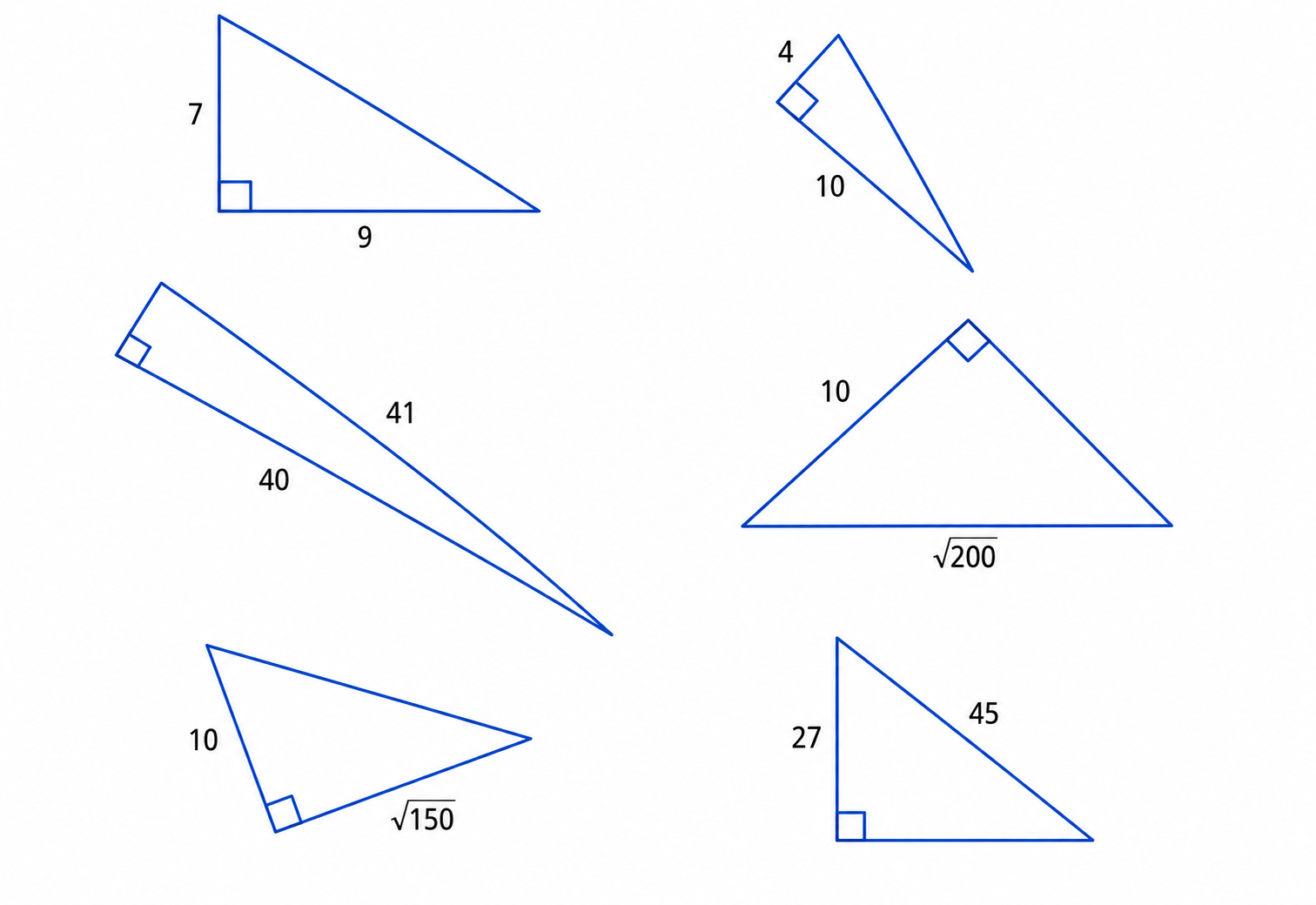
Solution:
(a)
The two perpendicular sides are 7 units and 9 units.
Using Baudhayana’s Theorem:
a² = 7² + 9²
a² = 49 + 81
a² = 130
a = √130
Therefore, the missing side is √130 units, approximately 11.40 units.
(b)
The two perpendicular sides are 4 units and 10 units.
Using Baudhayana’s Theorem:
b² = 4² + 10²
b² = 16 + 100
b² = 116
b = √116
b = √(4 × 29)
b = 2√29
Therefore, the missing side is 2√29 units, approximately 10.77 units.
(c)
The hypotenuse is 41 units and one shorter side is 40 units.
Using Baudhayana’s Theorem:
40² + c² = 41²
1600 + c² = 1681
c² = 1681 − 1600
c² = 81
c = √81
c = 9
Therefore, the missing side is 9 units.
(d)
The hypotenuse is √200 units and one shorter side is 10 units.
Using Baudhayana’s Theorem:
10² + d² = (√200)²
100 + d² = 200
d² = 200 − 100
d² = 100
d = √100
d = 10
Therefore, the missing side is 10 units.
(e)
The two perpendicular sides are 10 units and √150 units.
Using Baudhayana’s Theorem:
e² = 10² + (√150)²
e² = 100 + 150
e² = 250
e = √250
e = √(25 × 10)
e = 5√10
Therefore, the missing side is 5√10 units, approximately 15.81 units.
(f)
The hypotenuse is 45 units and one shorter side is 27 units.
Using Baudhayana’s Theorem:
27² + f² = 45²
729 + f² = 2025
f² = 2025 − 729
f² = 1296
f = √1296
f = 36
Therefore, the missing side is 36 units.
Question 3. Find the sidelength of a rhombus whose diagonals are of length 24 units and 70 units.
Solution:
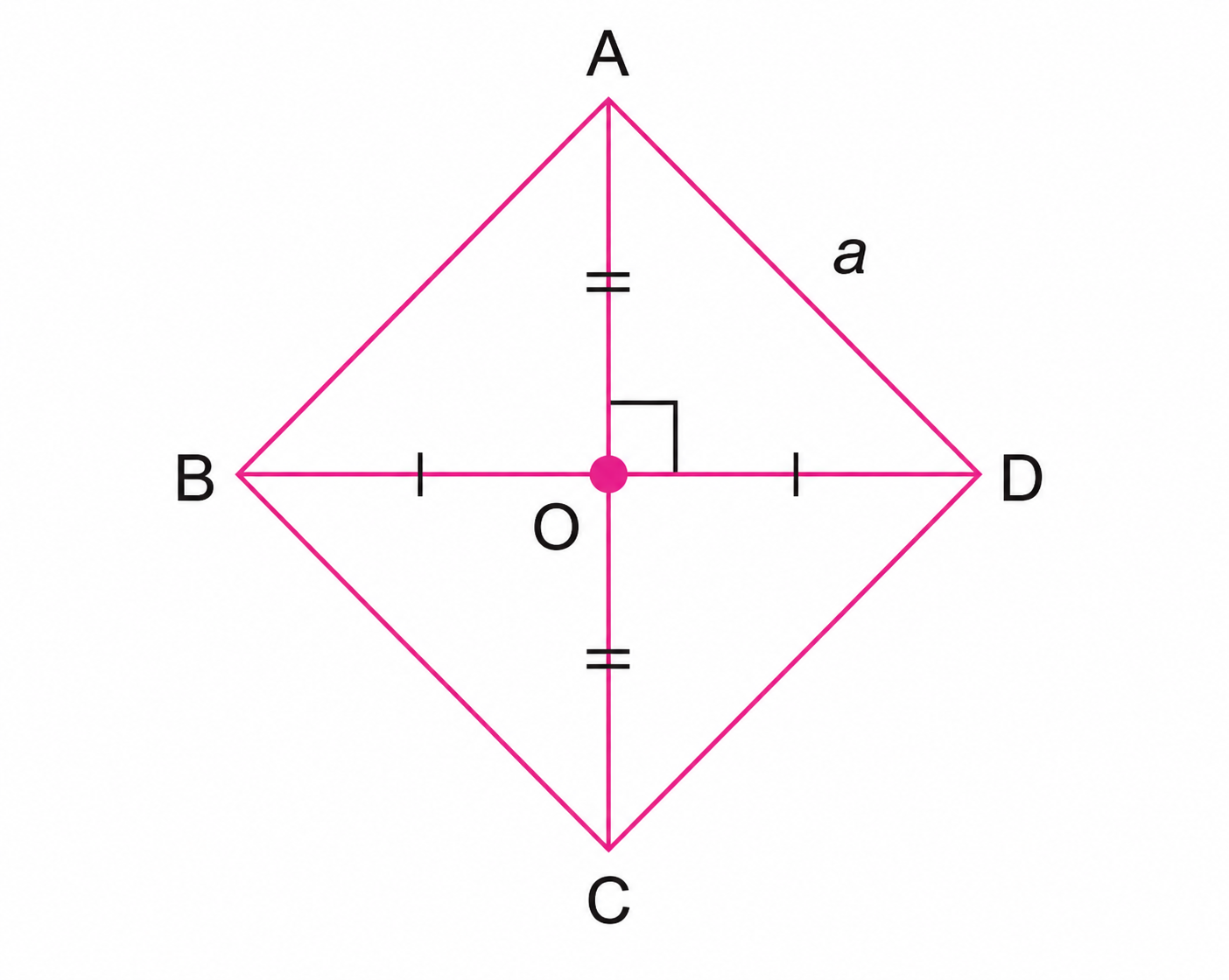
The diagonals of a rhombus bisect each other at right angles.
Let the diagonals intersect at O.
Half of the first diagonal:
OA = 24/2 = 12 units
Half of the second diagonal:
OD = 70/2 = 35 units
Triangle AOD is a right-angled triangle.
Let the side of the rhombus be a.
Using Baudhayana’s Theorem:
a² = OA² + OD²
a² = 12² + 35²
a² = 144 + 1225
a² = 1369
a = √1369
a = 37
Therefore, the side length of the rhombus is 37 units.
Question 4. Is the hypotenuse the longest side of a right triangle? Justify your answer.
Solution:
Yes, the hypotenuse is always the longest side of a right-angled triangle.
Let a and b be the two perpendicular sides and c be the hypotenuse.
According to Baudhayana’s Theorem:
c² = a² + b²
Since b² is positive:
c² > a²
Therefore:
c > a
Similarly, since a² is positive:
c² > b²
Therefore:
c > b
Thus, c is greater than both a and b.
Hence, the hypotenuse is the longest side of a right triangle.
Question 5. True or False — Every Baudhayana triple is either a primitive triple or a scaled version of a primitive triple.
Solution:
True.
Let (a, b, c) be a Baudhayana triple satisfying:
a² + b² = c²
Let the HCF of a, b and c be d.
Case 1: d = 1
If the HCF of a, b and c is 1, then the triple is a primitive Baudhayana triple.
For example:
(3, 4, 5)
HCF of 3, 4 and 5 = 1
Therefore, (3, 4, 5) is a primitive triple.
Case 2: d > 1
If the HCF is greater than 1, divide all three terms by d.
Suppose:
a = dx, b = dy and c = dz
Then:
a² + b² = c²
d²x² + d²y² = d²z²
Dividing by d²:
x² + y² = z²
Thus, (x, y, z) is also a Baudhayana triple.
For example:
(10, 24, 26)
HCF of 10, 24 and 26 = 2
Dividing each term by 2:
(5, 12, 13)
The triple (5, 12, 13) is primitive.
Therefore, (10, 24, 26) is a scaled version of the primitive triple (5, 12, 13).
Hence, every Baudhayana triple is either primitive or a scaled version of a primitive triple.
Question 6. Give 5 examples of rectangles whose sidelengths and diagonals are all integers.
Solution:
The length, breadth and diagonal of a rectangle form a Baudhayana triple because:
Diagonal² = Length² + Breadth²
Five examples are:
1. Length = 3 units, breadth = 4 units
Diagonal² = 3² + 4²
= 9 + 16
= 25
Diagonal = 5 units
Rectangle: 3 × 4, diagonal 5
2. Length = 5 units, breadth = 12 units
Diagonal² = 5² + 12²
= 25 + 144
= 169
Diagonal = 13 units
Rectangle: 5 × 12, diagonal 13
3. Length = 7 units, breadth = 24 units
Diagonal² = 7² + 24²
= 49 + 576
= 625
Diagonal = 25 units
Rectangle: 7 × 24, diagonal 25
4. Length = 8 units, breadth = 15 units
Diagonal² = 8² + 15²
= 64 + 225
= 289
Diagonal = 17 units
Rectangle: 8 × 15, diagonal 17
5. Length = 9 units, breadth = 40 units
Diagonal² = 9² + 40²
= 81 + 1600
= 1681
Diagonal = 41 units
Rectangle: 9 × 40, diagonal 41
Therefore, five examples are:
3 units, 4 units and 5 units
5 units, 12 units and 13 units
7 units, 24 units and 25 units
8 units, 15 units and 17 units
9 units, 40 units and 41 units
Question 7. Construct a square whose area is equal to the difference of the areas of squares of side lengths 5 units and 7 units.
Solution:
Area of the square with side 7 units:
= 7²
= 49 square units
Area of the square with side 5 units:
= 5²
= 25 square units
Required area:
= 49 − 25
= 24 square units
Therefore, the side of the required square must be:
√24 units
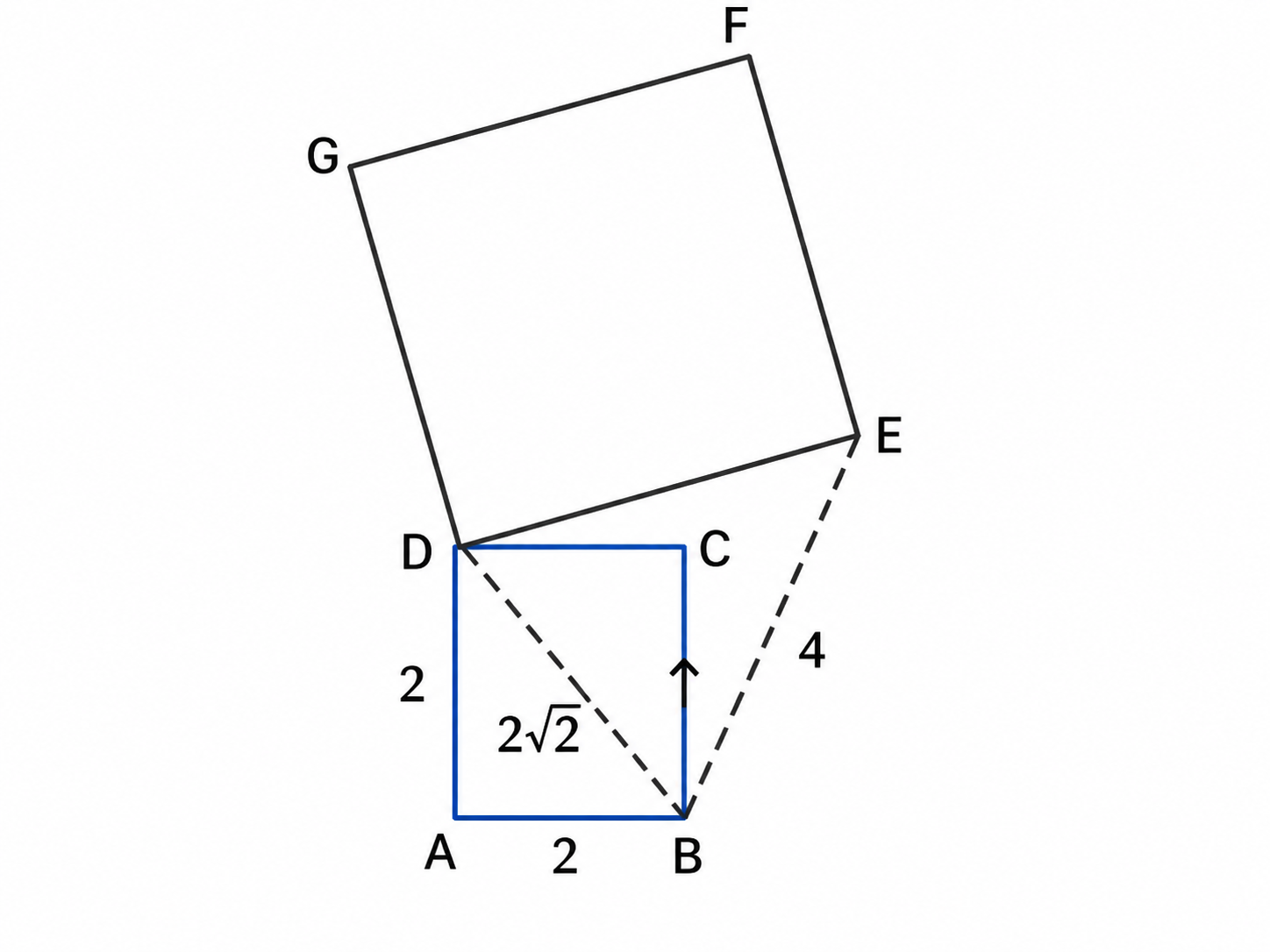
Construction:
Draw a line segment AB = 5 units.
At A, draw a perpendicular line AX.
With B as centre and radius 7 units, draw an arc cutting AX at C.
Thus, triangle ABC is right-angled at A, with:
AB = 5 units
BC = 7 units
Using Baudhayana’s Theorem:
AC² + AB² = BC²
AC² + 5² = 7²
AC² + 25 = 49
AC² = 24
AC = √24 units
Construct a square on AC as its side.
Area of the constructed square:
= AC²
= (√24)²
= 24 square units
Therefore, the constructed square has an area equal to the difference between the areas of squares with sides 7 units and 5 units.
Question 8.
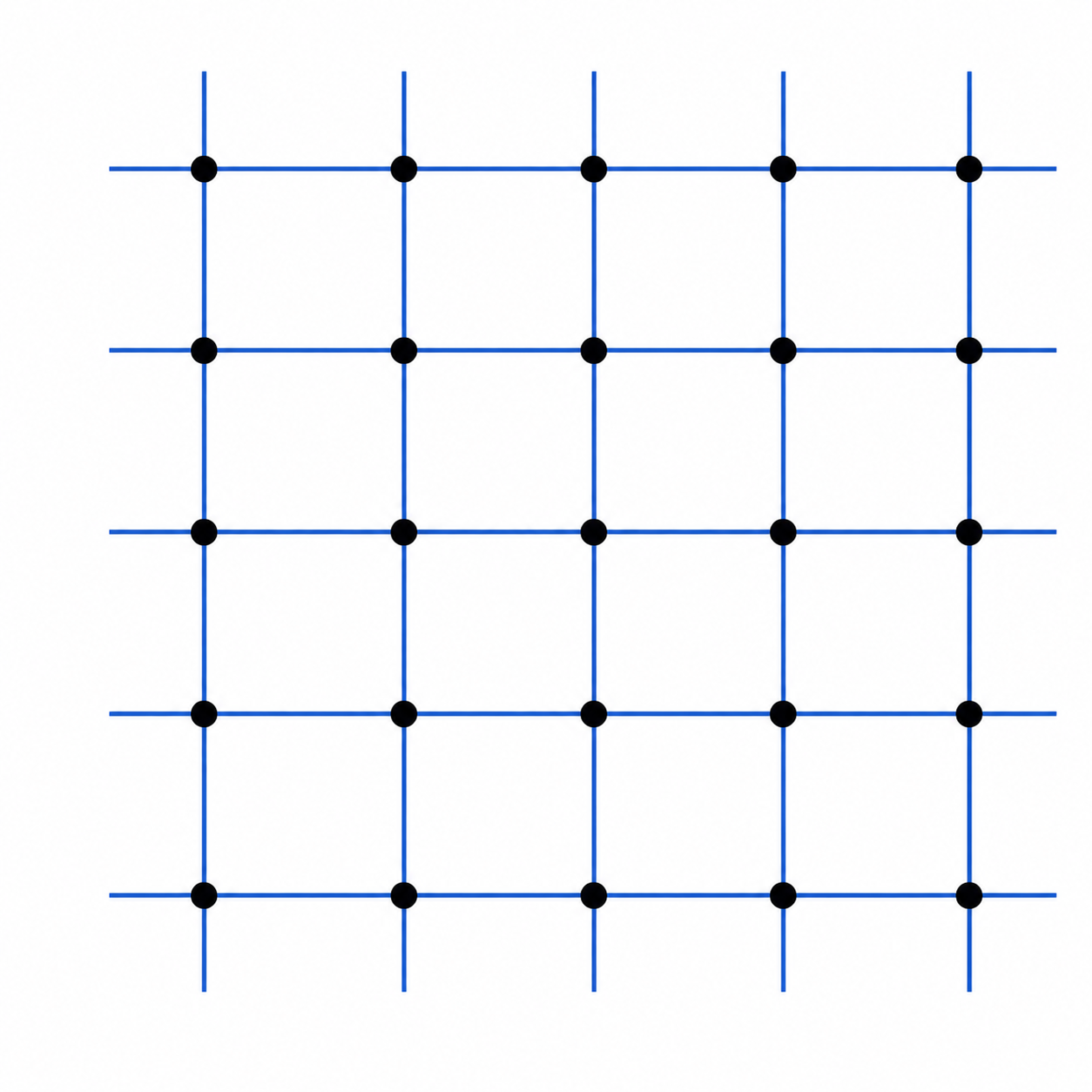
(i) Using the dots of a grid as the vertices, can you create a square that has an area of (a) 2 sq. units, (b) 3 sq. units, (c) 4 sq. units, and (d) 5 sq. units?
(ii) Suppose the grid extends indefinitely. What are the possible integer-valued areas of squares you can create in this manner?
Solution:
For a square drawn on a dot grid, suppose one side moves a units horizontally and b units vertically.
Using Baudhayana’s Theorem:
Side² = a² + b²
Since the area of a square is side²:
Area = a² + b²
Here, a and b are integers.
(i)
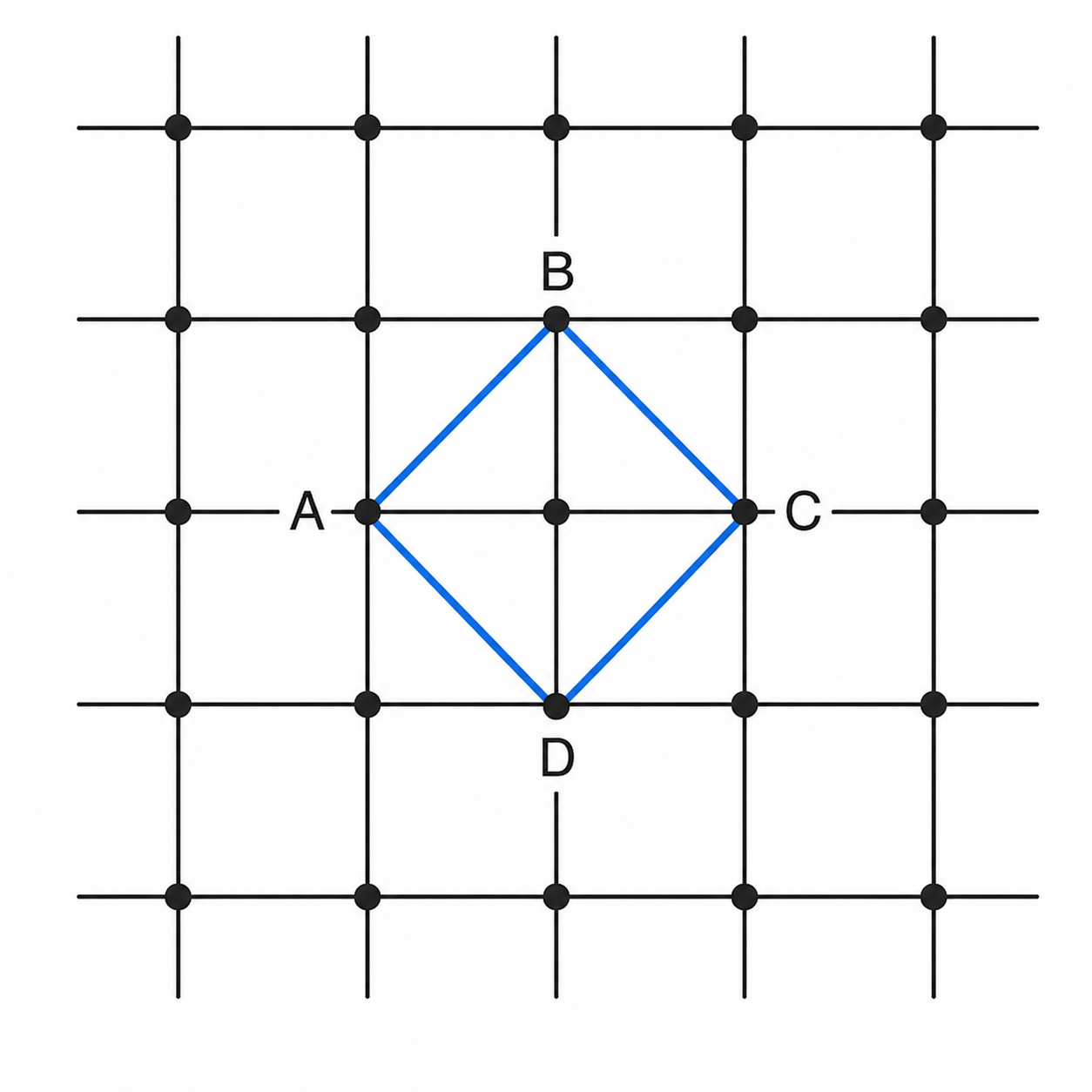
(a) Area = 2 square units
2 = 1² + 1²
Choose two neighbouring grid points that differ by 1 unit horizontally and 1 unit vertically.
The side length is:
√(1² + 1²) = √2 units
Area:
= (√2)²
= 2 square units
Therefore, a square of area 2 square units can be created.
(b) Area = 3 square units
For such a square, we would need integers a and b satisfying:
a² + b² = 3
The possible square numbers not exceeding 3 are 0 and 1.
However:
1² + 1² = 2
There are no integers a and b such that:
a² + b² = 3
Therefore, a square of area 3 square units cannot be created using grid points as vertices.
(c) Area = 4 square units
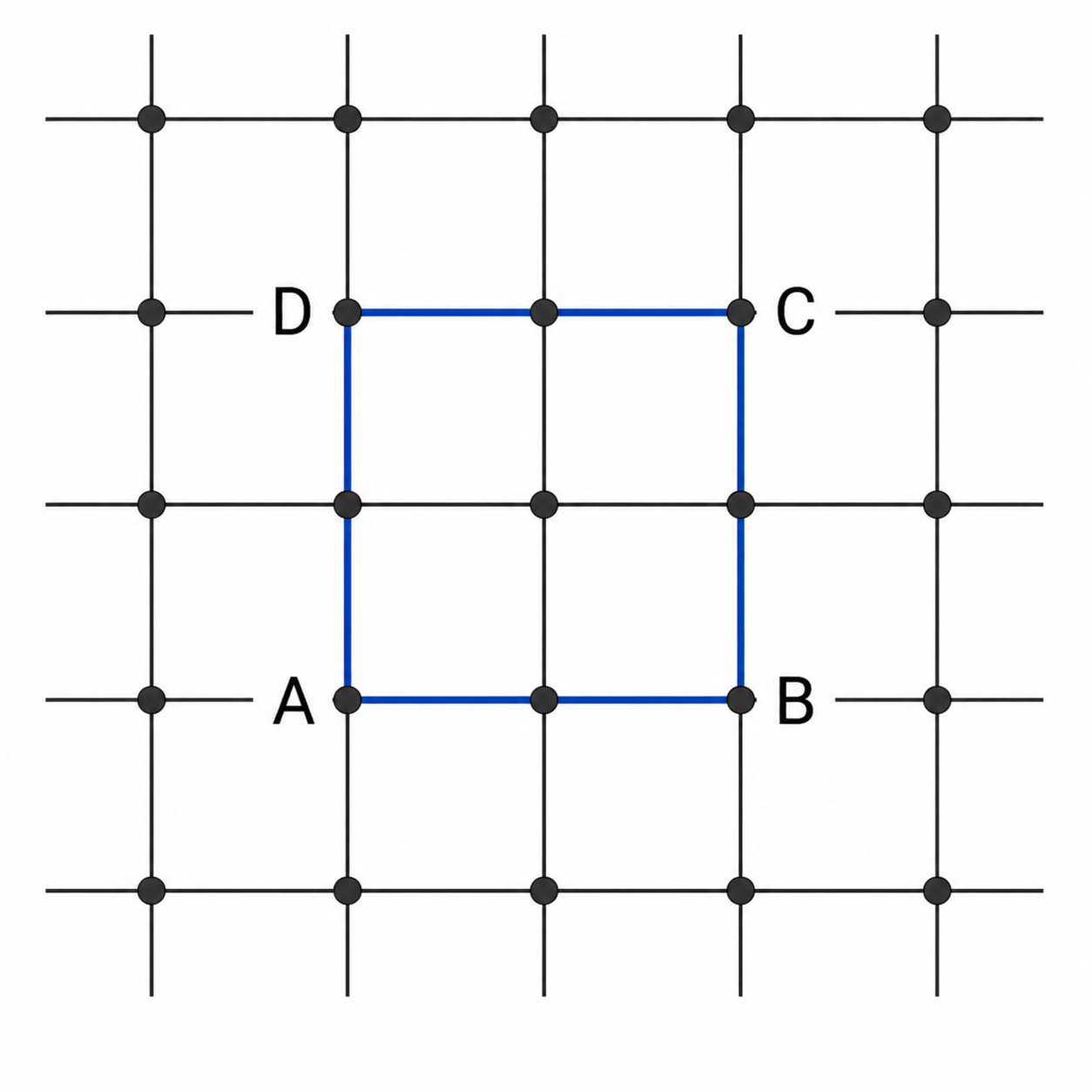
4 = 2² + 0²
Draw an ordinary square of side 2 units along the horizontal and vertical grid lines.
Area:
= 2 × 2
= 4 square units
Therefore, a square with an area of 4 square units can be created.
(d) Area = 5 square units
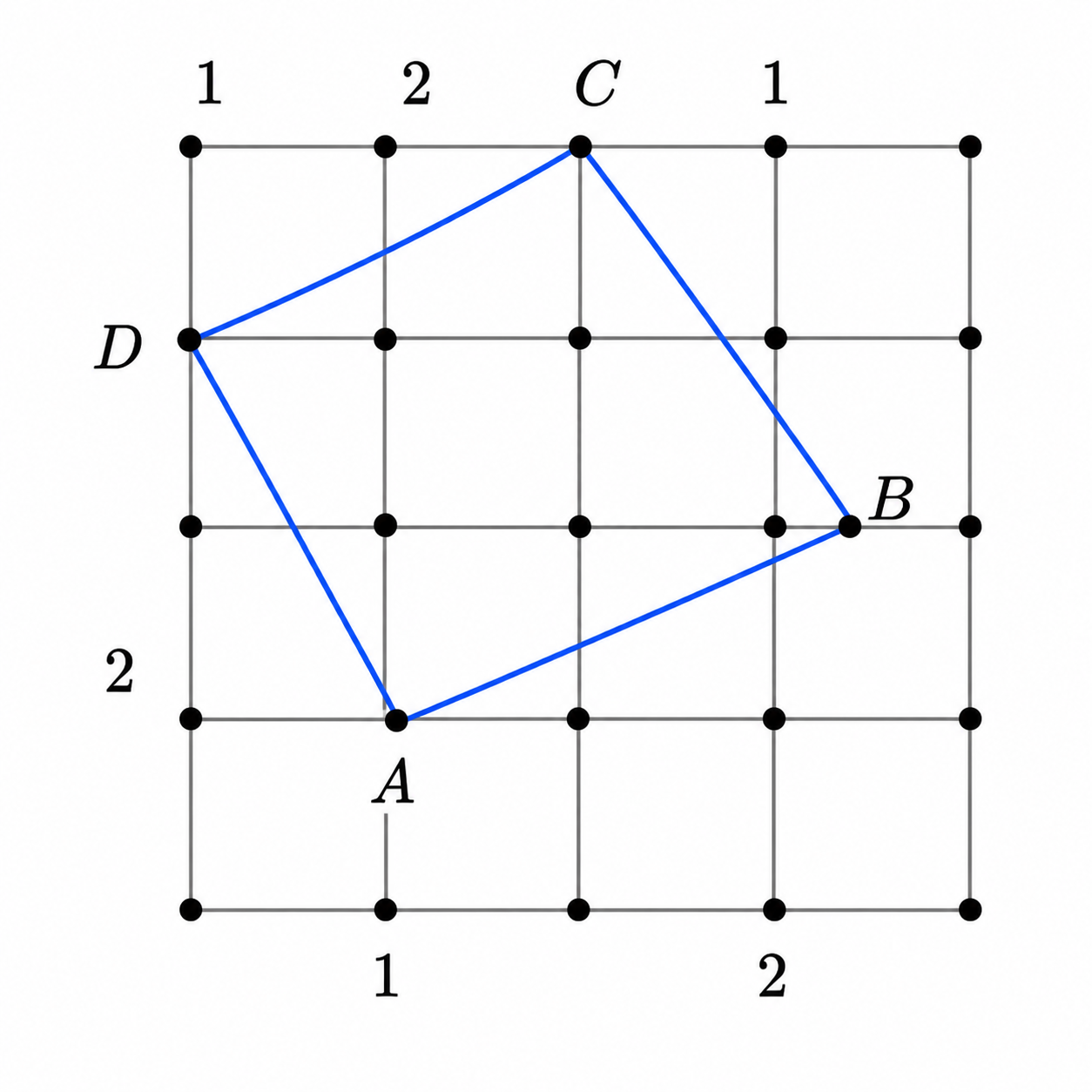
5 = 2² + 1²
Choose a side that moves 2 units horizontally and 1 unit vertically.
Its length is:
√(2² + 1²)
= √5 units
Area of the square:
= (√5)²
= 5 square units
Therefore, a square with an area of 5 square units can be created.
(ii)
An integer-valued area x is possible if it can be expressed as:
x = a² + b²
where a and b are integers.
Examples:
1 = 1² + 0²
2 = 1² + 1²
4 = 2² + 0²
5 = 2² + 1²
8 = 2² + 2²
9 = 3² + 0²
10 = 3² + 1²
13 = 3² + 2²
16 = 4² + 0²
17 = 4² + 1²
However, integers such as 3, 6, 7, 11, and 12 cannot be expressed as the sum of two squares of integers.
Therefore, the possible integer-valued areas are exactly those positive integers that can be written in the form:
a² + b²
where a and b are integers.
Question 9. Find the area of an equilateral triangle with sidelength 6 units.
[Hint: Show that an altitude bisects the opposite side. Use this to find the height.]
Solution:
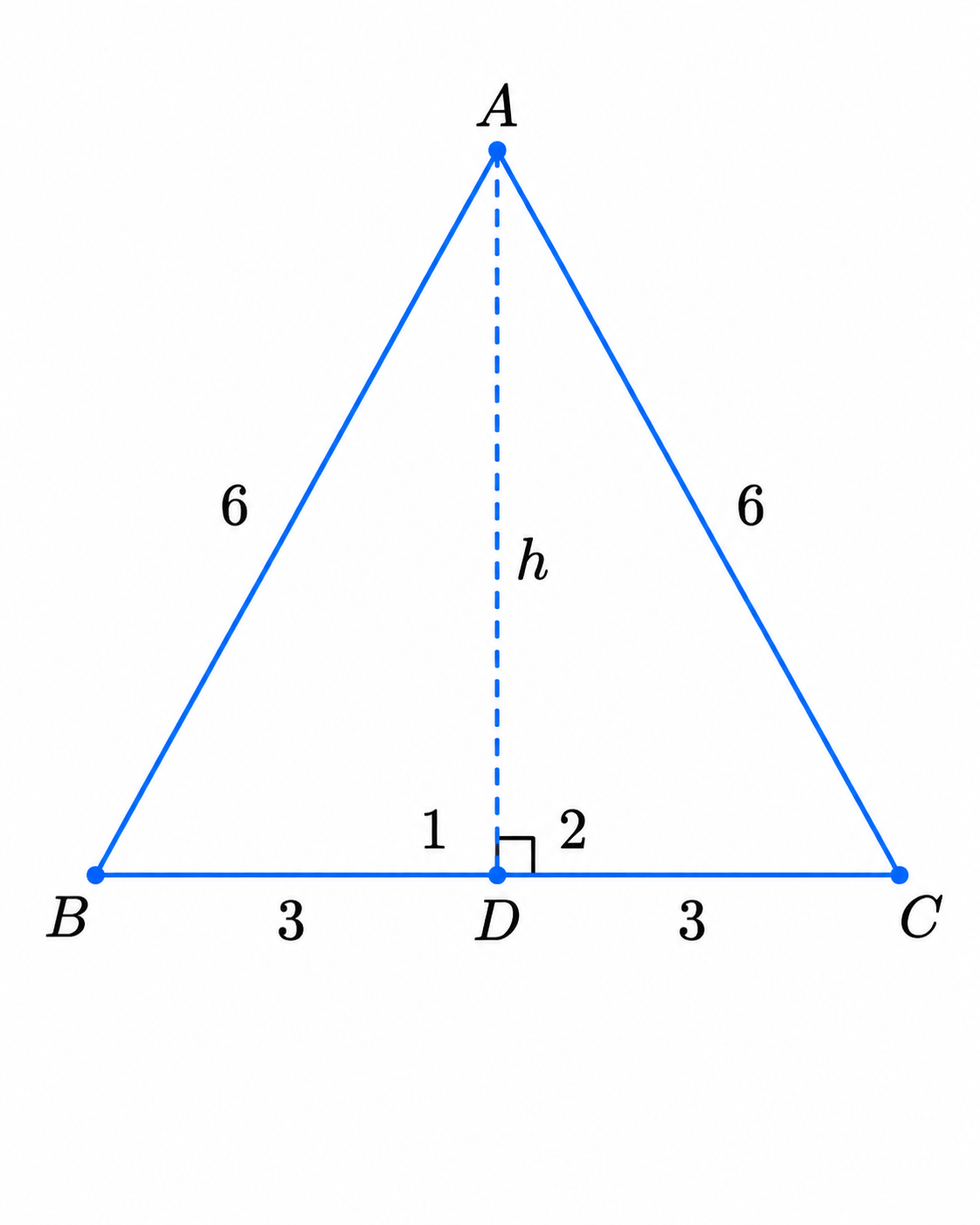
Let ABC be an equilateral triangle with:
AB = BC = CA = 6 units
Draw AD perpendicular to BC.
We first show that D is the midpoint of BC.
In triangles ADB and ADC:
AB = AC = 6 units
AD = AD, common side
∠ADB = ∠ADC = 90°
Therefore:
∆ADB ≅ ∆ADC by the RHS congruence rule.
Hence, by CPCT:
BD = DC
Since:
BC = 6 units
BD = DC = 6/2
BD = DC = 3 units
Now consider the right-angled triangle ADC.
AC = 6 units
DC = 3 units
Let AD = h.
Using Baudhayana’s Theorem:
h² + 3² = 6²
h² + 9 = 36
h² = 27
h = √27
h = 3√3 units
Now:
Area of triangle ABC
= 1/2 × Base × Height
= 1/2 × 6 × 3√3
= 9√3 square units
Therefore, the area of the equilateral triangle is 9√3 square units.
Its approximate value is:
9 × 1.732 = 15.588
Therefore, the area is approximately 15.59 square units.
How to Score Better with Vedantu’s NCERT Solutions for Class 8 Maths Chapter 2: The Baudhayana-Pythagoras Theorem?
To score well, always identify the hypotenuse (the longest side, opposite the right angle) before applying c² = a² + b².
A common error is adding the squares when one leg is unknown - instead, subtract: leg² = c² − other leg². Leave surd answers like 5√2 or √74 in exact form unless a decimal is asked.
Practise generating Baudhayana triples and recognising scaled ones, such as (10, 24, 26). Revise with Vedantu's Chapter 2 Important Questions, Revision Notes, and Sample Papers.
CBSE Class 8 Maths Ganita Prakash II Chapter 2 Other Study Materials
Chapter-Specific NCERT Solutions for Class 8 Maths Part 2
Given below are the chapter-wise NCERT Solutions for Class 8 Maths Ganita Prakash II. Go through these chapter-wise solutions to be thoroughly familiar with the concepts.
Additional Study Materials for Class 8 Maths
FAQs on NCERT Solutions for Class 8 Maths Ganita Prakash Part 2 Chapter 2 The Baudhayana-Pythagoras Theorem - 2026-27 Free PDF Download (Login Required)
1. What is the Baudhayana-Pythagoras Theorem in Class 8 Maths Chapter 2?
The theorem states that in a right-angled triangle, the square on the hypotenuse (the longest side) equals the sum of the squares on the other two sides, written as c² = a² + b². It was described in ancient India in Baudhayana's Sulbasutras, long before Pythagoras, which is why the new NCERT book uses both names.
2. How do you find the hypotenuse of an isosceles right triangle?
In an isosceles right triangle, both shorter sides are equal, say length a. By the Baudhayana-Pythagoras Theorem, hypotenuse² = a² + a² = 2a², so the hypotenuse = a√2. For example, if each equal side is 5 units, the hypotenuse is 5√2, approximately 7.07 units.
3. What is a Baudhayana triple from NCERT Solutions for Class 8 Maths Chapter 2 Part 2?
A Baudhayana triple is a set of three positive integers a, b, and c that satisfy a² + b² = c², such as (3, 4, 5) or (5, 12, 13). These are the integer side-lengths of a right-angled triangle. The new NCERT Ganita Prakash book refers to them as Baudhayana triples rather than Pythagorean triples.
4. How do you generate Baudhayana triples for Chapter 2 NCERT Solutions for Class 8 Maths?
Take an odd number n as one shorter side. Then the other shorter side is (n²−1)/2, and the hypotenuse is (n²+1)/2. For example, n = 7 gives (7, 24, 25), and n = 9 gives (9, 40, 41). In every triple made this way, the longer leg and hypotenuse are consecutive integers.
5. What is the difference between a primitive and a non-primitive Baudhayana triple?
A primitive triple has an HCF of 1 for all three numbers, such as (3, 4, 5). A non-primitive triple is a scaled multiple of a primitive one — for example, (10, 24, 26) is (5, 12, 13) multiplied by 2. Every Baudhayana triple is either primitive or a scaled version of a primitive triple.
6. Why is the hypotenuse always the longest side of a right triangle?
Since c² = a² + b² and both a² and b² are positive, c² must be greater than a² and greater than b². Taking square roots, c is greater than both a and b. Therefore, the hypotenuse is always longer than either of the other two sides.
7. How is the Baudhayana-Pythagoras Theorem used to find the side of a rhombus from the NCERT Solutions for Class 8 Maths Chapter 2 Part 2?
The diagonals of a rhombus bisect each other at right angles, forming four right-angled triangles. Half of each diagonal becomes the two shorter sides. For diagonals 24 and 70, the half-lengths are 12 and 35, so the side = √(12² + 35²) = √1369 = 37 units.
8. Where can I download NCERT Solutions for Class 8 Maths Ganita Prakash Chapter 2 PDF for free?
You can download the FREE PDF of NCERT Solutions for Class 8 Maths Ganita Prakash Part 2 Chapter 2 The Baudhayana-Pythagoras Theorem from Vedantu. The PDF includes step-by-step answers to every "Figure It Out" question across all sections and can be used offline for revision at any time.
9. Are these NCERT Solutions for Chapter 2 free and based on the latest 2026-27 syllabus?
Yes. Vedantu's solutions are completely free and based on the new NCERT Ganita Prakash Part 2 textbook and the latest CBSE 2026-27 syllabus. They cover all sections — from doubling a square to Baudhayana triples and applications — with clear, stepwise methods prepared by expert Maths teachers.
10. Is Chapter 2, The Baudhayana-Pythagoras Theorem, important for Class 8 Maths exams?
Yes. It is a high-weightage chapter, with questions on finding missing side lengths, isosceles right triangles, generating Pythagorean triples, and applications involving diagonals, rhombuses, and equilateral triangles. The theorem is also foundational for higher-class geometry and coordinate geometry.
