









What Is the Thousandth Place in Decimals and How to Identify It
Thousand, I hope you kids have heard of this word. You might have heard it from your parents, or teacher or while on your way to school or the park. It might have been used for a thousand rupees note or quantity many more. The fourth position to the left before the decimal point is at the thousands place value.
Whereas today we will learn about the thousandth place. The third position right after the decimal point is at the thousandth place value.
What is Place Value in Decimal?
A digit has a value called its place value depending where on its position in the number. A decimal point divides a decimal number into a whole number and a fractional part.
From these two statements, we can conclude that the digit's position in a number after the decimal point can be called the place value of a digit in decimal.
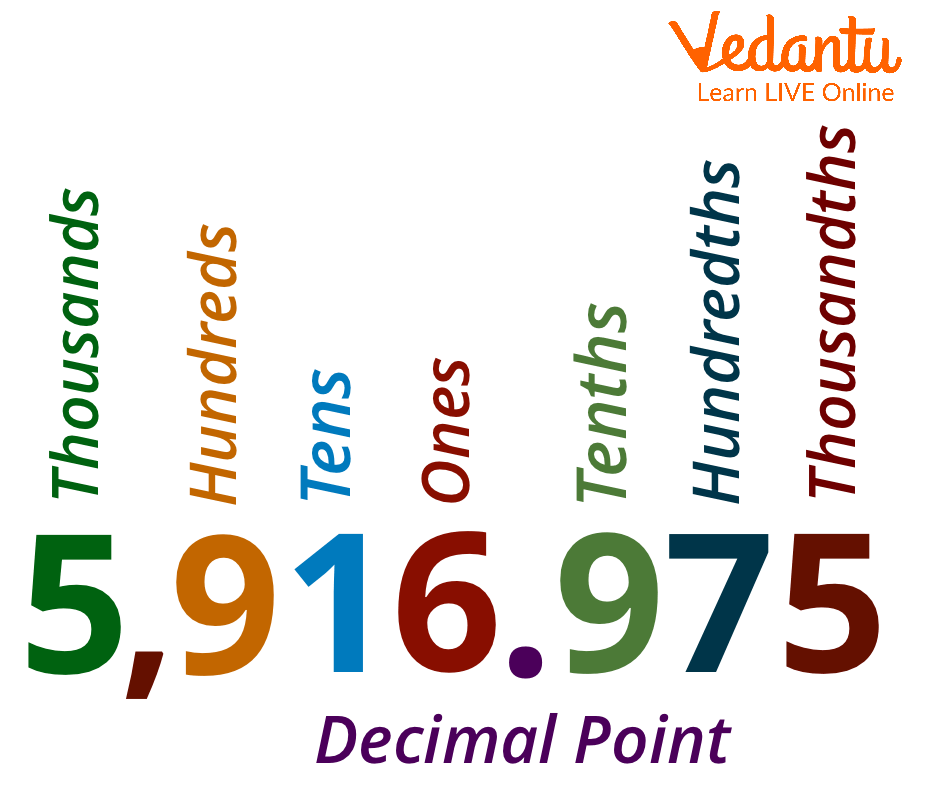
Place Value in Decimal
Thousandth Place in Decimal:
The thousandth place in decimals is the third numerical after the decimal.
One-thousandth is one part of the thousand parts or pieces. It does not start with ones. Instead, the number towards the right of the decimal is Tenths, the second digit after the decimal is Hundredths, and the third digit is called Thousandths.
For example, in 6.489 (SIX POINT FOUR EIGHT NINE),
4 (FOUR) is in Tenth place.
8 (EIGHT) is in the Hundredth place.
9 (NINE) is at the Thousandth place.
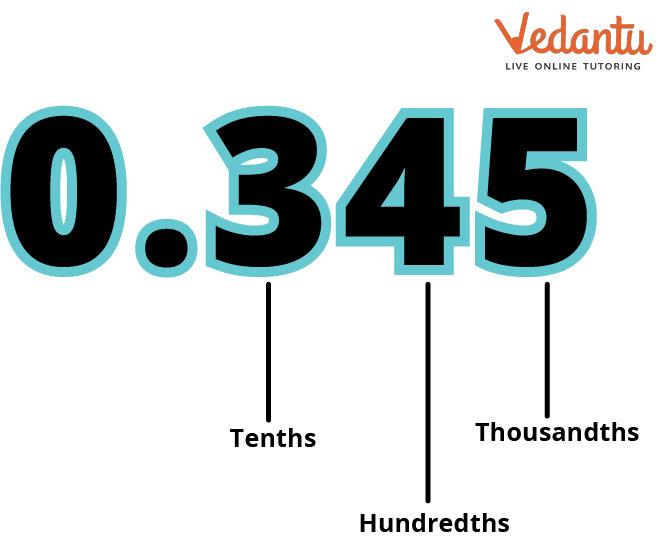
The Thousandth Place of 0.345
How to Convert the Decimal Fraction 0.825 into a Percentage
To convert a decimal number 0.825 into a percentage, follow the steps:
The first step is to multiply the decimal by 100.
Let's take the number 0.825
$ = \dfrac{825}{1000} \times 100 = 82.5$
The second step is to add the % (PERCENTAGE) sign to the value.
$ = 82.5\% $
Tenth, Hundredth, Thousandth - Chart
3 Decimal Places Example
The Thousandths place in place value means \[\dfrac{1}{{1000}}\] (ONE UPON THOUSAND). The Decimal number is a particular portion of the thousand. Let's take a look at some Thousandths place in decimals examples:
Example 1:
0.033 (ZERO POINT ZERO THREE THREE) is also represented as \[\dfrac{{33}}{{1000}}\] (THIRTY-THREE UPON THOUSAND) in fraction. It signifies that it is 33 over one thousand.
Example 2:
0.087 (ZERO POINT ZERO EIGHT SEVEN) is also represented as \[\dfrac{{87}}{{1000}}\] (EIGHTY-SEVEN UPON THOUSAND) in fraction. It signifies that it is 87 over one thousand.
Example 3:
0.002 (ZERO POINT ZERO ZERO TWO) is also represented as \[\dfrac{2}{{1000}}\] UPON THOUSAND) in fraction. It signifies that it is 2 over one thousand.
Conclusion
The value that a digit in a number represents depending upon its position is known as place value. The third position to the decimal's right is the thousandth place.
Now, that you guys know what we really mean by a thousandth. Then we can easily understand that if there are 1000 squares equal on a grid and if we spilt one of the squares into 10 equal squares, then one of such small squares will represent the thousandth, which is 1 over one thousand.
FAQs on Thousandth Place in Decimals with Definition and Examples
1. What is the thousandth place in decimals?
The thousandth place in decimals is the third digit to the right of the decimal point and represents parts of 1/1000.
- Place values after the decimal point are: tenths (1/10), hundredths (1/100), thousandths (1/1000).
- Example: In 0.456, the digit 6 is in the thousandth place.
- It shows how many thousandths are in the number.
2. How do you identify the thousandth place in a decimal number?
To identify the thousandth place, count three digits to the right of the decimal point.
- Step 1: Locate the decimal point.
- Step 2: Move right to the first digit (tenths).
- Step 3: Move to the second digit (hundredths).
- Step 4: The third digit is the thousandths.
- Example: In 3.7289, the digit 8 is in the thousandth place.
3. What is the value of the digit in the thousandth place?
The value of a digit in the thousandth place is the digit multiplied by 0.001.
- Formula: Value = Digit × 1/1000.
- Example: In 5.239, the digit 9 is in the thousandth place.
- Its value is 9 × 0.001 = 0.009.
4. How do you round a number to the thousandth place?
To round to the thousandth place, look at the digit in the ten-thousandth place (fourth digit after the decimal).
- If it is 5 or more, increase the thousandth digit by 1.
- If it is less than 5, keep the thousandth digit the same.
- Example: 4.5678 rounded to thousandths is 4.568.
5. What is an example of a number with thousandths?
A number with thousandths has three decimal places, such as 0.125.
- The digit 1 is in the tenths place.
- The digit 2 is in the hundredths place.
- The digit 5 is in the thousandths place.
- 0.125 means 125 thousandths or 125/1000.
6. What is the difference between tenths, hundredths, and thousandths?
The difference between tenths, hundredths, and thousandths lies in their place value and fraction form.
- Tenths = 1/10 = first digit after decimal.
- Hundredths = 1/100 = second digit after decimal.
- Thousandths = 1/1000 = third digit after decimal.
- Each place is 10 times smaller than the one before it.
7. How do you write thousandths as a fraction?
Thousandths are written as a fraction with denominator 1000.
- Example: 0.007 = 7/1000.
- Example: 0.345 = 345/1000.
- You can simplify the fraction if possible.
8. Why is the thousandth place important in decimals?
The thousandth place is important because it provides greater precision in measurements, calculations, and data.
- Used in science and engineering measurements.
- Important in money calculations involving small units.
- Helps improve accuracy when rounding decimal numbers.
9. Can a decimal have more than one thousandth?
Yes, a decimal can represent multiple thousandths depending on the digit in the thousandth place.
- Example: 0.008 means 8 thousandths.
- 0.125 means 125 thousandths.
- The digit in the thousandth place shows how many 1/1000 parts are present.
10. What happens if there is no digit in the thousandth place?
If there is no digit in the thousandth place, it is understood to be 0.
- Example: 4.5 can be written as 4.500.
- The thousandth digit here is 0.
- Adding zeros after the decimal does not change the value of the number.
