








What Is Ones Place Value Definition Chart and Solved Examples
In general, a number's place value indicates the value of a certain digit based on that digit's position inside the number, among other factors. The one's place or unit's place refers to the location within a number. The number itself is the value of the digit in the one's position.
What is Place Value?
The term "place-value" is typically used to describe the importance of a digit in a given number based on the location of that digit inside that number. According to the number's digits, the locations in a number are ordered starting with the rightmost digit, such as the one's place, tens place, hundreds place, and so on. For instance, since 6 is in the tens place in the number 468, its place value is 60.
What is One’s Place?
One's place is defined as the first digit from the left or the rightmost position of a number. Any number's rightmost digits are referred to as the number's "one's position." The value of the digit in one's position is the same as the value of the digit itself in terms of place value. Consider the number 342, for instance. The rightmost number is 2, and its place value is 2 itself.
How to Identify One’s Place?
With the exception of integers that contain decimals, the rightmost position is regarded as the one's place. In the case of decimals, the one's place is the position immediately to the right of the decimal point. For single-digit integers, the number itself takes the place of one.
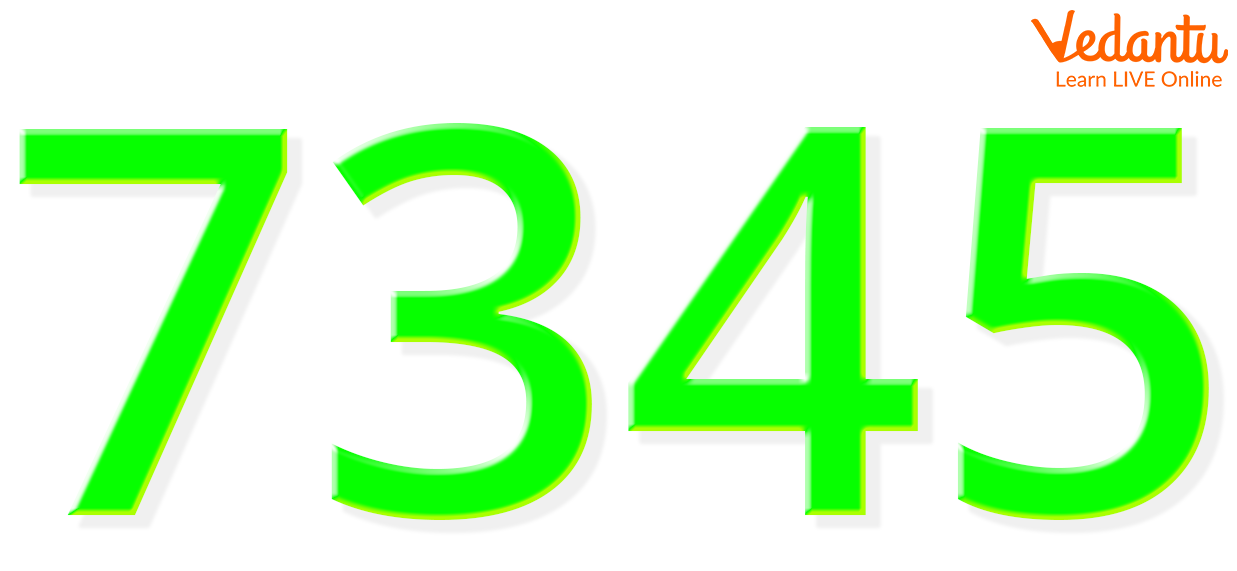
Example to Identify One’s Place
In the image above, the rightmost digit is 5. Hence, the number in the one’s place is 5
Solved Examples :
Identify the digit in the one’s place in the number 7,45,67.
Solution: Here, in the number 7,45,67 the rightmost digit is 7. Hence, the digit in one's place is 7.
Identify the digit in the one’s place in the number 72.
Solution: Here, in the number 72 the rightmost digit is 2. Hence, the digit in one's place is 2.
Identify the digit in the one’s place in the number 94.33.
Solution: Here, in the number 94.33 the rightmost digit before the decimal point is 4. Hence, the digit in one's place is 4
Identify the digit in the one’s place in the number 10,000.
Solution: Here, in the number 10,000 the rightmost digit is 0. Hence, the digit in one's place is 0.
Identify the digit in the one’s place in the number 468.23.
Solution: Here, in the number 468.23 the rightmost digit before the decimal point is 8. Hence, the digit in one's place is 8.
Conclusion
As a result, the place value is used to determine a number's digit value. The one's place is at the number's rightmost position. Therefore, it is assumed that the digit in the number's rightmost position is the one whose value equals the number itself.
FAQs on Ones Place Value in the Place Value Chart Explained Clearly
1. What is the ones place value in Maths?
The ones place value is the digit in a number that represents single units. In the place value system, it is the rightmost digit of a whole number.
- In 47, the digit 7 is in the ones place, meaning 7 ones.
- In 305, the digit 5 is in the ones place.
2. How do you find the ones place in a number?
The ones place is found by identifying the rightmost digit in a whole number. Follow these steps:
- Step 1: Look at the number.
- Step 2: Move to the far right digit.
- Step 3: That digit represents the ones value.
3. What is the value of the digit in the ones place?
The value of a digit in the ones place is the digit itself because it represents units. For example:
- In 52, the digit 2 has a value of 2.
- In 914, the digit 4 has a value of 4.
4. What is the difference between ones and tens place value?
The ones place represents single units, while the tens place represents groups of ten. Key differences:
- Ones place value = digit × 1
- Tens place value = digit × 10
- 4 is in the ones place (value = 4).
- 3 is in the tens place (value = 30).
5. Can you give an example of ones place value?
An example of ones place value is seen in the number 276, where the digit 6 represents 6 ones. Breaking it down:
- 2 = 200 (hundreds)
- 7 = 70 (tens)
- 6 = 6 (ones)
6. Why is the ones place important in the place value system?
The ones place is important because it forms the base of the decimal number system and helps in understanding larger place values. It helps students:
- Build numbers correctly
- Perform addition and subtraction
- Understand regrouping or carrying
7. What happens to the ones place when adding numbers?
When adding numbers, you always add the ones digits first. Steps:
- Step 1: Add the digits in the ones column.
- Step 2: If the sum is 10 or more, carry over to the tens place.
- 7 + 5 = 12
- Write 2 in the ones place and carry 1 to the tens place.
8. How does the ones place work in subtraction?
In subtraction, you subtract the ones digits first. Steps:
- Step 1: Subtract the bottom ones digit from the top ones digit.
- Step 2: If the top digit is smaller, borrow from the tens place.
- 3 − 8 requires borrowing.
- After borrowing, 13 − 8 = 5.
9. What is the ones place in decimal numbers?
In decimal numbers, the ones place is the digit immediately to the left of the decimal point. For example:
- In 4.56, the ones digit is 4.
- In 23.8, the ones digit is 3.
10. What are common mistakes students make with ones place value?
A common mistake with the ones place value is confusing digit position with digit value. Common errors include:
- Reading numbers from left to right without checking place value.
- Forgetting to carry or borrow in addition and subtraction.
- Mixing up ones and tens columns.
