









How to Convert Metres to Centimetres with Formula and Examples
Just imagine that you are participating in a race competition with a group of friends and the winner is who runs fast. In order to decide who the winner is, you will have to measure the length. So you can measure this by using different types of units. One of the units is metre. We can calculate the length of the playground where the race competition happens with the help of a metre unit.
Introduction of Metre and Centimetre
Metre: Metre is a primary unit of distance in the measuring system. In this, you will understand how to convert metre into centimetre.
Centimetre: A centimetre is a measuring unit of length that equals one-hundredth of a metre.
1m = 100cm.
Metre and centimetre are the units of distance that are measured with the help of scale or inch tape or any other thing where metre and centimetre are mentioned.
one metre is equal to 100 centimetres and 100 centimetres are equal to 1 metre.
We can say that the relation between metres and centimetres is reversed.
Convert Metre to Centimetre
1 m = 100 cm
1 cm = 0.01 m
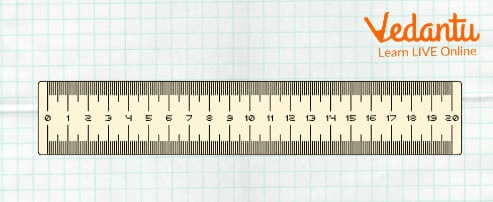
Scale
Convert a Metre Into a Centimetre
We can convert metre to centimetre with the help of two steps that are given below:
Step 1: Multiply the number of metres by 100.
Step 2: change the units to centimetres.
For Example:
Convert 8 metres into centimetres.
8 m × 100 = 800
8 m = 800 cm.
Convert 1 metre to centimetres.
1 m × 100 = 100
1 m = 100 cm.
Just like we convert metres into centimetres, we can convert centimetres into metres. And the formula is just the opposite of this.
Conversion of Centimetre Into Metre
We can convert centimetres into metres by following two steps that are :
Step 1: divide the centimetre number by 100
Step 2: change the unit to metres.
Remember the above example, the reverse of the first example where we convert 8 m to 800 cm. and we convert 800 cm to 8 m. Let's check through the example.
Example: Convert 800 cm to metres.
800 cm ÷ 100 = 8
800 cm = 8 m.
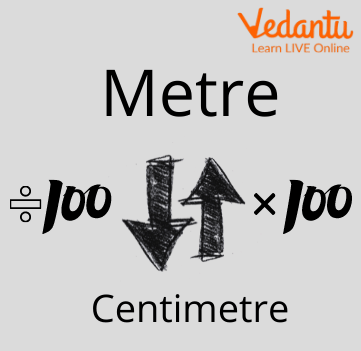
Conversion
Conversion Table
Solved Example:
Q1. (a) How many centimetres are in a metre?
(b) One metre is equal to how many centimetres?
(c) Convert 0.7 m to cm
Sol: (a) 100 cm are in a metre.
(b) 1 m = 100 cm
(c) As we know 1 m = 100 cm
0.7 m = 0.7 x 100 cm = 70.0 cm = 70 cm
Practice Questions
Convert 0.5 m to cm.
Convert 1000 cm to m.
Convert 550 cm to m.
Convert 75 m to cm.
Convert 885 cm to m.
Ans:
50 cm
10 m
5.5 m
7500 cm
8.85 m.
Summary
Metres and centimetres help to measure the length of any particular thing. The length is measured with the help of a scale. metre and centimetres are denoted on the scale. metre and centimetre are related to each other in a reversible manner.
1 m = 100 cm and 100 cm = 1 m.
FAQs on Metres Into Centimetres Conversion Explained
1. How do you convert metres into centimetres?
To convert metres into centimetres, multiply the number of metres by 100. In the metric system, 1 metre = 100 centimetres, so the conversion rule is:
Centimetres = Metres × 100
Example:
- 5 m × 100 = 500 cm
- 0.8 m × 100 = 80 cm
2. What is 1 metre in centimetres?
1 metre is equal to 100 centimetres. This is a standard metric conversion based on the metric system scale.
- 1 m = 100 cm
- 2 m = 200 cm
- 0.5 m = 50 cm
3. What is the formula to convert metres to centimetres?
The formula to convert metres to centimetres is Centimetres = Metres × 100. This works because each metre contains 100 centimetres.
Steps:
- Write the length in metres.
- Multiply it by 100.
- Add the unit “cm” to the result.
4. How many centimetres are in 5 metres?
There are 500 centimetres in 5 metres. Since 1 metre equals 100 centimetres, multiply 5 by 100.
Calculation:
- 5 × 100 = 500
5. How do you convert centimetres back to metres?
To convert centimetres to metres, divide the number of centimetres by 100. This is the reverse of converting metres to centimetres.
Metres = Centimetres ÷ 100
Example:
- 250 cm ÷ 100 = 2.5 m
- 75 cm ÷ 100 = 0.75 m
6. Why do we multiply by 100 to convert metres into centimetres?
We multiply by 100 because the prefix “centi-” means one hundredth, so 1 metre = 100 centimetres. The metric system is based on powers of 10, making conversions simple.
- “Centi-” means 1/100.
- There are 100 equal centimetres in 1 metre.
- So, multiply metres by 100 to get centimetres.
7. What is 0.5 metres in centimetres?
0.5 metres is equal to 50 centimetres. Multiply 0.5 by 100 to convert metres to centimetres.
Calculation:
- 0.5 × 100 = 50
8. What is the difference between metres and centimetres?
The difference between metres and centimetres is that a metre is a larger unit of length, and 1 metre = 100 centimetres. Both are metric units used to measure distance or length.
- Metre (m): Base unit of length in the metric system.
- Centimetre (cm): Smaller unit equal to 1/100 of a metre.
9. Can you give an example of converting metres into centimetres?
Yes, to convert 2.75 metres into centimetres, multiply by 100 to get 275 centimetres.
Step-by-step example:
- Given: 2.75 m
- Multiply by 100 → 2.75 × 100
- Result: 275 cm
10. Is converting metres to centimetres a metric conversion?
Yes, converting metres to centimetres is a metric conversion within the standard metric system of measurement. Both units measure length and are related by powers of 10.
- 1 m = 100 cm
- Based on the decimal (base-10) system
- Easy conversion by multiplying or dividing by 100
