









Formula and Solved Examples on Converting a Ratio Into a Number
How to Convert Ratio Into Number
Ratio, in math, is a term that is used to compare different numbers. It is used to indicate how big or small a quantity is when compared to another.
We will study how we can convert a ratio into a number, or, we can say, a whole number. Let's break it down by solving the examples with steps provided below in the given examples.
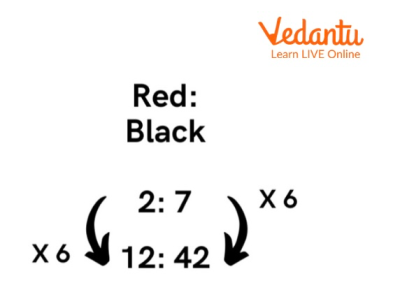
Ratio
How to Simplify Fraction Ratios
How to Find Ratio of 3 Fractions
1. Convert the ratio \[\frac{1}{5}:\frac{1}{3}\] into the whole number ratio or the ratio in its simplest form?
Ans: Given, the ratio is \[\frac{1}{5}:\frac{1}{3}\].
Now, we need to convert the ratio into the whole number ratio, we need to follow the steps given below:
Step 1 : Let’s find the least common multiple (L. C. M.) of the denominators.
So, As the Denominators are 5 and 3 and then the LCM of denominators is \[5 \times 3\; = {\rm{ }}15\].
Step 2: Multiply the both term of the ratio by the least common multiple (L. C. M.) that is,
\[\frac{1}{5} \times 15:\frac{1}{3} \times 15\]
Step 3: Now, just simplify it. We will get the value \[\frac{{15}}{5}:\frac{{15}}{3} = 3:5\].
Hence, the whole number ratio is \[3:5\].
Example. How to Convert the fractional ratio into the whole number ratio. The fractional ratio is \[\frac{1}{6}:\frac{1}{12}:\frac{1}{9}\]?
Solution:
Given, the fractional ratio is \[\frac{1}{6}:\frac{1}{12}:\frac{1}{9}\].
Now, we need to convert the given ratio into the whole number ratio.
Taking L.C.M of the denominators, we get 36
Multiplying each ratio with 36 we get,
Therefore, the whole number ratio is \[6:3:4\].
How to Convert Fraction Into Ratio
Steps to convert a fraction to a ratio.
Take the numerator of the fraction as the first term of the ratio.
Then the denominator is the second term of the ratio, after the colon.
And lastly, simplify the ratio.
Example 2:
Convert \[\frac{2}{6}\] into a ratio.
The numerator becomes the 1st term. \[2\]
Then the denominator becomes the second term. \[6\]
\[\frac{2}{6}\]
When we simplify we get, \[1:3\]
How to Solve Fraction Ratio
Example 3. Ratio \[1\frac{5}{{12}}:\frac{7}{30}\]
Step 1: Convert mixed fractions to improper fractions
As we can see we have \[1\frac{5}{{12}}\] let’s convert this into proper fraction \[\frac{{12 \times 1 + 5}}{{12}}\] will get \[\frac{{17}}{{12}}\] is our proper fraction.
Step 2: Convert both fractions using the LCM
\[\frac{{17}}{{12}}\] and \[\frac{7}{30}\] the lcm of both fraction is \[60\]
Let’s multiply
\[12{\rm{ }} \times {\rm{ }}5{\rm{ }} = {\rm{ }}60\] and\[17{\rm{ }} \times {\rm{ }}5{\rm{ }} = {\rm{ }}85\], giving us \[\frac{{85}}{{60}}\]
\[30{\rm{ }} \times {\rm{ }}2{\rm{ }} = {\rm{ }}60\]and \[7{\rm{ }} \times {\rm{ }}2{\rm{ }} = {\rm{ }}14\], giving us \[\frac{{14}}{{60}}\]
Step 3: Write the numerator as ratio
This gives us \[84:14\]
Step 4 . Simplify the ratio
As it is already in its lowest form hence , the ration is \[84:14\].
How to Convert Number Into Ratio
Example 4:
In a bag we have 8 blue balls and 12 pink balls. What is the ratio of both?
Ans: to get the ratio we need to divide both terms \[\frac{8}{{12}} = \frac{2}{3}\]
Hence, the ratio is \[2:3\]
Solved Questions
1. What is the number ratio of \[\frac{4}{2}:\frac{8}{3}\]?
Ans: Given in the question, the ratio is \[\frac{4}{2}:\frac{8}{3}\].
Now, to convert the ratio into the whole number ratio, we need to follow the steps given below:
Step 1: Find the least common multiple (L. C. M.) of the denominators.
So, the Denominators are 2 and 3 and the LCM of the denominators is \[2 \times 3\; = {\rm{ }}6.\]
Step 2: Multiply each term of the ratio by the least common multiple (L. C. M.) that is,
\[\frac{4}{2} \times 6:\frac{8}{3} \times 6\]
Step 3: Now, simplify it. So the value is \[\frac{{24}}{2}:\frac{{48}}{3} = 12:16\].
Thus, the whole number ratio is \[12:16\].
2. What is the number ratio of the fractional ratio value is \[\frac{1}{5}:\frac{1}{10}:\frac{1}{20}\]?
Ans:
As given in the question, the fractional ratio is \[\frac{1}{5}:\frac{1}{10}:\frac{1}{20}\].
L.C.M of the denominators are 20
Now, multiply each ratio with 20. We get,
Therefore, the whole number ratio is \[4:2:1\].
Summary
We have discussed the ratio and how it is solved in a variety of contexts, including whether it is an improper fraction, mixed fraction, number, etc. by resolving many examples using answers to questions.
FAQs on How To Convert Ratio Into Number Step by Step Guide
1. How do you convert a ratio into a number?
To convert a ratio into a number, divide the first term by the second term. For example, if the ratio is 3:4, convert it into a fraction 3/4 and calculate 3 ÷ 4 = 0.75. Steps:
- Write the ratio as a fraction (a:b = a/b).
- Divide the numerator by the denominator.
- The result is the numerical (decimal) value of the ratio.
2. What is the formula to convert a ratio into a fraction or decimal?
The formula to convert a ratio into a fraction or decimal is a:b = a/b. To get a decimal value, divide a by b. For example, for 5:2:
- Write as fraction: 5/2
- Divide: 5 ÷ 2 = 2.5
3. How do you convert a ratio into a percentage?
To convert a ratio into a percentage, first change it into a fraction, then multiply by 100%. For example, for 2:5:
- Write as fraction: 2/5
- Convert to decimal: 2 ÷ 5 = 0.4
- Multiply by 100: 0.4 × 100 = 40%
4. Can you convert a ratio into a whole number?
You can convert a ratio into a whole number only if the division of its terms gives a whole result. For example, 6:3 becomes 6/3 = 2, which is a whole number. However, ratios like 3:4 give 0.75, which is not whole. So it depends on whether the division results in an integer.
5. How do you convert a ratio into a single number in simplest form?
To convert a ratio into a single number in simplest form, divide both terms by their greatest common divisor (GCD) first, then divide. For example, 8:12:
- GCD of 8 and 12 is 4
- Simplify: 8 ÷ 4 : 12 ÷ 4 = 2:3
- Convert to number: 2/3 = 0.67 (approx.)
6. What is the difference between a ratio and a fraction?
A ratio compares two quantities, while a fraction represents a part of a whole. A ratio like 3:5 compares 3 units to 5 units, whereas the fraction 3/5 represents 3 parts out of 5 equal parts. However, any ratio a:b can be written as the fraction a/b for calculation purposes.
7. How do you convert a ratio with three terms into numbers?
To convert a three-term ratio into numbers, express each term relative to the total or compare pairs separately. For example, in 2:3:5:
- Total = 2 + 3 + 5 = 10
- Fractions: 2/10, 3/10, 5/10
- Decimals: 0.2, 0.3, 0.5
8. How do you convert a ratio into a real-life quantity?
To convert a ratio into real-life quantities, multiply each term by the same number. For example, if the ratio of boys to girls is 2:3 and there are 10 boys:
- 2 parts = 10 boys
- 1 part = 10 ÷ 2 = 5
- Girls = 3 × 5 = 15
9. How do you convert a ratio into a proportion?
To convert a ratio into a proportion, set it equal to another ratio using the form a/b = c/d. For example, 3:4 becomes 3/4 = x/8. Solve by cross-multiplication:
- 3 × 8 = 4 × x
- 24 = 4x
- x = 6
10. What are common mistakes when converting a ratio into a number?
Common mistakes when converting a ratio into a number include dividing in the wrong order and not simplifying first. Key points to remember:
- Always write a:b as a/b, not b/a.
- Simplify the ratio using the GCD before dividing.
- Check whether the answer should be a decimal, fraction, or percentage.
