









What Are Cubic Units Definition Formula and Solved Examples
Learn About Cubic Units
As we grow up, our mathematics learning also gets influenced. As kids first we start with addition and multiplication. Growing up we advance our learning and know about geometries, long divisions, and other enhanced mathematical concepts. Likewise, studying cubic units is one of the important concepts which we study when we proceed in middle school.
This content is devoted to the learning of cubic units. We will begin with the discussion of “what are cubic units?”
Discussion on Cubic Units
Did you know that the concept of cubic units actually originated from the study of Geometry? In geometry, the cubic units are the units that are measured in terms of volume. The volume of the unit cube where the length, width, and height are 1 unit each is 1 cubic unit.
Have you seen a rectangular prism?
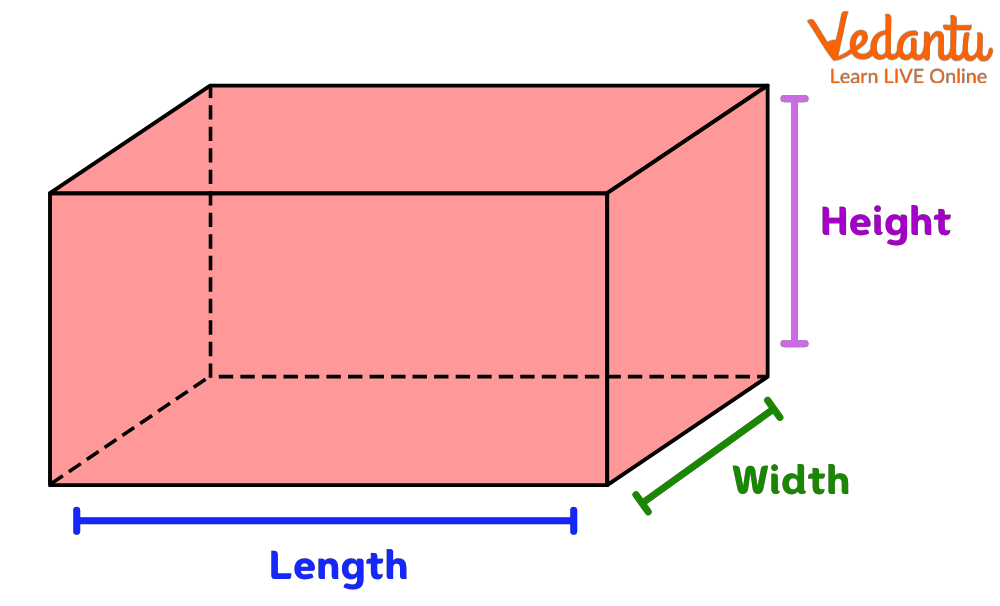
This rectangular prism is also made up of small cubic units. The measurement of length, width, and height of the rectangular prism can be done by counting the number of cubic units. The volume is estimated in terms of cubic units as well. Some of the examples that are cubic in terms of metric units are:
Cubic metrics
Cubic centimeters
In customary units like inches and cubic feet.
The Symbol of the Cubic Unit
The symbol for the cubic unit is cm3 or cc, ccm. This is a prefixed SI-driven unit which is the unit of volume.
An Example of Cubic Unit
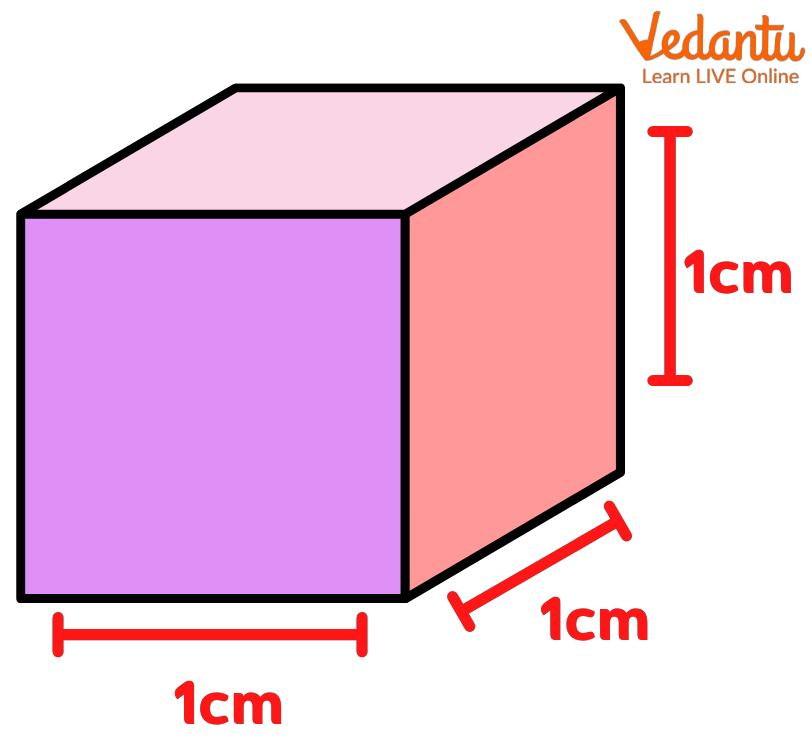
A cube
A cube is represented in the above figure. The length of each of the sides of this cube is measured as 1 centimeter and thus the volume is 1 cubic centimeter only.
Did You Know?
All the 6 faces of the cubic unit are square and all of its 12 edges are measured in one unit each measurement, which is derived in length.
Have you ever wondered why is volume cubic? When we estimate the volume of any structure the answer we get is always in the cube. Thus the estimated answer is in cubed or inches cube. For this, we are required to know only one side, then we can easily find out the volume of the structure.
The properties of the cube are - A cube has 12 edges, 6 faces, and 8 vertices.
This content on the topics of cubic meters, cubic units, and cubes is not exhaustive. If you want to learn more about it, you can do so by solving various problems on the same and engaging yourself in finding out the volume and estimating it in terms of a cube.
FAQs on Cubic Units in Volume Measurement
1. What are cubic units in maths?
Cubic units are units used to measure volume, representing the space occupied by a three-dimensional object. A cubic unit is the volume of a cube with sides of 1 unit (such as 1 cm, 1 m, or 1 inch). For example, a cube with side length 1 cm has a volume of 1 cubic centimetre (1 cm³). Cubic units are commonly written as cm³, m³, in³, or ft³.
2. How do you calculate volume in cubic units?
Volume in cubic units is calculated by multiplying the object’s dimensions: length × width × height. For a rectangular prism:
Volume = l × w × h
Example:
- If l = 5 cm, w = 3 cm, and h = 2 cm
- Volume = 5 × 3 × 2 = 30 cm³
3. Why are cubic units used to measure volume?
Cubic units are used to measure volume because volume measures three-dimensional space. Since objects have length, width, and height, we multiply three linear measurements, resulting in a unit raised to the power of three (unit³). For example, multiplying cm × cm × cm gives cm³, which represents cubic centimetres.
4. What is the formula for volume of a cube in cubic units?
The formula for the volume of a cube is V = a³, where a is the length of one side. Since all sides of a cube are equal:
- Volume = side × side × side
- Example: If a = 4 m
- V = 4³ = 4 × 4 × 4 = 64 m³
5. What is the difference between square units and cubic units?
Square units measure area, while cubic units measure volume. The key differences are:
- Square units (unit²) measure two-dimensional space (length × width).
- Cubic units (unit³) measure three-dimensional space (length × width × height).
- Example: Area = 20 cm², Volume = 20 cm³.
6. Can you give an example of cubic units in real life?
Cubic units are used in real life to measure the volume of solid objects and spaces. Examples include:
- Volume of a room in cubic metres (m³)
- Volume of a box in cubic centimetres (cm³)
- Capacity of a shipping container in cubic feet (ft³)
7. How do you convert cubic units from one unit to another?
To convert cubic units, multiply or divide by the cube of the conversion factor. Since 1 m = 100 cm:
- 1 m³ = (100 cm)³
- 1 m³ = 1,000,000 cm³
8. What does cm³ mean in volume?
cm³ means cubic centimetre, which is the volume of a cube with sides of 1 centimetre each. It represents:
- 1 cm × 1 cm × 1 cm
- Volume = 1 cm³
9. How many cubic units are in a rectangular prism?
The number of cubic units in a rectangular prism equals length × width × height. This counts how many 1-unit cubes fit inside the prism. Example:
- l = 6 units, w = 4 units, h = 3 units
- Volume = 6 × 4 × 3 = 72 cubic units
10. What are common mistakes when working with cubic units?
Common mistakes with cubic units usually involve forgetting that volume is three-dimensional. Key errors include:
- Using square units (unit²) instead of cubic units (unit³)
- Forgetting to cube the conversion factor when changing units
- Adding dimensions instead of multiplying them
- Writing the wrong unit in the final answer
