









What Is the Formula for the Perimeter of a Cube with Solved Examples
This article provides information about the perimeter and surface area of a cube, including what they are and the formulas used to calculate them. The perimeter of a cube is simply the distance around the outside of it, while surface area is how much space it takes up. The formula for perimeter and surface area of a cube is 12a and 6$a^2$, where a represents the length of the cube.
So the perimeter is the length of the sides, and the surface area is how much it takes up. It could be helpful to know some formulas to help calculate these.
Surface Area of a Cube
The total area of all the cube's faces makes up the surface area of the object. We are aware that every face in a cube is equal, or that they all have the same area. By multiplying the area of one of its faces by six, we may determine its surface area.
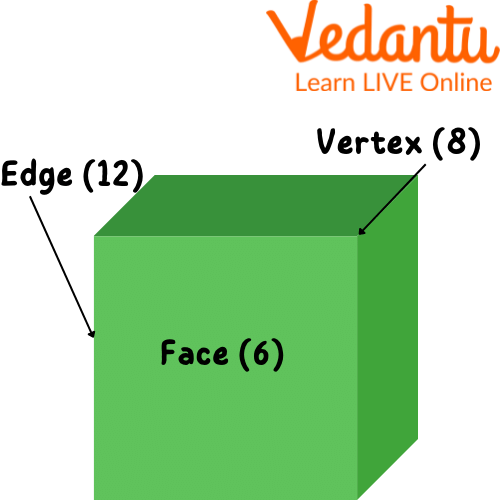
Shape of a Cube
Now let’s learn about cube area and perimeter formulas.
The total area of all the cube's faces makes up the surface area of the object. We must sum the areas of each of the cube's six faces in order to get its surface area because it has six faces.
We are aware that the cube contains a square figure on each face. As a result, the square of one side's length is equal to the area of each face of the cube. If an is used to represent one of the sides' lengths, we get the following:
Area of a cube face $=a^{2}$
If we add the six faces, we have:
$A_{s}=a^{2}+a^{2}+a^{2}+a^{2}+a^{2}+a^{2}$
$A_{s}=6 a^{2}$
where $A_{s}$ represents the surface area and $a$ represents the length of one side of the cube.
Cube Perimeter formula
Let’s discuss how to find the perimeter of a cube formula. The lengths of all the cube's sides, often referred to as its edges, add together to form the perimeter of a cube. There are a total of 12 edges in a cube.
The perimeter of one face of cube formula:
$p=4a$
Additionally, since a cube is a regular shape, all 12 of its edges must be the same length. Taking all of this into account, we can derive the cube perimeter formula shown below:
$p=12 a$
where $a$ is the length of one of the edges of the cube.
Now we have command over the cube area and perimeter formula. Let’s see some solved examples based on it.
Solved Examples
Q1. The perimeter of a cube is 36 cm. Find the surface area of the cube.
Perimeter of a cube = 12a (a = side length)
Ans: Given that 12a = 36
$a=\dfrac{36}{12}$
$=3 \mathrm{~cm}$
Surface Area $=6 (a^2) =6 \times (3^2)$
$=6 \times 9$
$=54 \mathrm{cm}^{2}$
Q2. Find the perimeter of a cube having edges of a length of 5m.
Ans: Put length $a=5$ in the perimeter formula:
$p=12 a$
$p=12(5)$
$p=60 \mathrm{~m}$
The perimeter is equal to $60 \mathrm{~m}$.
Q3. Find the length of the sides of a cube that has a perimeter of $120 \mathrm{~m}$.
Ans: To find the length of the sides or edges, we have to use $p=120$ and solve for $a$ :
$p=12 a$
$120=12 a$
$a=\dfrac{120}{12}$
$a=10 m$
The sides have a length of 10m.
Q4. What will be the surface area of a cube if it has sides of a length of 10m?
Ans: Put $a=10$ in the surface area formula
$A_{s}=6 a^{2}$
$A_{s}=6(10)^{2}$
$A_{s}=6(100)$
$A_{s}=600 m^{2}$
The surface area is $600 \mathrm{~m}^{2}$.
Q5. Find the side length of a cube if it has a surface area of $240 \mathrm{~m}^{2}$.
Ans: Put the surface area in the formula and solve
$A_{s}=6 a^{2}$
$240=6 a^{2}$
$\dfrac{240}{6}=a^{2}$
$40=a^{2}$
$a=6.32 m$
The length of the sides is $6.32 \mathrm{~m}$.
Practice Questions
Q1. What is the length of the sides of a cube that has a perimeter of 144m?
Ans: 12 $m$
Q2. If a cube has sides of length 4m, what is its surface area?
Ans: 96 $m^2$
Q3. If a cube has a surface area of 54m2, what is the length of its sides?
Ans: 3 $m$
Q4. If the perimeter of one face of a cube is 20cm, then its surface area is
Ans: 150 $cm^2$
Q5. Each edge in a cube is 5 cm. What is the surface area in square cm?
Ans: 150 $cm^2$
Summary
One of the most prevalent three-dimensional solid objects is the cube. The length of each side of a cube is its defining property. 6 faces, 12 edges, and 8 vertices make up a cube. Examples of these figures in everyday life include the Rubik's cube and a conventional 6-sided dice. We discussed in the article the formula of perimeter of the cube as well as area.
When we wish to measure a two-dimensional quantity in the cube, the surface area is a measurement that might be helpful. The perimeter of a cube is equal to the total of its individual sides, commonly known as the cube's edges, much like the perimeter of a square is equal to the sum of its side lengths.

Real-life Examples of a Cube
FAQs on Understanding the Perimeter of a Cube
1. What is the perimeter formula of a cube?
The perimeter of a cube (total length of all its edges) is given by the formula P = 12a, where a is the side length. A cube has 12 equal edges, so:
- Number of edges = 12
- Length of each edge = a
- Total perimeter = 12 × a
2. How do you find the perimeter of a cube step by step?
To find the perimeter of a cube, multiply the side length by 12. Follow these steps:
- Step 1: Identify the side length (a).
- Step 2: Use the formula P = 12a.
- Step 3: Substitute the value of a.
3. Why is the perimeter of a cube 12a?
The perimeter of a cube is 12a because a cube has 12 equal edges, each of length a. Since perimeter here means the total length of all edges:
- Total edges = 12
- Each edge = a
- Total length = 12 × a
4. What is the perimeter of a cube with side length 7 cm?
The perimeter of a cube with side 7 cm is 84 cm. Using the formula P = 12a:
- a = 7 cm
- P = 12 × 7
- P = 84 cm
5. Is the perimeter of a cube the same as its surface area?
No, the perimeter of a cube is different from its surface area. The perimeter is the total length of all edges (P = 12a), while the surface area is the total area of all 6 faces (SA = 6a²).
- Perimeter measures length.
- Surface area measures area.
6. Can you find the perimeter of a cube if the volume is given?
Yes, you can find the perimeter if you first determine the side length from the volume. Since Volume = a³:
- Step 1: Find a by taking the cube root of the volume.
- Step 2: Use P = 12a.
7. What is the difference between the perimeter of a cube and the perimeter of one face?
The perimeter of one face of a cube is 4a, while the perimeter of the entire cube (all edges) is 12a. A single face is a square:
- Perimeter of one square face = 4 × a
- Total cube edge length = 12 × a
8. What units are used for the perimeter of a cube?
The perimeter of a cube is measured in linear units such as cm, m, or inches. Since perimeter represents total edge length:
- If side is in cm, perimeter is in cm.
- If side is in meters, perimeter is in meters.
9. How many edges does a cube have?
A cube has 12 edges. These edges connect the 6 square faces and 8 vertices of the cube.
- Each face has 4 edges.
- Edges are shared between faces.
- Total distinct edges = 12.
10. What are common mistakes when calculating the perimeter of a cube?
A common mistake is confusing the perimeter with surface area or volume. Remember:
- Perimeter (total edge length) = 12a
- Surface area = 6a²
- Volume = a³
