









How to Do Multi Digit Multiplication Step by Step with Examples
In our earlier classes, we learned about all four maths operations: addition, subtraction, multiplication and division. And from all the operations, our favourites were addition and multiplication because they were simpler than subtraction and division. But today in this article, we will learn about multi-digit multiplication in a very easy and enjoyable way. Doing multiplication is fun if it's done in the right way. So in this article, we will learn about 5 digit multiplication, which we might call hard multiplication. Here we provided multiplication practice problems and 3-digit multiplication worksheets to clear your concepts.
What is Multiplication?
Multiplication is an important arithmetic operation; it helps to find the total number of items quickly. It's the operation representing the basic idea of repeated addition of the same number. So we can say that it's a method of finding the product of two or more numbers. We use multiplication in our everyday life. Do you want to know how?
So let's say you went to a grocery store to buy 5 apples, which cost 10 rupees. How much money do you need to pay to buy those 5 apples? Do you know the answer? Ok, stop, don't waste your time adding them repeatedly; just multiply 5 by 10, so the answer is 50. So you will need 50 rupees to buy those 5 apples.
Here we understand multiplication and why we need it, we find it interesting, too, so don't worry. We are not going to stop here. We are going to explore multiplication a little bit more. We are going to learn about multi-digit multiplication.
Symbol of Multiplication
While doing multiplication, there are many symbols which are used to denote the most interesting arithmetic operation, i.e. multiplication. So let's check what symbols are used to denote multiplication.
Cross sign “X”, dot sign “.”, and the star sign “*”. And remember, if there is no symbol after the bracket, there is also multiplication between the numbers. Confused? Don't worry. Let's check it with an example 5(7)= 35.

Symbol of multiplication
Formula for Multiplication
The multiplication formula is very simple. Let's see what it is, Multiplicand x Multiplier = Product. Where multiplicand refers to the first number, the total number of objects in each group. Then Multiplier is the second number which is the number of equal groups.
And the last is the product which is the final result that we get after multiplying the multiplicand and the multiplier.
Example: If a multiplier is 6 and multiplicand is 5, the product is 30.
12 x 10 = 120

Multiplication
Rules for Multiplication
If any number is multiplied by 0, the product will be 0.
Example: $5 \times 0 = 0$
The multiplication of two integers is an integer.
Example: $5 \times 5 = 25$
The order of the number does not matter when they are multiplied together.
Example: $25 \times 5 = 125$ or $5 \times 25 = 125$
If any number multiplied by 1 is equal to the original number.
Example: $5 \times 1 = 5$
Solved Example
Let's learn about multiplication by looking at solved examples based on 5-digit multiplication and 3-digit multiplication:
Q 1. Multiply 123 x 3
Ans: Step-1. Write the number one below the other as per the places of their digits.
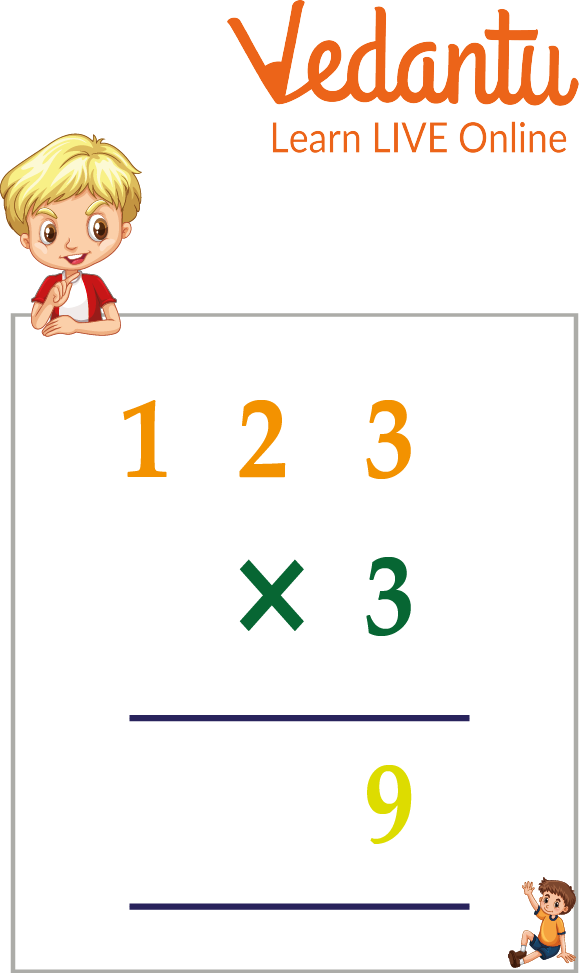
Multiplication
Step-2. Multiply the ones digit of the top number by the ones digit of the bottom number.
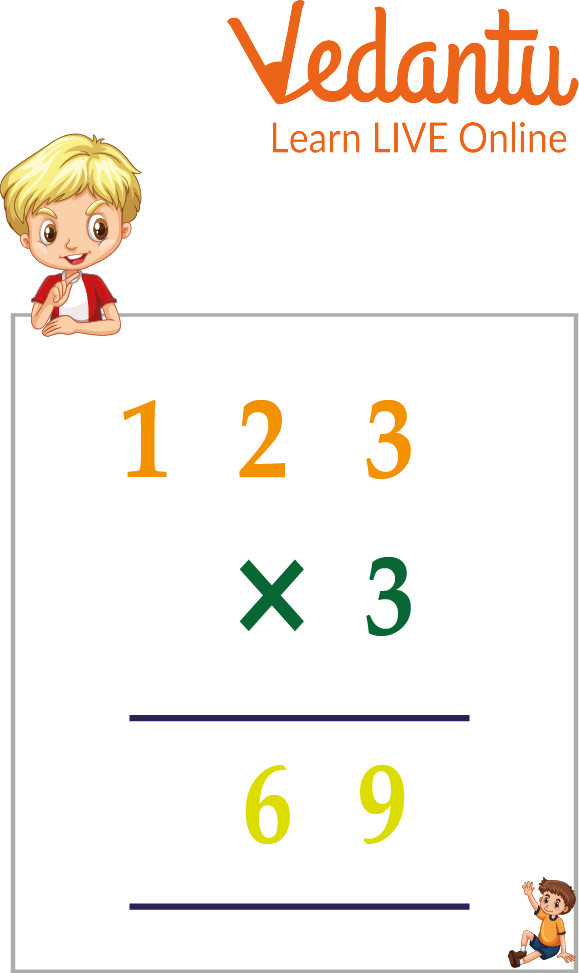
Multiplication
Step-3. Multiply the tens digits of the top by the ones digit of the bottom number and you will get your answer.
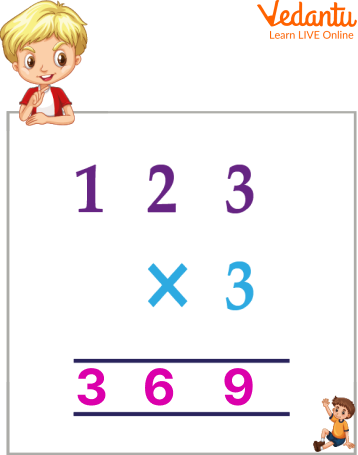
Multiplication
Q 2. Multiply 36953 x 3
Ans: Step-1. Write the number one below the other as per the places of the digit.
Step-2. Now by multiplying the tens place, if there is a carry of number, shift it to another number at the top of the hundreds place.
Step-3. By multiplying in this way, you will get your answer. i.e. 110859.
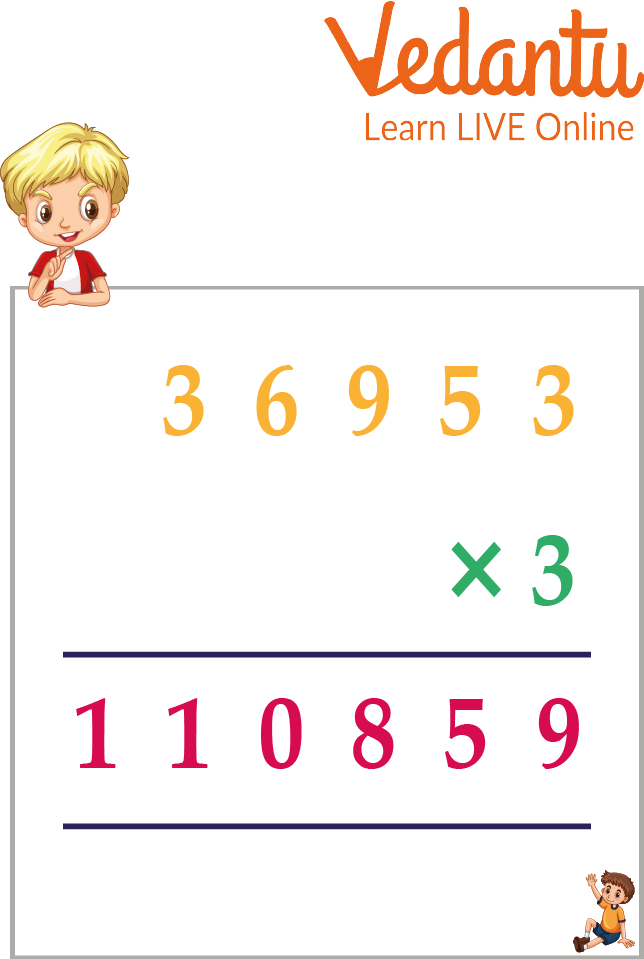
5-digit multiplication
Multiplication Practice Problems
Here are some practice problems based on hard multiplication:
Q 1. 343 x 213
Ans. 73,059
Q 2. 369 x 15
Ans. 5535
Q 3. 513 x 33
Ans. 16,929
3 Digit Multiplication Worksheets
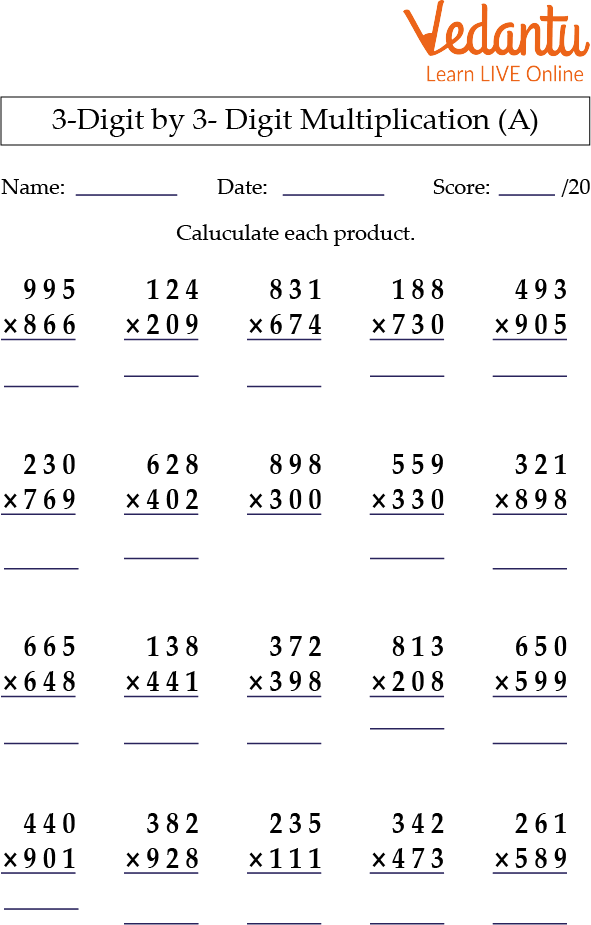
3-Digit Multiplication Worksheets
Summary
So in this article, we learned about many wonderful things related to multiplication. We learned about multiplication, like what multiplication is and what are the symbols of multiplication. We learned the formula of multiplication. We also discussed the rules for multiplication to make hard multiplication easy.
We just did not end there. We also did some multiplication practice problems as we know that maths is not learned by reading. It's learned by solving by doing questions.
That's why we have provided a 3-digit multiplication worksheet to clear all your doubts.
FAQs on Multi Digit Multiplication Method and Concept Guide
1. What is multi digit multiplication?
Multi digit multiplication is the process of multiplying numbers that have two or more digits by breaking them into place values and multiplying step by step. It uses the standard algorithm or area model to find the product.
- Multiply each digit of one number by each digit of the other.
- Align place values correctly.
- Add all partial products to get the final product.
2. How do you multiply two multi digit numbers step by step?
To multiply two multi digit numbers, use the standard multiplication algorithm by multiplying digit by digit and adding partial products.
- Step 1: Multiply the top number by the ones digit of the bottom number.
- Step 2: Multiply the top number by the tens digit (shift one place left).
- Step 3: Add the partial products.
- 34 × 2 = 68
- 34 × 10 = 340
- Add: 68 + 340 = 408
3. What is the standard algorithm for multi digit multiplication?
The standard algorithm for multi digit multiplication is a column method where each digit is multiplied according to its place value and partial products are added.
- Write numbers vertically aligned by place value.
- Multiply starting from the rightmost digit.
- Carry over when needed.
- Add all partial products.
4. Can you give an example of multi digit multiplication?
Yes, an example of multi digit multiplication is 56 × 23, which equals 1,288.
- 56 × 3 = 168
- 56 × 20 = 1,120
- Add: 168 + 1,120 = 1,288
5. Why do you add a zero when multiplying multi digit numbers?
You add a zero in multi digit multiplication to represent multiplication by 10 or higher place values. When multiplying by a tens digit, the result shifts one place to the left.
- Example: 45 × 30
- First multiply 45 × 3 = 135
- Since 3 represents 30, write 1,350 (add one zero)
6. What is the area model in multi digit multiplication?
The area model is a visual method of multi digit multiplication that breaks numbers into expanded form and multiplies each part separately.
- Example: 23 × 15
- (20 + 3)(10 + 5)
- 20×10 = 200
- 20×5 = 100
- 3×10 = 30
- 3×5 = 15
- Add: 200 + 100 + 30 + 15 = 345
7. What are partial products in multi digit multiplication?
Partial products are the intermediate results obtained when multiplying each digit separately before adding them together.
- Example: 36 × 24
- 36 × 4 = 144
- 36 × 20 = 720
- Add: 144 + 720 = 864
8. What are common mistakes in multi digit multiplication?
Common mistakes in multi digit multiplication include place value errors and incorrect addition of partial products.
- Not aligning digits by place value.
- Forgetting to add a zero when multiplying by tens.
- Errors in carrying over numbers.
- Adding partial products incorrectly.
9. How do you multiply multi digit numbers with decimals?
To multiply multi digit decimals, multiply as whole numbers first and then place the decimal point correctly in the final product.
- Example: 2.4 × 1.3
- Ignore decimals: 24 × 13 = 312
- Total decimal places = 2
- Place decimal: 3.12
10. How do you check multi digit multiplication answers?
You can check multi digit multiplication by using estimation or the inverse operation, division.
- Estimate by rounding numbers to see if the answer is reasonable.
- Divide the product by one factor to see if you get the other factor.
