









How to Solve Circle Number Puzzle Questions with Step by Step Tricks
Circle puzzles or pattern of circle are simple brain teasers that can be found everywhere, from newspapers to quiz books. They are popular, especially among children but adults also love to solve these puzzles. Solving these puzzles requires no knowledge, but sometimes they require arithmetic knowledge and strong logical skills. If you enjoy solving circle puzzles or have been wanting to attempt one for a long time, go through this article for a comprehensive guide.
What is a Circle Puzzle?
A Circle puzzle is a game or issue or numerical question that puts one's creativity or knowledge to the test. In order to get the right or enjoyable answer, the solver of a puzzle is supposed to logically arrange the parts together. Crossword puzzles, word searches, number puzzles, relational puzzles, and logic puzzles are only a few examples of the various puzzle subgenres. Enigmatology is the term for the study of puzzles in academia.
What Do You Need to Know Before Attempting?
This is the most basic question asked while attempting brain teasers. You do not need any kind of hard maths concept or magical spells, you can solve these puzzles with just a little logic. Recognise a pattern and follow it to find the missing number. Let’s see the procedure of solving puzzles and see the circle puzzles with solution.
How to Solve a Missing Number Puzzle?
Here are the steps to solve a missing number puzzle.
First, recognise a pattern between the numbers of the first set.
Verify the pattern for the second set.
If the second set satisfies the pattern we got our required pattern, otherwise we look for a different pattern.
Once the required pattern is found, use the pattern on the last set to find the missing number.
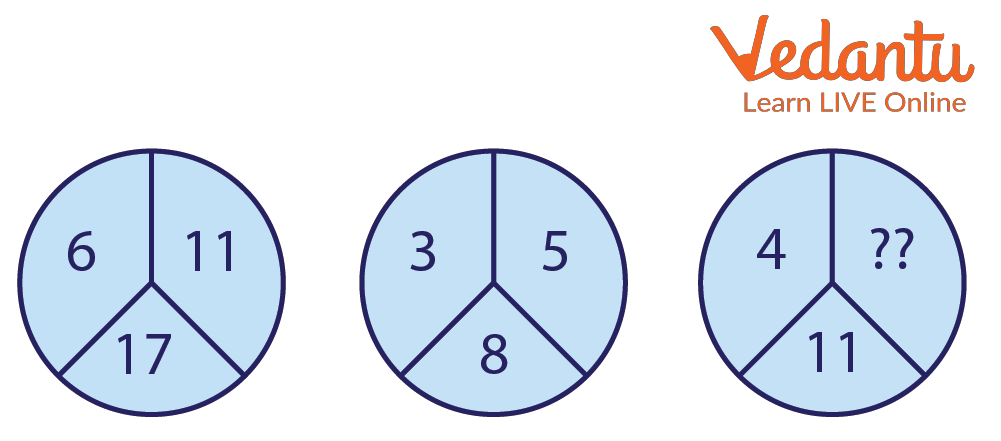
Now that we have learnt the steps to solve these puzzles, let’s solve a puzzle to get our hands on this. For this purpose, we are going to solve the puzzle given in the image below.
Solve the Following Puzzle
To solve the above circular number puzzle, we will follow the steps carefully.
The first step is to find a pattern in the first set. Fortunately, we see that the sum of two numbers at the top equals the third number, i.e, \[6 + 11 = 17\].
Next, we verify the pattern found for the second set of numbers. Here, We see that it works for the second image as \[3 + 5 = 8\].
Since it works for both images, we can use it for the last one to find the missing number.
Hence, applying the pattern for the third image gives us, \[4 + {\rm{x}} = 11\]. Thus, \[{\rm{x}} = 7\].
Great! We have understood how to solve these types of puzzles where we recognise a pattern between numbers and ding the missing number at last. Now, we look at some solved examples to get a better understanding of what we learnt.
Solved Examples
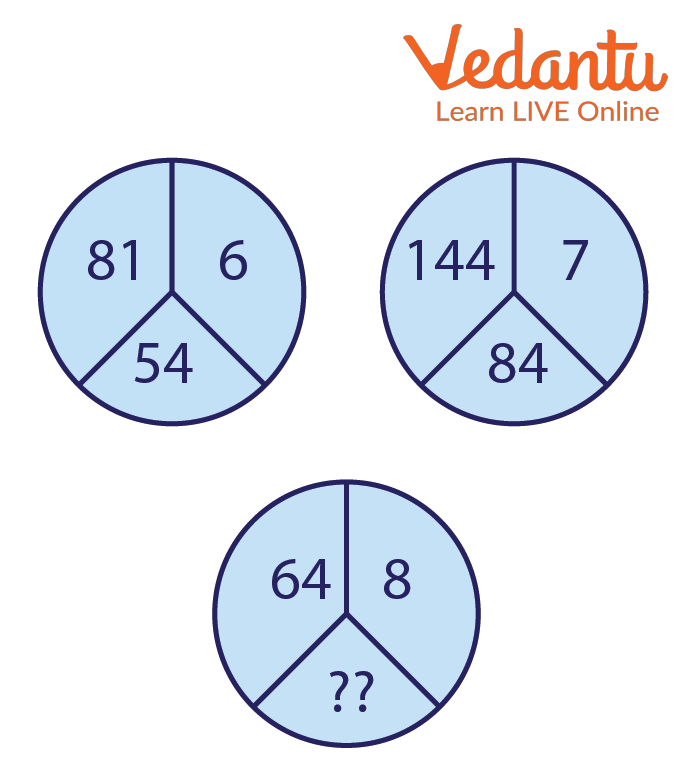
1. Find the missing number.
Find the Missing Number
We see that the square root of 81 is 9. And the product of 9 and 6 gives 54. So we have found a pattern that works for the first image. Let’s verify it for the second image. The square root of 144 is 12 and the product of 12 and 7 is 84. Hence, our pattern satisfies both images, so we can use it on the third image to find the missing number. The square root of 64 is 8 and the product of 8 and 8 is 64. Hence, the missing number should be 64.
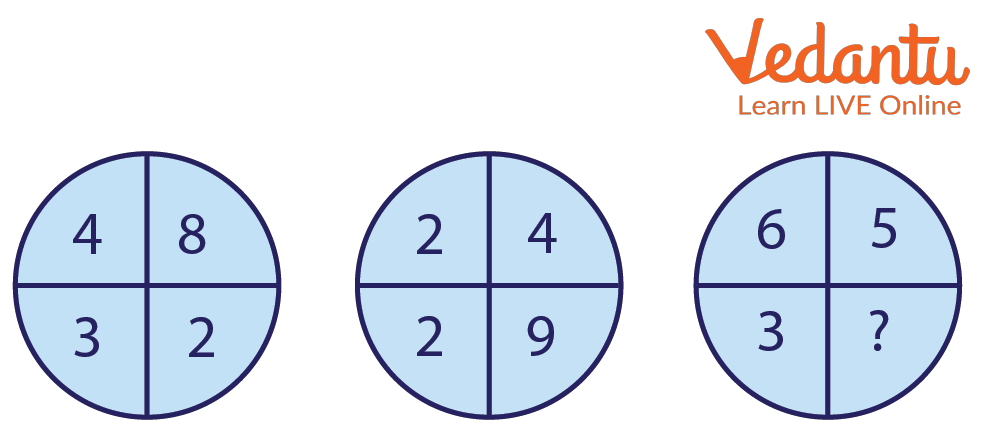
2. Find the missing number in the pattern.
Find the Missing Number
We see that the sum of all the numbers in the first image is 17 as \[4 + 8 + 3 + 2 = 17\]. Now we verify this pattern for the second image, \[2 + 4 + 2 + 9 = 17\]. Hence, the pattern satisfies both images. Thus, we can apply this pattern to find the missing number in the last image, \[6 + 5 + 3 + {\rm{x}} = 17\], this gives \[{\rm{x}} = 3\].
3. Find the next number in the sequences 0, 2, 2, 4, 5, 9, 14, 23…
Here we see that every term is obtained by adding the previous two terms. Hence the missing number is \[23 + 14 = 37\].
4. Find the missing value (5,2,6), (4,3,2), (8,4,?)...
We see that the third term is twice the difference between the first two-term in each triplet. \[2 \times [5 - 2] = 6\]\[2 \times [5 - 2] = 6\], \[2 \times [4 - 3] - 2\] hence the missing number is \[2 \times [8 - 4] = 8\].
Conclusion
Circle puzzles with missing numbers are a very interesting brain teaser. They are very fun to play with friends. We have learnt how to solve these puzzles as well as solving some examples. They increase our ability to think logically and increase our arithmetic skills. They can be easily found everywhere, from newspapers to the reasoning section of any competitive examinations.
FAQs on Circle Number Puzzle Explained with Rules and Logic
1. What is a Circle Number Puzzle?
A Circle Number Puzzle is a logic-based maths puzzle where numbers are arranged in a circle and must satisfy specific arithmetic conditions. Typically, the puzzle requires that adjacent numbers add, subtract, multiply, or divide to produce given results inside or outside the circle. These puzzles test logical reasoning, number patterns, and basic arithmetic skills. They are commonly used in primary and middle school maths practice.
2. How do you solve a Circle Number Puzzle step by step?
To solve a Circle Number Puzzle, start by identifying the arithmetic rule connecting the numbers and then fill in missing values logically.
- Step 1: Identify the operation used (addition, subtraction, multiplication, or division).
- Step 2: Look for given numbers and calculate possible missing values.
- Step 3: Check that all adjacent pairs satisfy the rule.
- Step 4: Verify the full circle works consistently.
3. What are the common rules used in Circle Number Puzzles?
The most common rules in a Circle Number Puzzle involve basic arithmetic operations between adjacent numbers.
- Addition: Two neighbouring numbers add to give a result.
- Subtraction: The difference between adjacent numbers matches a given value.
- Multiplication: Adjacent numbers multiply to produce a result.
- Division: One number divided by another gives a target value.
4. Can you give an example of a Circle Number Puzzle with a solution?
Yes, for example: If two adjacent numbers add to 10 and one number is 6, the missing number is 4.
- Given rule: Addition
- Equation: 6 + ? = 10
- Missing number: 4
5. What skills does a Circle Number Puzzle improve?
A Circle Number Puzzle improves arithmetic accuracy, logical thinking, and pattern recognition. Specifically, it develops:
- Mental maths skills
- Problem-solving strategies
- Understanding of number relationships
- Critical thinking
6. What is the difference between a Circle Number Puzzle and a Magic Circle?
The main difference is that a Magic Circle requires all sums around the circle to be equal, while a Circle Number Puzzle may follow different arithmetic rules. In a magic circle:
- All adjacent pairs sum to the same constant.
- Rules may involve addition, subtraction, multiplication, or mixed operations.
7. How do you find a missing number in a Circle Number Puzzle?
To find a missing number, rearrange the arithmetic rule into an equation and solve it. For example, if adjacent numbers multiply to 24 and one number is 6, then:
- Equation: 6 × ? = 24
- Missing number = 24 ÷ 6 = 4
8. Are Circle Number Puzzles suitable for primary school students?
Yes, Circle Number Puzzles are highly suitable for primary school students because they reinforce basic arithmetic operations in a fun way. Teachers often use them to practise:
- Addition and subtraction facts
- Times tables
- Number bonds
9. What are common mistakes when solving Circle Number Puzzles?
A common mistake in a Circle Number Puzzle is ignoring one pair of adjacent numbers that does not satisfy the rule. Frequent errors include:
- Using the wrong arithmetic operation
- Forgetting to check the full circle
- Miscalculating basic arithmetic
10. Why are Circle Number Puzzles important in maths learning?
Circle Number Puzzles are important because they combine arithmetic practice with logical reasoning in one activity. They help learners:
- Apply number operations in context
- Strengthen problem-solving skills
- Build confidence in handling numbers
