









How to Find the Center of a Circle Using Formula and Geometric Construction
A circle, in particular, is a simple closed curve that splits the plane into two areas: interior and exterior. In common usage, the term "circle" can refer either to the figure's boundary or the entire figure, including its interior; in strict technical everyday language, the circle is only the border, and the entire figure is called a disc. The center of a circle is the point where all the lines that form the boundary meet. The origin of circle is a point from which all distances to it are measured. In this article, we will be exploring origin of circle and its implications.
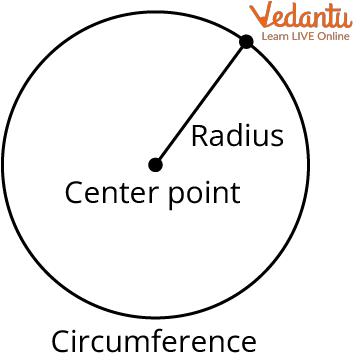
Center of a Circle
What is the Center of a Circle?
The point inside a circle that is equally spaced from all other points on the circle is considered the center of a circle.
It is a point inside the circle which is at an equal distance from all the points on its circumference.
The center of a circle is often referred to as the origin of a circle.
A circle's radius-The radius of a circle is the distance between the circle's center and any point on its circumference.
It is usually represented by the letters 'R' or 'r'.
A circle's diameter- The diameter is the length of the line passing through the center and touching two points on the circle's boundary.
A Circle's Chord-A straight line joining two points on the circumference of the circle is the chord of the circle.
The diameter of a circle is defined as the circle's longest chord.
How to Find the Center of a Circle?
Following is the method to find the origin of a circle by drawing chords.
1. Draw a chord in a circle (ab)
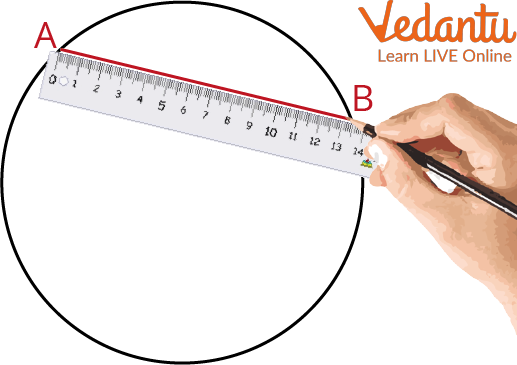
Chord in a Circle
2. Draw another chord parallel to the previous chord (XY)
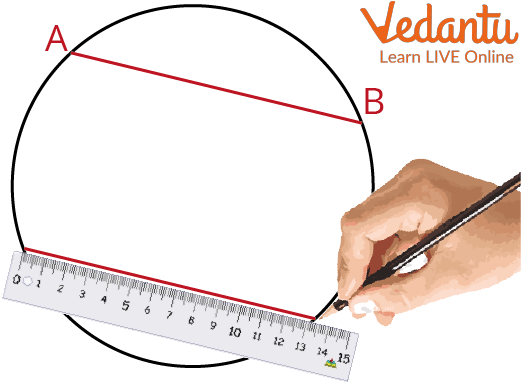
Another Chord
3. Join points a and y Using a ruler
4. Join points b and x Using a ruler
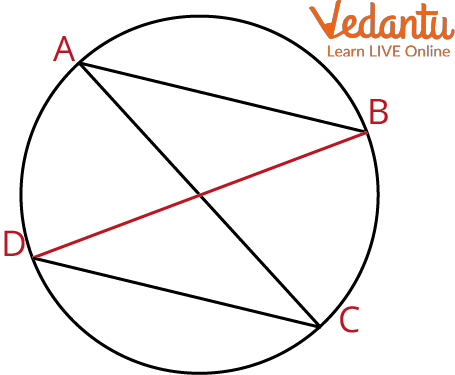
Join the Points
5. The point where the lines intersect is the center of the circle.
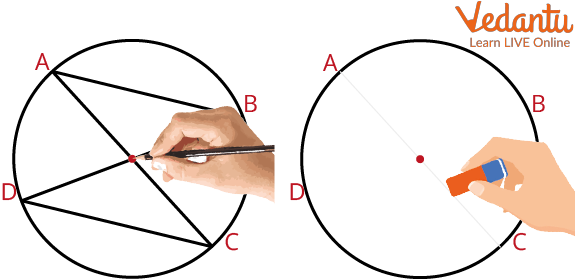
The Lines Intersecting is the Center of the Circle
Solved Example
Example 1: Find the area of a circle whose radius is 28 cm.
Ans: Given,
Radius of circular region = r = 28 cm
Area of a circle = $\pi\,r^2$
= $\dfrac{22}{7}\times 28 \times 28$
= $22\times 4\times21$
= 1848 sq. cm
Therefore, the area of the circular region is 1848 sq. cm.
Example 2: Tell whether the given statement is true or not: If the endpoints of the diameter of the circle are given, then to find the coordinates of the center we use the mid-point formula.
Ans: True, if the endpoints of the circle's diameter are given, then to find the coordinates of the center we use the mid-point formula.
Practice Questions
Q1. Find the diameter of a circle whose radius is 10 cm.
Ans: 20cm
Q2. The radius of a circle is 2 cm. What is the diameter of a circle whose radius is 3 times that of the given circle?
Ans: 12cm
Summary
So, from the article, we know that a circle is made up of all points in the same plane that are equidistant from one another. The center of a circle is the point equidistant from all points on the edge of the circle. It is also the point at which the circle's circumference (the line that defines the edge of the circle) intersects its diameter (the distance across the circle). The center of a circle is important in geometry because it is used to define many other geometric concepts, such as radius, chord, and arc.
FAQs on Center of a Circle Explained with Definition and Diagram
1. What is the center of a circle?
The center of a circle is the fixed point inside the circle that is at an equal distance from every point on the circle. This equal distance is called the radius.
- All radii of a circle are equal in length.
- The center determines the size and position of the circle.
- In coordinate geometry, the center is written as (h, k).
2. How do you find the center of a circle from its equation?
The center of a circle in standard form is found directly from the equation (x − h)² + (y − k)² = r² as (h, k).
- Identify the values of h and k.
- The signs inside the brackets are opposite of the center coordinates.
3. What is the formula for the center of a circle?
The formula for the center of a circle comes from its standard equation (x − h)² + (y − k)² = r², where the center is (h, k).
- h represents the x-coordinate of the center.
- k represents the y-coordinate of the center.
- r is the radius of the circle.
4. How do you find the center of a circle from a general equation?
The center of a circle from the general form x² + y² + Dx + Ey + F = 0 is found using (−D/2, −E/2).
- Identify D and E from the equation.
- Apply the formula (−D/2, −E/2).
5. Why is the center of a circle important?
The center of a circle is important because it defines the circle’s position and ensures all points on the circle are equidistant from it.
- It helps calculate the radius and diameter.
- It is used to write the circle’s equation.
- It is essential for solving geometry and coordinate geometry problems.
6. How do you find the center of a circle given two endpoints of a diameter?
The center of a circle is the midpoint of the diameter, calculated using the midpoint formula.
- Use midpoint formula: ((x₁ + x₂)/2, (y₁ + y₂)/2).
7. What is the difference between the center and the radius of a circle?
The center of a circle is a point, while the radius is the distance from the center to any point on the circle.
- Center: Fixed point inside the circle (h, k).
- Radius: Length of a line segment from center to the circle.
8. Can a circle have more than one center?
No, a circle has exactly one center because only one point is equidistant from all points on the circle.
- If there were two centers, the distances would not remain equal.
- This uniqueness defines the geometric property of a circle.
9. How do you find the center of a circle graphically?
The center of a circle can be found graphically by locating the midpoint of the diameter or by constructing perpendicular bisectors of chords.
- Draw any two chords of the circle.
- Construct perpendicular bisectors of both chords.
- Their intersection point is the center.
10. What are some real-life applications of the center of a circle?
The center of a circle is used in real life to design and measure circular objects accurately.
- Engineering: locating the center of wheels and gears.
- Architecture: designing domes and circular structures.
- Navigation: calculating circular motion paths.
