









How to Use the Area Model Method with Step by Step Examples
Multiplication is a fundamental arithmetic operation that students learn at a young age. If they have a keen understanding of multiplication, they can start applying this concept to real-world problems. The area model multiplication worksheets consist of various questions that help students to visualise multiplication. With the help of the given solved examples, students will understand the area model of multiplication more clearly. Some practice problems are given that need to be solved by the students on their own, to develop a better understanding of the topic.
What is the Multiplication with Area Model?
In mathematics, an area model is defined as a rectangular diagram or model which is used in multiplication and division problems, where the factors or the quotient and divisor specify the length and width of the rectangle. One can break one large area of the rectangle into several smaller boxes, using number bonds, to make the calculation easier. Then add the number to get the area of the whole, which is the product.
By using the area model we can multiply 2 two-digits numbers by following the given steps:
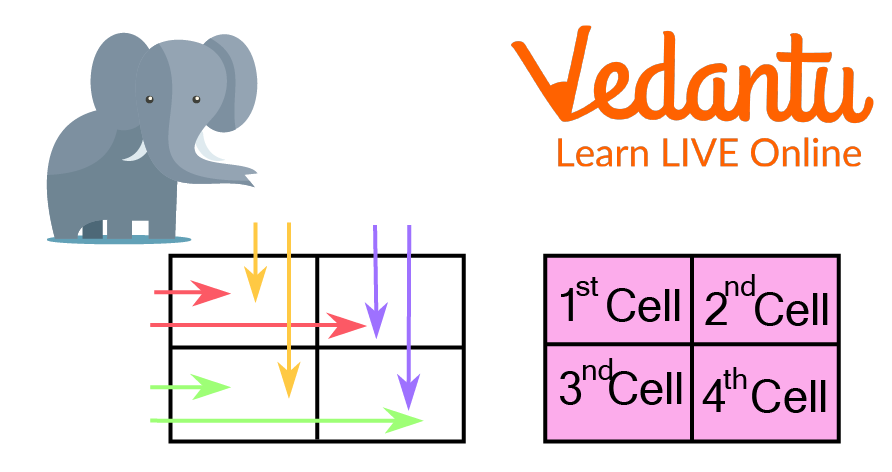
Multiplication with Area Model
Here, as an example, the area model has been used to multiply 27 and 35.
Write the multiplicands in expanded form as tens and ones. For example, 27 is 20 and 7, and 35 is 30 and 5.
Draw a 2 × 2 grid, which is a box with 2 rows and 2 columns.
Write the terms of 1 of the multiplicands on the highest of the grid (box). One of the highest of every cell.
On the left of the grid write the terms of the other multiplicand. One on the side of every cell.
Write the product of the number on the tens in the first cell. Then write the product of the tens and ones in the second and third cells. Write the product of the ones in the fourth cell.
Lastly, to get the final product, add all the partial products.
Thus, The multiplication of 27 and 35 is 945.
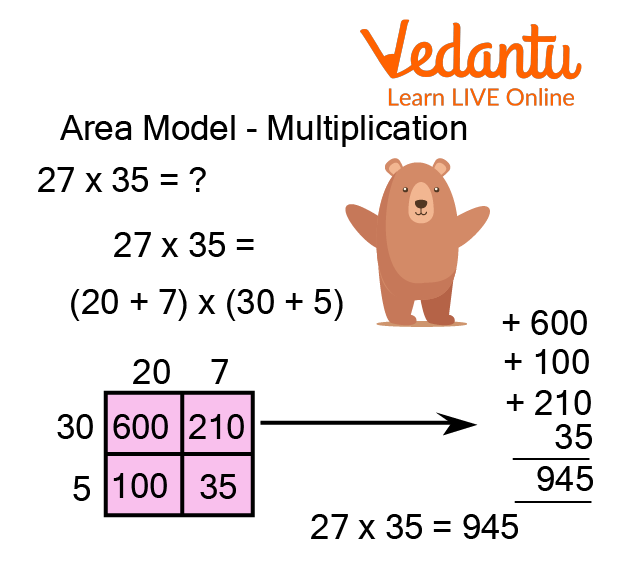
Area Model Multiplication
Multiplying with Area Model a 1-Digit Number
One can use area models in multiplying large numbers. Display the problem as the area of a rectangle, and then break that rectangle into smaller parts to solve it easily. This method is also known as the box multiplication method. Now, try it with 628 × 5. Let the problem be shown as the area of a rectangle:
Next, let the rectangle split into smaller pieces for easier multiplication. We will use the expanded form of 628 to keep the maths simple:
628 = 600 + 20 + 8
Now, multiply to find the area of each smaller rectangle. Lastly, to find the area of the original rectangle adds those products.
3000 + 100 + 40 = 3140
So, the product 628 × 5 is equal to 3140.
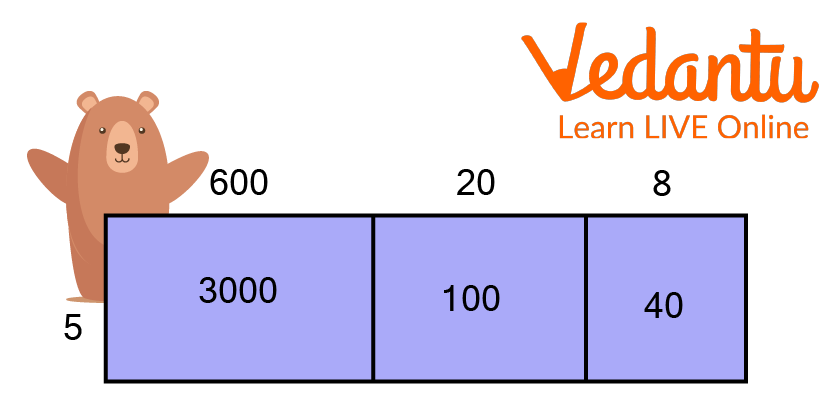
Multiplying with The Area Model
Multiplying with Area Model a 2-Digit Number
One can use area models for larger problems, too. Let's use 36×52 as an example. Firstly, write each factor in expanded form, i.e.
36 = 30 + 6
52 = 50 + 2
Then, draw your model.
To find the area of each smaller rectangle, multiply the above expansion
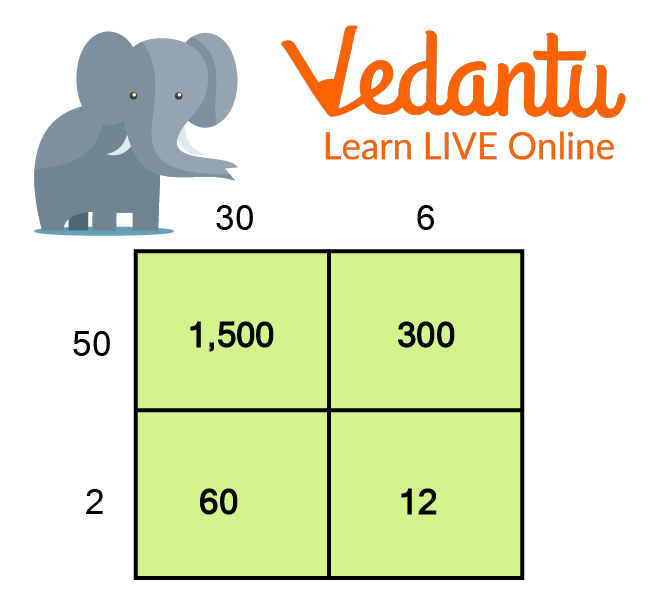
On Multiplying The Above Expansion
Lastly, add those products to find the total area.
1500 + 300 + 60 + 12 = 1872
So, the required product of 36 × 52 is 1872.
Solved Examples
Q1. Multiply Using Area Model
(1). 6 x 24
Ans: Multiplication with area model of the term, 6 x 24 is given by:
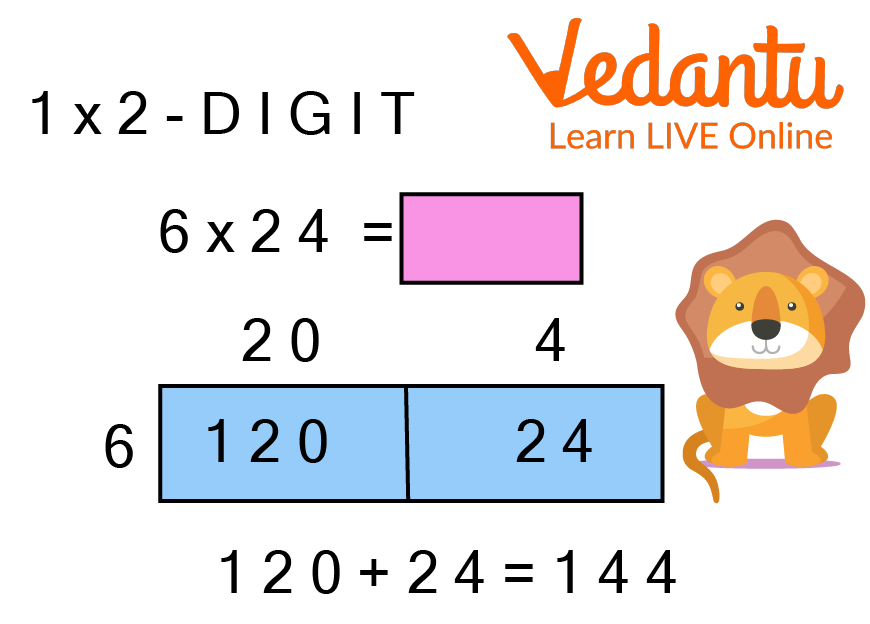
Multiplication of 6 and 24
Thus, the multiplication of 6 x 24 using the area model is 144.
(2). 4 x 125
Ans: Multiplication with area model of the term, 4 x 125 is given by:
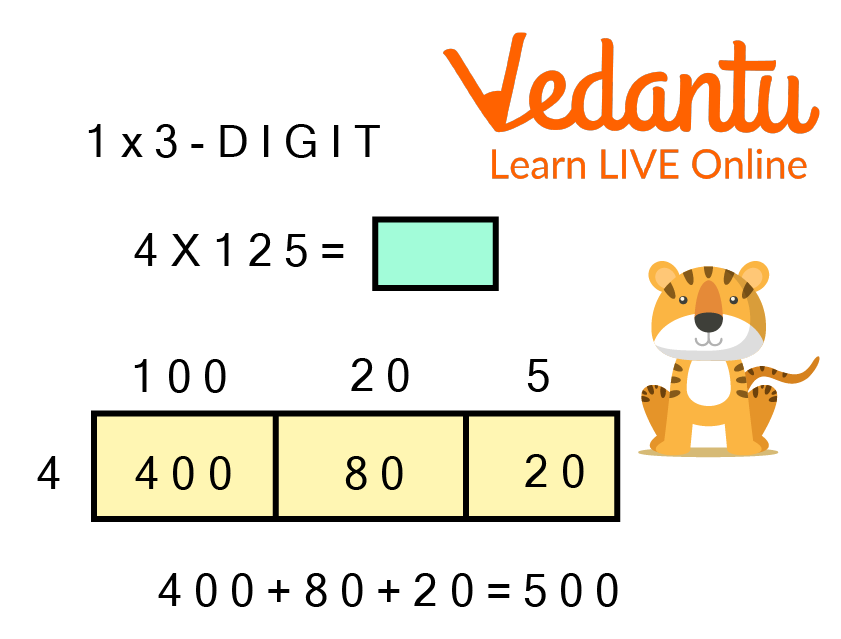
Multiplication of 4 and 125
Thus, the multiplication of 4 x 125 using the area model is 500.
Practice Questions
Q1. 94 x 12
Ans: 1128.
Q2. 70 x 13
Ans: 910.
Q3. 69 x 36
Ans: 2484.
Summary
In this article, we have learned about the Area Model Multiplication. In area model multiplication, a rectangular diagram or model is used for solving multiplication and division problems. In this article, we have learned to multiply a 1-digit number & a 2-digit number using an area model. Lastly, we have also learned about some fun facts related to multiplying with the area model. Some solved examples based on the area model are being discussed for the clarity of concepts. Practice problems are also assigned, along with their answers.
FAQs on Understanding Area Model for Multiplication in Maths
1. What is area model multiplication?
Area model multiplication is a visual method of multiplying numbers by breaking them into place values and finding partial products. It uses a rectangle divided into smaller sections to represent the multiplication.
- Each side of the rectangle shows the expanded form of a number.
- Each smaller box represents a partial product.
- Add all partial products to get the final product.
2. How do you do area model multiplication step by step?
To do area model multiplication, break numbers into place values, multiply each part, and add the results.
- Step 1: Write each number in expanded form (e.g., 23 = 20 + 3).
- Step 2: Draw a rectangle and label the sides with the expanded values.
- Step 3: Multiply each pair to find partial products.
- Step 4: Add all partial products to get the final answer.
3. Can you give an example of area model multiplication?
Yes, for example, 23 × 14 using the area model equals 322.
- Write 23 = 20 + 3 and 14 = 10 + 4.
- Multiply: 20×10 = 200, 20×4 = 80, 3×10 = 30, 3×4 = 12.
- Add: 200 + 80 + 30 + 12 = 322.
4. Why is the area model used in multiplication?
The area model is used in multiplication because it helps students understand place value and partial products visually. It:
- Breaks large problems into smaller, manageable parts.
- Reinforces the distributive property.
- Builds conceptual understanding before using the standard algorithm.
5. What is the formula behind area model multiplication?
The formula behind area model multiplication is based on the distributive property: a(b + c) = ab + ac. For two two-digit numbers:
- (a + b)(c + d) = ac + ad + bc + bd
6. What is the difference between the area model and the standard algorithm?
The main difference is that the area model shows partial products visually, while the standard algorithm is a compact written method.
- The area model breaks numbers into expanded form and adds partial products.
- The standard algorithm multiplies digits in columns and carries values.
7. How does the area model work for 3-digit multiplication?
The area model for 3-digit multiplication works by expanding each number into hundreds, tens, and ones and multiplying all parts. For example, 123 × 45:
- 123 = 100 + 20 + 3
- 45 = 40 + 5
- Multiply each pair and add all partial products.
8. Can the area model be used for decimals?
Yes, the area model can be used for decimal multiplication by expanding decimals into place values. For example, 2.3 × 1.4:
- 2.3 = 2 + 0.3
- 1.4 = 1 + 0.4
- Multiply each part and add: 2×1, 2×0.4, 0.3×1, 0.3×0.4.
9. What are common mistakes in area model multiplication?
Common mistakes in area model multiplication include missing partial products or adding them incorrectly. Students often:
- Forget to multiply every combination of place values.
- Make addition errors when combining partial products.
- Incorrectly expand numbers in expanded form.
10. How does the area model relate to the distributive property?
The area model directly represents the distributive property of multiplication over addition. When you expand (a + b)(c + d), you calculate:
- ac
- ad
- bc
- bd
