









How to Solve Addition and Subtraction of 3 Digit Numbers with Regrouping
What do you understand by the term, "putting things together"? The term "putting things together'' is used for addition. Removing things from a group of several things is equivalent to subtraction. In this article, we will be learning about 3-digit addition and subtraction by making use of several creative images for a better understanding of the topic. Some 3-digit addition worksheets, along with addition practice problems are assigned for getting a hold of the concepts. Let us now begin with the learning.
3-Digit Addition and Subtraction
In performing 3-digit addition or subtraction, one needs to place the given numbers into columns according to their respective place values, like ones, tens, hundreds, thousands, and so on.
While performing addition, one should keep in mind that the numbers being added are known as addends, and the result of their addition is known as the sum.
While performing subtraction, one should keep in mind that the numbers being subtracted are known as subtrahend, the number from which the subtrahend is subtracted is known as minuend, and the result of their subtraction is known as the difference.
Steps to Solve 3-Digit Addition
If one wishes to add three-digit numbers, then the addition always adds the digits according to the place value. Some steps to carry out the operation are given:
Arrange the given numbers in columns based on their place value
Beginning with ones location and progressing to tens and hundreds place
If the problem involves regrouping, i.e. the sum is greater than 9, then put the tens digit of the sum onto the successive digit
Now, add the digits on which the carry is put, and finally, add the carry also to get the required sum at that place value
Repeat the same process till the addition of all the digits does not take place.
For Example: If we wish to add 526 and 214. We start this addition by placing the numbers in column form based on their place value. Then add 6 and 4 to obtain 10, which is greater than 9, so we will use regrouping. It will add 1 to the sum of tens place digits, i.e. 2+1+1, which gives the result as 4. Now take the sum of 5 and 2, which will give 7. So, the addition of 526 and 214 is 740.

Addition of 3-digit Numbers
Steps to Solve 3-Digit Subtraction
The following are the steps for solving the subtraction of 3-digit numbers:
Arrange the given numbers in columns based on their place value
Starting with the ones place and then moving to tens, and hundreds place
If the problem involves borrowing, i.e. the ones place of minuend is less than the ones place of subtrahend, then borrow the carry from the successive digit, which after providing borrowing reduces by 1
Repeat the same process, till the complete subtraction of the digits does not take place.
For example: If we wish to subtract 203 and 110. We will start the subtraction from the right by placing the numbers according to their place values, i.e. 3-0 to obtain 3. As 0 is less than 1, we will borrow a carry of 1 from 2 and then subtract 1 from 10 to get 9. Now 1 is left at the place of 2, taking its difference with 1 results in 0. So, the difference between 203 and 110 is 93.
Solved Examples
Q 1. Add 436 + 486.
Ans: Some steps to carry out the addition are given:
Arrange the given numbers in columns based on their place value
Begin the addition from the ones place, i.e. 6 and 6
As the problem involves regrouping i.e. the sum of 6 and 6 is 12, which is greater than 9, thus put the tens digit of the sum, i.e. 1 onto the successive tens digit
Now, add the tens place digits, i.e. 3 and 8, and also add one carry to obtain the sum
Put the carry of tens place, i.e. 1, onto the digits at hundreds place and repeat the addition process, i.e. 4 and 4 with one carry.
Thus, the result of the addition of the three-digit problem is 922.

Addition of 3-digit Numbers
Ques 2. Subtract 326 and 103.
Ans: Some steps to carry out the operation are given:
Arrange the given numbers in columns based on their place value
Starting the subtraction with the ones place, i.e. 6 and 3
As the problem does not require any borrowing, so moving to the tens place and proceeding to calculate the difference between 2 and 0, which is 2
Then moving to the hundreds place and subtracting 3 and 1, we get 2
Thus, the result of the three-digit subtraction problem is 223.
Subtraction and Addition Practice Problems
Q 1. By using addition with regrouping, add 182 + 50.
Ans: 232
Q 2. Add 600 + 450.
Ans: 1050
Q 3. Subtract 512 - 100.
Ans: 412
Q 4. State true or false: 650 + 420 = 1070.
Ans: True
3-Digit Addition Worksheets
3-digit addition with a carryover worksheet is given, which needs to be solved by the students themselves, without any help.
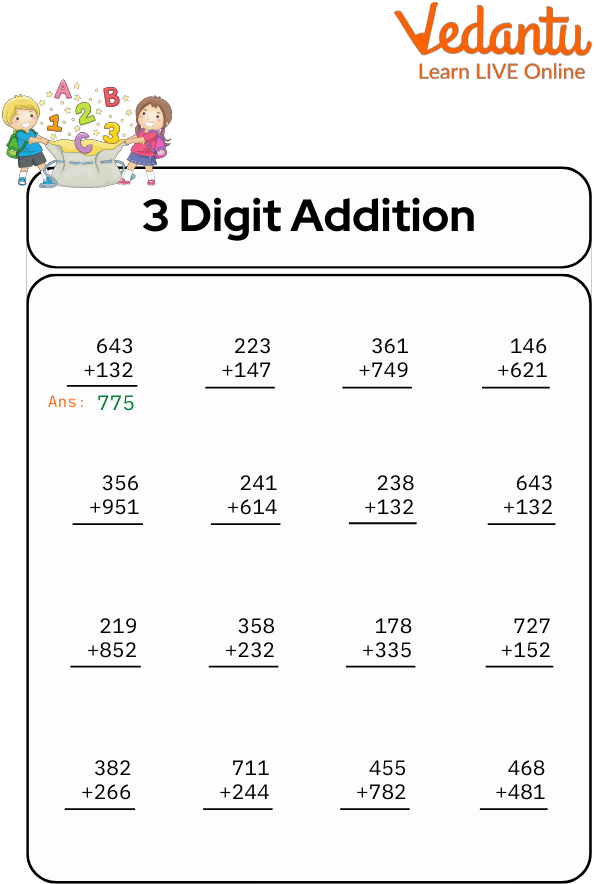
Worksheet
Summary
To wrap up here with the topic of 3-digit addition and subtraction. Mathematics deals with the grouping of numbers according to their place value to perform a particular arithmetic operation. This article has discussed in detail the steps performed to add and subtract a three-digit number. Some 3-digit addition with carryover worksheets are also assigned to the students for practice and to get hold of the concepts. I Hope you find it useful to read the article. Feel free to put your doubts in the comments.
FAQs on Master Addition and Subtraction with 3 Digit Numbers
1. What is addition of 3 digit numbers?
Addition of 3 digit numbers is the process of combining two or more numbers between 100 and 999 to find their total sum. In standard column addition, digits are added place by place.
- Arrange numbers according to hundreds, tens, and ones.
- Add the ones column first.
- Regroup (carry) if the sum is 10 or more.
- Repeat for tens and hundreds.
2. How do you add 3 digit numbers with regrouping?
To add 3 digit numbers with regrouping, add each place value and carry over when the sum in a column is 10 or more.
- Example: 468 + 257
- Ones: 8 + 7 = 15 → write 5, carry 1
- Tens: 6 + 5 + 1 = 12 → write 2, carry 1
- Hundreds: 4 + 2 + 1 = 7
3. How do you subtract 3 digit numbers step by step?
To subtract 3 digit numbers, subtract digits place by place from right to left, borrowing when needed.
- Example: 532 − 248
- Ones: 2 − 8 → borrow → 12 − 8 = 4
- Tens: 2 (after borrowing) − 4 → borrow → 12 − 4 = 8
- Hundreds: 4 − 2 = 2
4. What is regrouping in addition and subtraction of 3 digit numbers?
Regrouping is the process of carrying in addition or borrowing in subtraction when a column total is 10 or more or when the top digit is smaller than the bottom digit.
- In addition: 9 + 6 = 15 → carry 1 to the next column.
- In subtraction: 3 − 7 → borrow 1 from the tens place.
5. What is the place value method for adding and subtracting 3 digit numbers?
The place value method means breaking numbers into hundreds, tens, and ones before adding or subtracting.
- Example: 356 + 243
- (300 + 50 + 6) + (200 + 40 + 3)
- Add each place: 500 + 90 + 9 = 599
6. Can you give an example of addition and subtraction of 3 digit numbers?
An example of addition and subtraction of 3 digit numbers shows how to apply both operations correctly.
- Addition: 724 + 135 = 859
- Subtraction: 724 − 135 = 589
7. What are common mistakes in adding and subtracting 3 digit numbers?
Common mistakes in addition and subtraction of 3 digit numbers include errors in place value and regrouping.
- Not aligning hundreds, tens, and ones correctly.
- Forgetting to carry in addition.
- Forgetting to borrow in subtraction.
- Subtracting the bigger digit from the smaller without borrowing.
8. How do you check addition and subtraction of 3 digit numbers?
You can check addition using subtraction and check subtraction using addition.
- If 456 + 321 = 777, then 777 − 321 should equal 456.
- If 654 − 213 = 441, then 441 + 213 should equal 654.
9. What is the difference between addition and subtraction of 3 digit numbers?
The difference is that addition combines numbers to find a total, while subtraction finds the difference between numbers.
- Addition example: 310 + 220 = 530
- Subtraction example: 530 − 220 = 310
10. Why is place value important in addition and subtraction of 3 digit numbers?
Place value is important because it ensures digits in the hundreds, tens, and ones positions are calculated correctly.
- Incorrect alignment changes the value of digits.
- Example: 345 + 120 must align by place value to get 465.
