









Circumcircle of a Triangle formula properties and how to find the center
A plane figure in which a point is taken as the centre and from that point dots which are equidistant are marked and then joined which makes a circle. The first point or the reference point is known as a centre and the distance between the centre and the surrounding path is known as the radius of the circle.
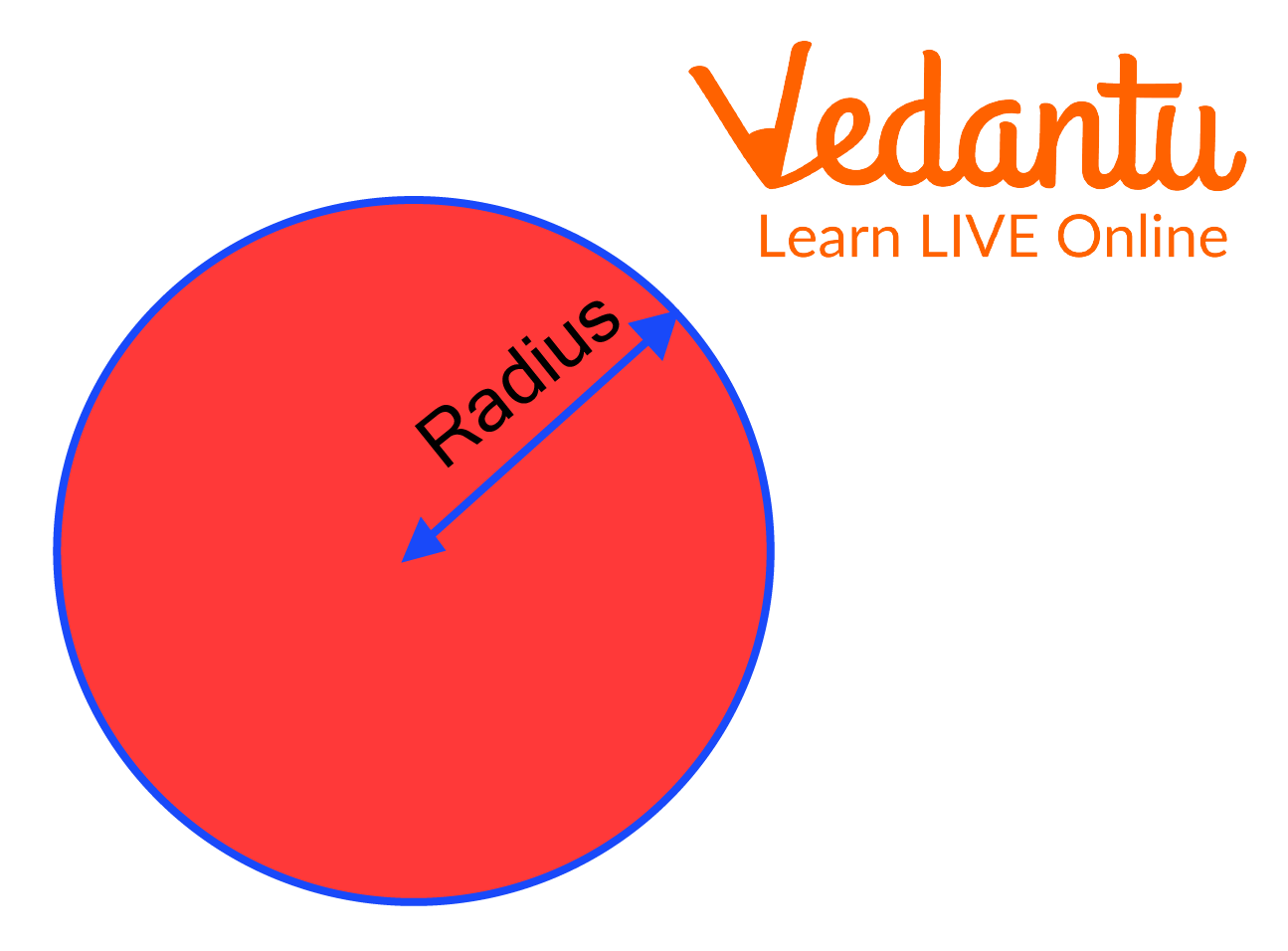
Radius of a Circle
The circle which encircles a polygon by touching each vertex of the polygon is termed a circumcircle. It is drawn by taking the meeting point of the perpendicular bisector to the sides of the polygon as the centre.
What is Circumcircle?
A circumcircle is a circle which circumscribes any polygon and touches each vertex of the polygon. The radius of the circumcircle is the distance between the point of meeting of bisectors and the vertex. The circumcircle is drawn by taking the meeting point of the perpendicular bisector to the sides of the polygon as the centre.
The Circumcircle of a Triangle Formula
The circumcircle of a triangle can be simply derived using the following various methods. The formula is not universal since it changes based on the type of triangle. So let’s find out more about how to find the circumcircle of a triangle.
The Circumcircle of a Triangle
For example, we have to draw a circumcircle to the given triangle then the following steps must be followed;
Step 1: Draw the perpendicular bisectors of the sides.
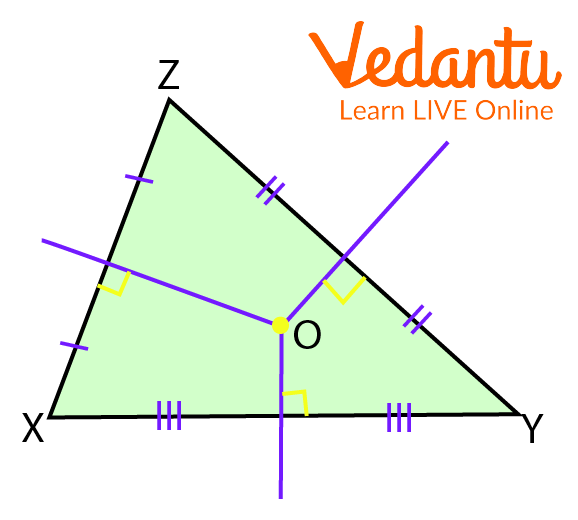
Circumcircle around a Triangle
Step 2: Taking point O as the centre we draw a circle which touches each vertex of the triangle.
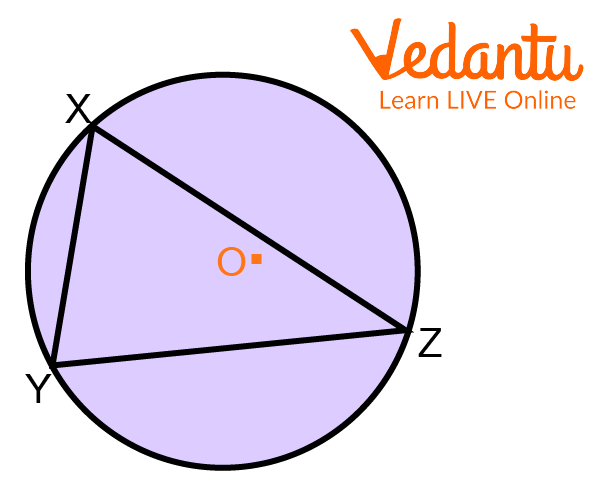
Process of Drawing a Circumcircle Around a Triangle
Step 3: The distance OZ, OX and OY is said to be the circumradius.
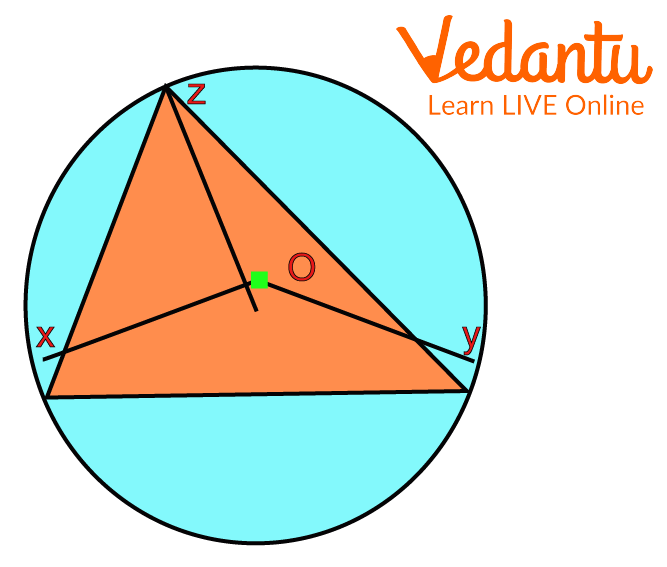
Circumcentre
Hence, the required circumcircle is as above with the circumcentre as O.
Circumradius of Right Angle Triangle
The Circumradius of the right angle triangle is the radius of the circle of the circumcircle which is drawn around a polygon. Let us draw a circumcircle for the right-angled triangle.
Step 1: Take a right-angled triangle.
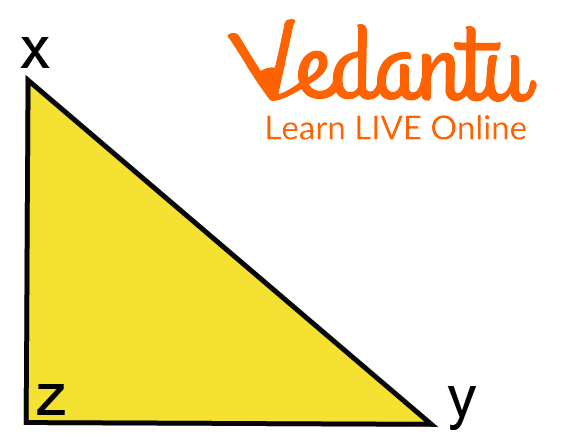
Right-angled Triangle
Step 2: Draw the perpendicular bisector of the sides of the triangle.
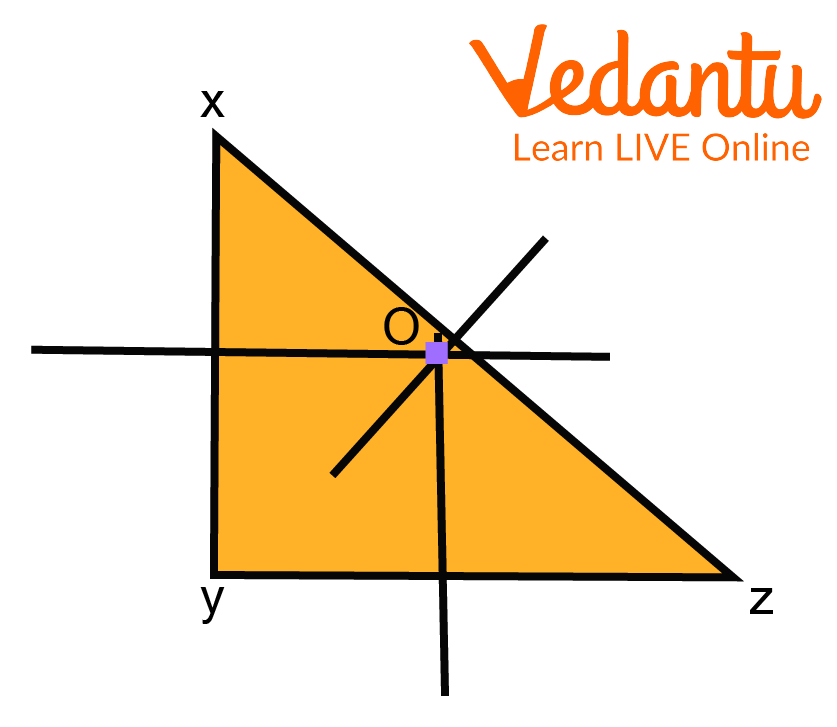
Perpendicular Bisector
Step 3: Taking the meeting point of the perpendicular bisector and the vertex which is most distant from it as a radius, draw a circle which passes through each vertex of the triangle.
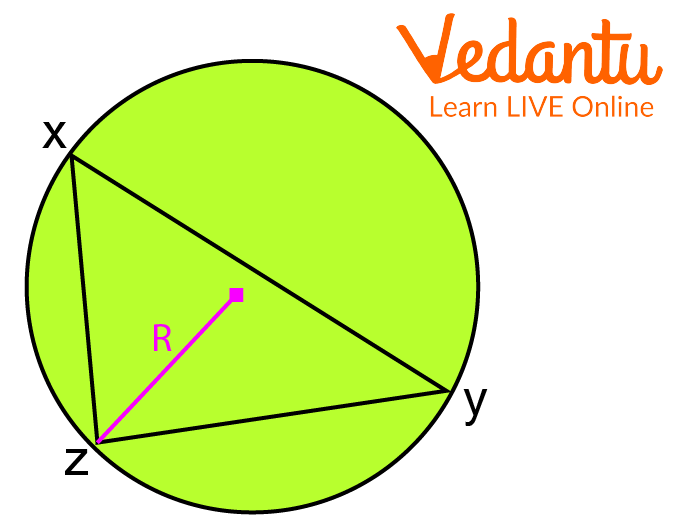
Right-angled Triangle in a Circumcircle
Hence, the circumcircle of the given right-angled triangle with circumradius “R” is as depicted in the figure above.
How to find the Circumradius of a Triangle?
Let that there is a circumcircle which is circumscribing a triangle with sides a, b and c with a circumcentre.
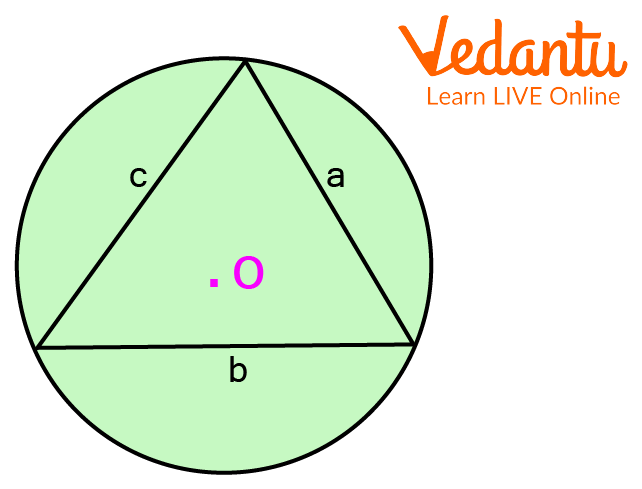
Circumcircle Circumscribing a Triangle
$2 \mathrm{R}=\dfrac{a}{\operatorname{Sin} A}=\dfrac{b}{\operatorname{Sin} B}=\dfrac{c}{\sin C}$
Now, Area of triangle $\left(A_{t}\right)=\dfrac{1}{2} a b \operatorname{Sin} C$
$\operatorname{Sin} C=\dfrac{C}{2 R}$
Therefore, $\mathrm{A}_{\mathrm{t}}=\dfrac{1}{2} a b \dfrac{C}{2 R}$.
Now, $\mathrm{R}=\dfrac{a b c}{4 A}$
Hence, the required formula to find the circumradius of the triangle is $\mathrm{R}=\dfrac{a b c}{4 A}$.
Solved Questions
Q1. List all the steps in drawing a circumcircle of a triangle.
Ans: To draw a circumcircle of a triangle follows the steps below:
Step 1: Draw the perpendicular bisectors of the sides
Step 2: Taking point O as the centre we draw a circle which touches each vertex of the triangle.
Step 3: The distance between OZ, OX and OY is said to be the circumradius.
Q2. Draw the circumcircle of a triangle with sides of 6 cm, 8 cm and 10 cm. What is the radius of this circle?
Ans: 5 cm
Steps for construction:
Step 1: Construct ΔABC with AB = 6 cm, BC = 8 cm and CA = 10 cm.
Step 2: Draw the perpendicular bisectors of any two sides of the triangle (say, AB and BC).
Step 3: Find the point of intersection of the perpendicular bisectors and mark it as O.
Step 4: Measure the distance OA or OB or OC, they are all equal to the radius of the circumcircle.
Step 5: OA = OB = OC = 5 cm
Practice Questions
Q1. Considering the given statement states whether it is true or false with reason: “A circle drawn inside a triangle touching all its sides is known as a circumcircle.”
Ans: False
Q2. Circumradius is the distance between the meeting point of the bisector of sides of a polygon and the vertex. True or False explain with reason.
Ans: True
Q3. Circumcentre of a circle is the point of concurrency of the
(a) angular bisectors of vertices
(b) medians
(c) perpendicular bisectors of sides
(d) any two sides
Ans: (c) perpendicular bisectors of sides
Q4. The ratio of the area of the circumcircle and incircle of an equilateral triangle is
(a) 4:1
(b) 1:4
(c) 9:1
(d) 1:9
Ans: (a) 4:1
Summary
After reading this article you must have been very well aware of the concepts of the circumcircle, circumradius, how to draw a circumcircle of a triangle and about circles. These concepts will help in solving problems of geometry and Circles in your textbook. You have also learnt the relationship between the radius of the circumcircle and the area of the triangle. We have learnt that a circle that touches the vertex of the triangle and is drawn outside the triangle is known as a circumcircle. But when a circle touches the sides of the triangle and is drawn inside the triangle it is known as a circle. The distance between the meeting point of the bisector of sides and the vertex is known as the circumradius.


FAQs on Circumcircle of a Triangle Explained Clearly
1. What is the circumcircle of a triangle?
The circumcircle of a triangle is the unique circle that passes through all three vertices of the triangle. The center of this circle is called the circumcenter.
- It touches each vertex exactly once.
- Every triangle has exactly one circumcircle.
- The radius of this circle is called the circumradius.
2. How do you find the circumcenter of a triangle?
The circumcenter of a triangle is found by intersecting the perpendicular bisectors of its sides.
- Step 1: Draw the perpendicular bisector of one side.
- Step 2: Draw the perpendicular bisector of another side.
- Step 3: The point where they intersect is the circumcenter.
3. What is the formula for the circumradius of a triangle?
The formula for the circumradius (R) of a triangle is R = (abc) / (4Δ), where a, b, c are the side lengths and Δ is the area of the triangle.
- a, b, c = sides of the triangle
- Δ = area (can be found using Heron’s formula)
4. Where is the circumcenter located in different types of triangles?
The location of the circumcenter depends on the type of triangle.
- In an acute triangle, it lies inside the triangle.
- In a right triangle, it lies at the midpoint of the hypotenuse.
- In an obtuse triangle, it lies outside the triangle.
5. Why is the circumcenter equidistant from all three vertices?
The circumcenter is equidistant from all three vertices because it lies on the perpendicular bisector of each side.
- Any point on a perpendicular bisector is equidistant from the endpoints of that side.
- Since the circumcenter lies on all three perpendicular bisectors, it is equally distant from all three vertices.
6. What is the circumcircle of a right triangle?
The circumcircle of a right triangle has its center at the midpoint of the hypotenuse and its radius equal to half the hypotenuse.
- If the hypotenuse = c, then R = c/2.
- The hypotenuse acts as the diameter of the circumcircle.
7. How do you find the circumcircle equation in coordinate geometry?
To find the equation of the circumcircle, first determine the circumcenter and radius, then use the circle formula (x − h)² + (y − k)² = R².
- Step 1: Find perpendicular bisectors of two sides.
- Step 2: Solve to get the center (h, k).
- Step 3: Compute radius R as distance from center to any vertex.
8. What is the relationship between sides, angles, and circumradius?
The relationship between a side and its opposite angle in a triangle is given by a = 2R sin A, where R is the circumradius.
- a = side opposite angle A
- R = circumradius
- A = angle in the triangle
9. Can you give an example of finding the circumradius of a triangle?
Yes, for a triangle with sides 3, 4, and 5, the circumradius is 2.5 units.
- This is a right triangle (3² + 4² = 5²).
- For a right triangle, R = hypotenuse/2.
- So, R = 5/2 = 2.5.
10. What is the difference between circumcenter and incenter of a triangle?
The circumcenter is the intersection of perpendicular bisectors and is the center of the circumcircle, while the incenter is the intersection of angle bisectors and is the center of the incircle.
- Circumcenter: Equidistant from vertices.
- Incenter: Equidistant from sides.
- Circumcircle passes through vertices; incircle touches sides.
