







Top Real-Life Mass Examples Every Student Should Know
In physics terms, mass will refer to the quantity of matter in the object. Mass is generally measured by how much something weighs. We must know that the meaning of mass of a body is different from that of the weight of that body. The two terms, mass and weight, are different within the important sense. But within the initial stages for youngsters , the difference is ignored when we use the terms weight and mass in the same sense.
Weight of an object changes from place to place , above and below the surface of the planet , but the mass of a body never changes. We know, within the surface of the world we take the units of mass similar to the units of weight.
Example of Mass:
The smallest unit of mass is milligram. For example 1 milligram is often written as 1 mg.
1 milligram = 1000 microgram
1 milligram= 1/1000 gram
1 milligram=0.0154 grains
Gram is another term for mass or weight. The basic unit of the metric system is the gram.
1000 milligram= 1 gram
1/10 decagram=1 gram
1/100 hectogram=1 gram
1/1000 kilogram=1 gram
for example- sugar, book, table, chair etc. are calculated in gram in mathematics terms.
Example of Mass and Weight:
Mass is the quantity to be counted an object contains. The extra count something has, the extra it will weigh. Kilogram is the standard unit of mass in our metric system. In our daily life we calculate mass or weight.
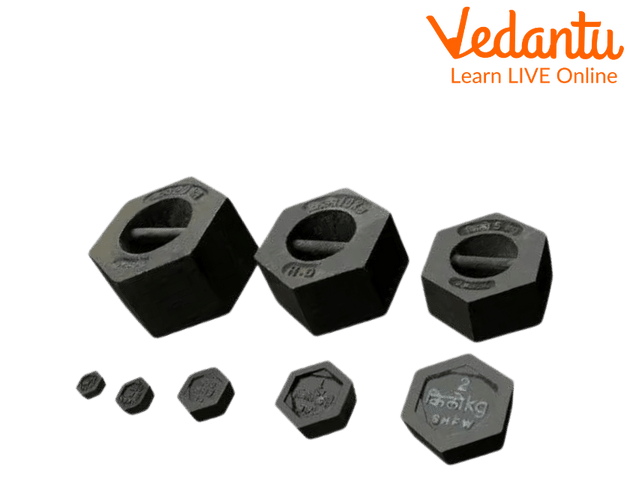
Weights
1 kilogram = 10 hectogram
1 kilogram = 1000 gram
1 kilogram = 10000 milligram
Different objects can calculate in different types of measurements. But when we talk about mass or weight most things are calculated in kilograms.

Standard Weights Pic
For example, Our daily needs are things like rice, wheat, pulses and many more things we purchase in kilograms.
Mass Examples:
Here are some objects of mass in our everyday objects with their measurement. (It is an approximate measurement, not the exact measurement.)
Example,
Sheet of Paper = 0.0045kg.
Pencil. = 0.0085kg.
Cell phone. = 0.141kg
Book. = 0.34 kg
Bicycle. = 11.3 kg
Average Child. = 22kg
Average Adult = 77Kg
What is an Example of Mass?
Mass can be calculated in different measurements like kilogram, tonnes, in our metric system. In the international system mass can be calculated in pounds and ounces. The standard unit of mass will be kilogram.
Here are example of mass (approximately)of very large objects,
Aeroplane = 40,823kg.
Military tank = 54,531kg.
Space shuttle (empty) = 74,842kg.
Space shuttle (loaded) = 2,000,000kg.
Weight is literally different from mass because weight is calculated due to the mass and force of gravitational force, in physical language.
The Mass is an Example of:
Mass is very useful in our daily life. Mass is also an example of weight. The help of these measurements we can find out the mass of every single object.
In an approximate value we can measure the weight of solar objects.
Solved Examples:
Fill in the blanks:
1 kilogram=
5 kilogram=
26 kilogram=
50 kilogram=
Ans:: 1 kilogram= 1000 gm
5 kilogram= 5000 gm
26 kilogram=26000 gm
50 kilogram=50000 gm
2. The mass of an object will be 12000 pounds. Calculate its mass in tonnes.
Ans: We know that,
2000 pounds = 1 tonne
12000 pounds = 12000÷2000
= 6000 tonnes
Ans. 6000 tonnes
3. Convert 4000 gram into kilograms
Ans. We know that,
1000 gram. = 1 kilogram
4000 gram = 4000÷ 1000
= 4 kilogram
Ans. 4 kilogram
Conclusion
In our daily life, we can use many things which contain mass. Mass refers to the weight of an object. Mass refers to the quantity of a matter or object. Mass is calculated in grams or kilograms. Every single object quantity is measured in mass in the form of a gram or kilogram.
FAQs on Mass Examples Explained: Definitions, Concepts & Uses
1. What is mass, explained with a simple example?
Mass is the measure of the amount of 'stuff' or matter that an object contains. It stays the same no matter where the object is. For example, a large textbook has more mass than a single pencil because it is made of more paper, ink, and cardboard.
2. What are some examples of mass in our daily life?
You can find examples of mass all around you. Here are a few from daily life:
- A bag of rice you buy from the store has a specific mass, like 5 kilograms.
- A school bag filled with books has more mass than an empty one because the books add matter.
- A large boulder has a very large mass, while a small pebble has a very small mass.
- Your own body has mass, which is a measure of all the bones, muscles, and tissues you are made of.
3. What are the common units used to measure mass?
Mass is measured using standard units to ensure consistency. The most common units in the metric system are:
- Grams (g): Used for measuring light objects, like a feather or a paperclip.
- Kilograms (kg): The standard unit for measuring everyday objects, like groceries, people, or luggage. 1 kilogram is equal to 1000 grams.
- Tonnes (t): Used for very heavy objects, such as cars or elephants. 1 tonne is equal to 1000 kilograms.
4. How is mass different from weight?
This is a key concept in science. Mass is the amount of matter in an object and is constant everywhere. For example, an astronaut's mass is the same on Earth and on the Moon. Weight, however, is the force of gravity pulling on that mass. Since the Moon has weaker gravity, the astronaut would weigh much less there, even though their mass has not changed.
5. Why is it important to understand the concept of mass?
Understanding mass is fundamental for many real-world applications. It is important because it helps us to:
- Follow recipes in the kitchen, which require precise masses of ingredients for a successful outcome.
- Load vehicles safely, as every car or truck has a maximum mass it can carry.
- Understand health and nutrition, as body mass is a key indicator of health.
- Conduct scientific experiments where accurate measurement is crucial for results.
6. Can the mass of an object change?
Yes, the mass of an object can change, but only if matter is added to it or taken away from it. For example, if you fill an empty bottle with water, you are adding matter (water), so its total mass increases. If you then take a sip, you are removing matter, and its mass decreases. The mass of a single, sealed object does not change on its own.
7. If two objects are the same size, do they always have the same mass?
No, not necessarily. Two objects can be the same size (have the same volume) but have very different masses. This is because of a property called density. For example, a balloon and a cricket ball might be the same size, but the cricket ball has much more mass because it is made of denser material packed into the same amount of space.
