







Where do Mummies Come From?
You must have seen the Egyptian pyramids in certain cartoons and movies, and the mummies they keep very safely. A pyramid is a solid figure whose base is in the shape of a Polygon and whose sides meet at a common point called the vertex or apex of the pyramid. As the name suggests Egyptian pyramids are located in Egypt and are made up of stones or bricks. Sources have found at least 130 Egyptian pyramids out of which 80 Were built within the Kingdom of Kush, which is now converted into the city of Sudan. In this article, we will see more about the Egyptian Pyramids Facts. Here are 12 facts about Egyptian pyramids.
Interesting Facts About Pyramids
History of Pyramids
Ancient Egyptian pyramids are one of the most well-known Pyramids structures known to us. Pyramids have been discovered more than 4650 years ago. The earliest known pyramid structures are found at Saqqara, which lies northwest of Memphis. The pyramid of Djoser and its surrounding complex are considered to be one of the oldest pyramids built around 4650 years ago. Over 130 pyramids have been found in Egypt and they are known worldwide and are a great source of tourist attraction.
Why Were Pyramids Built?
Most of the Egyptian pyramids were built to be used as tombs for Pharaohs and their families. Pharaoh was a ruler in ancient Egypt. It is said that these pyramids are made for pharaohs Khufu, Khafre and Menkaure housed the royal mummies and their worldly effects were thought to protect and be used by the kings in their afterlife.

The Great Sphinx Pyramid
The Gold Mask of Tutankhamun
The bodies in tombs are preserved by mummification. Egyptians buried the Dead bodies with Burial goods which included all sorts of items from items of daily use to earthly possessions. It was believed that these items helped the dead soul in their afterlife. Due to this many robberies happened at these pyramids and most of the robbers would target royal tombs.
One tomb that was left largely intact was that of Tutankhamun who was a pharaoh from 1332 BC to 1323 BC. The tomb was rediscovered in 1922 by Howard Carter, this famous tomb is best known for the solid gold funerary mask of Tutankhamun.

Mask of Tutankhamun
12 Interesting Facts About The Pyramids of Giza
The Great Pyramid of Giza is the oldest and largest pyramid in the Giza pyramid complex.
It is the oldest of the Seven Wonders of the Ancient World, and the only one to remain largely intact.
The 3 pyramids of Giza are the oldest and largest stone structures on Earth.
It is located in Cairo, Egypt on an island right next to the Nile River that had been the site of human settlement at least since 3000 BC.
The pyramid of Giza is also known as the Pyramid of Khufu. The entrance of the parameter of Giza is about 59 seats above the ground level.
The original height of the pyramid was about 146 meters (481 feet). But due to certain changes due to weathering, harsh climate, etc . the height of the pyramids was reduced to 138.5 meters (454.4 ft).
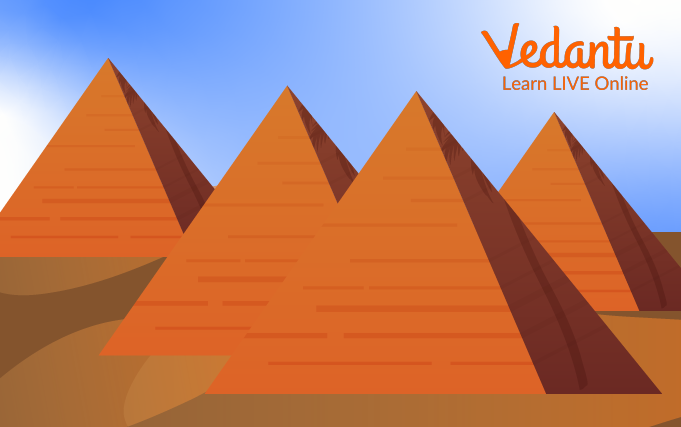
The Pyramids of Giza
The pyramid of Djoser, The Bent pyramid, The Red Pyramid, and The pyramid of Sahure are some other important Pyramids.
The Pyramid of Djoser and its surrounding complex are considered to be one of the oldest pyramids built around 4650 years ago.
These pyramids contain more than 2 million blocks and were built with extreme precision in a time when there were no measuring devices.
The Pyramids of Giza were originally covered with limestone but all of it has eroded.
The pyramids are built with limestone quarried from local sources. The stones were lifted by a ramp that was as much as 10 meters high or could have been slid on logs.
Nearly all the Egyptian pyramids are located to the left of the river Nile as the west was where the sunset and where the dead were thought to enter the underworld.

Egyptian Mummy
Summary
In this article, we have seen some amazing Egyptian Pyramids Facts. We also discussed the history of pyramids, the golden mask of Tutankhamun and much more. We also learned some fun facts about the The Great Pyramid of Giza which was the tallest man-made structure in the world for over 3800 years. Lastly we discussed some important historical facts about pyramids as well why were the built. In case of any other doubts feel free to ask in the comments.
FAQs on 12 Facts About Egyptian Pyramids
1. What is inside an Egyptian pyramid?
Inside a typical Egyptian pyramid, you will find a network of corridors and chambers. The most important of these is the burial chamber, which was built to house the pharaoh's sarcophagus. Other rooms were used for storing treasures and items the pharaoh would need in the afterlife. Some pyramids, like the Great Pyramid of Giza, have multiple chambers, including a Queen's Chamber and a King's Chamber.
2. How long did it take to build the Great Pyramid of Giza?
Experts estimate that the construction of the Great Pyramid of Giza, the largest of all Egyptian pyramids, took approximately 20 to 27 years to complete. This incredible feat was accomplished using a massive, highly organised workforce and the engineering knowledge available to the ancient Egyptians around 4,500 years ago.
3. What were the pyramids built from?
The Egyptian pyramids were primarily built from enormous blocks of limestone, which were quarried nearby. For the outer casing, a finer, white Tura limestone was used to give the pyramids a smooth, polished, and brightly reflective surface. Some of the interior chambers, such as the King's Chamber in the Great Pyramid, were constructed using massive blocks of granite, a much harder stone that had to be transported from distant quarries.
4. Who were the Egyptian pyramids built for?
The pyramids were built as magnificent tombs for the pharaohs of ancient Egypt and their consorts. The ancient Egyptians believed that a pharaoh was a divine being who would continue to guide his people in the afterlife. The pyramids were designed to protect the pharaoh's body and possessions, ensuring their safe passage and eternal life after death.
5. Why were the pyramids so important to the ancient Egyptians?
The pyramids were much more than just tombs. For ancient Egyptians, they were powerful symbols that represented:
- The greatness of their civilisation: Their massive scale and precise construction demonstrated the power and resources of the pharaoh.
- A connection to the gods: The pyramid's shape was thought to mimic the primordial mound from which the Egyptians believed life began.
- A stairway to the heavens: The pointed shape was believed to help the pharaoh's soul ascend to the afterlife to join the gods.
6. How did the ancient Egyptians move the giant stones to build the pyramids?
One of the biggest mysteries of the pyramids is how the massive stone blocks were transported. Recent discoveries suggest that the Egyptians were brilliant engineers who likely used a combination of methods. It is now widely believed they used a now-lost branch of the River Nile that flowed very close to the Giza plateau. They would transport the giant blocks on boats and then likely use wet sand to reduce friction while dragging the stones on large wooden sleds to the construction site.
7. Were the pyramids built by slaves?
This is a common misconception, largely popularised by films. Archaeological evidence, including the discovery of workers' tombs near the pyramids, suggests that the pyramids were built not by slaves but by a skilled, paid workforce. These labourers were respected for their work, well-fed, and given proper burials, indicating they were valued members of society, not slaves.
8. Are all Egyptian pyramids the same shape?
No, not all pyramids are the same. The design evolved over time. The earliest pyramids were step pyramids, like the Pyramid of Djoser, which look like stacked layers. Later, there were attempts like the Bent Pyramid, which changes its angle partway up. The famous smooth-sided, true pyramid shape, seen at Giza, was the final and most refined design.
9. Why do pyramids have a pointed, triangular shape?
The iconic shape of the pyramids is deeply symbolic. It is thought to represent the sun's rays shining down on Earth, creating a ramp or stairway for the pharaoh's soul to climb to the sky and join the sun god, Ra. The shape also represents the 'benben', a mythical, pyramid-shaped stone that was considered the primordial mound where creation began.
