







Overview About Countries
The world is a beautiful place to live. It is an entity in itself and comprises many continents. We have 7 continents around the globe. Now, what is a country? To put it simply, when we further divide the world into smaller continents, we call it a country. A country has an entity of itself. It is a mass of land with a government that rules over it. The world consists of not more than 200 countries.
In this article, we will be learning about Continents and Countries and some exciting country information for kids. Let’s now begin with country research for kids.
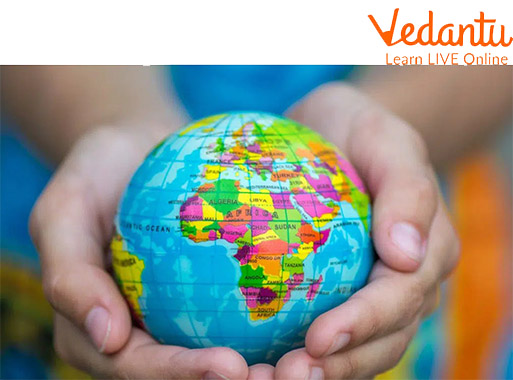
The World
Continents of the World
As discussed earlier, continents constitute the world. They are like big pieces of land surrounded by water, mountains, and islands. There are, in total, 7 continents in the world. They are listed below, ranging from the largest to the smallest continent.
Asia
Africa
North America
South America
Antarctica
Europe
Australia
Most continents have different counties in them. If you take Asia, it includes countries like India, Pakistan, Thailand, Japan, and China, to name a few.
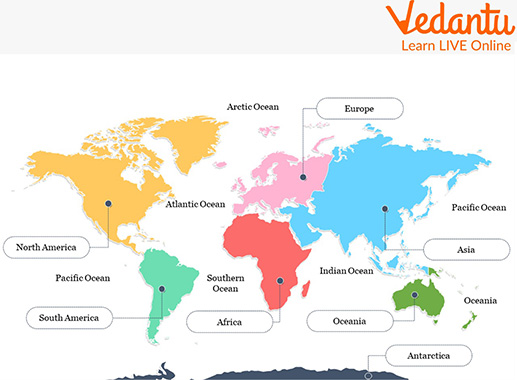
Seven Continents
What is a Country?
As we have discussed above, our world and different continents, let us throw some more light on countries.
When continents are further divided into smaller pieces of land, they are called countries. Countries are territories that have borders to separate them from other countries to avoid confusion and conflicts. They are managed by their respective governments to maintain peace, law, and order. Countries are further divided into smaller parts called states.
The people who live in a particular country are called its citizens, which becomes their nationality. For e.g. a person living in India is called an Indian. Similarly, a person who resides in Canada will be called a Canadian, or if someone says they are from Australia, you will know that they are an Australian or an African is someone from Africa.
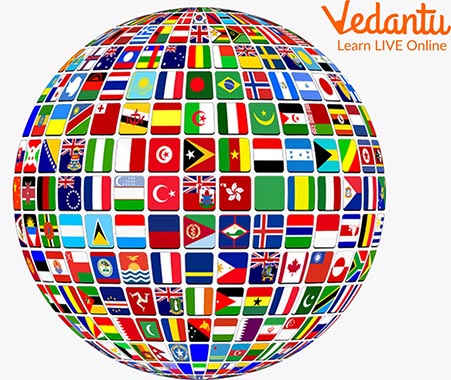
195 countries of the world
Different Countries, Different Cultures
As the two sides of the coin are not the same, similarly, no two countries are the same geographically. Different countries have different cultures, values, traits, attitudes, and behaviours. Won’t you agree that Russian people are culturally, ethically, and linguistically quite different to Indians? As different people have different personalities, the same is the case with countries.
One can differentiate between countries on the following parameters:
Name: No two countries will and can share the same name. This is to avoid confusion for its citizens and other people. The country's name is normally derived from its history and features.
Flags: A country is recognised globally by the flag that represents it. The flag's colour, style, and pattern hold great significance to its country. Flags also create a sense of unity amongst different people living in different states of a nation.
Languages: Though English is rapidly becoming the universal language for all countries, we should never forget that each country has its mother tongue, which its residents are super proud of. Like we speak Hindi, Tamil, etc., in India, people in Russia majorly converse in Russian, whereas you will find a person from Italy who will prefer to talk in Italian.
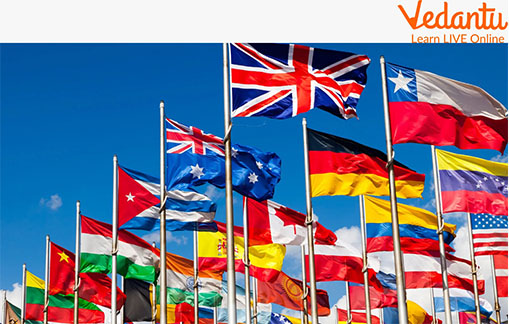
Different Countries but Stand as One
Country Fun Facts for Kids
Below are some facts about different countries for kids, which enhance their general knowledge and amuse them. Did you know there are around 7.7 billion people in the whole wide world?
You will be amazed to know that out of 195 countries, Canada has the largest number of lakes.
The tag of the oldest country in the world goes to San Marino, which covers an area of just 62 square kilometres.
For those who do not like hills, you will be happy to know that the Maldives is the flattest country in the world. Well, this might be the perfect place for you!
Summary
In this article, we have seen a brief about the world's seven continents, what a country is, and some fun facts about countries for kids.
To conclude, we can say that a country becomes a nationality to the people who reside in it, and it has a direct relation to its ethnicity, and the culture it promotes. It also has physical borders that are protected by its army. All these give a sense of belongingness and security to the people residing there. There are in total 195 countries that complete the world. These are a few things about a country for kids to understand about the country.
FAQs on Fun Facts About Countries for Kids
1. What makes a country the 'largest' in the world?
A country is considered the 'largest' based on its total land area, which is the amount of space it covers on the map. For example, Russia is the largest country because it occupies over 17 million square kilometres, which is more land than any other nation. This is different from a country's population, which is the number of people who live there.
2. What is the difference between the largest country and the most populated country?
This is a great question that often confuses people! The largest by area refers to the physical size of the country (like Russia), while the most populated refers to the country with the highest number of people living in it (like India and China). A country can be huge in size but have fewer people, or be smaller in size but have a very large population.
3. Why are some cities or countries spread across two continents?
Continents are huge landmasses, and sometimes a country or city is built on a piece of land that acts as a bridge between two of them. For example, Istanbul in Turkey is a famous city that lies in both Europe and Asia. The Bosphorus Strait, a narrow body of water, runs through the middle of the city, separating the two continental parts.
4. How are the borders between different countries decided?
Borders between countries can be formed in two main ways. Some are natural borders, created by geographical features like rivers, mountains, or lakes. Others are man-made borders, which are imaginary lines drawn on a map and agreed upon by neighbouring countries. The border between Canada and the USA, the world's longest, is mostly a man-made line.
5. What are some examples of different types of fun facts about countries?
There are many kinds of interesting facts about countries beyond just their size. These can include:
- Geographical Facts: Like how the Netherlands has land that is below sea level, or how Bolivia has two capital cities.
- Cultural Facts: Such as the unique foods people eat, the festivals they celebrate, or the languages they speak.
- Animal Facts: For instance, Australia has more kangaroos than people.
- Historical Facts: Like which country is the oldest in the world.
6. Are there any countries that are completely inside another country?
Yes, there are! These are called enclaves. They are small, independent countries that are completely surrounded by the territory of another, larger country. A perfect example is Vatican City, which is the smallest country in the world and is located entirely inside the city of Rome, Italy. Another example is Lesotho, which is completely surrounded by South Africa.
