







What Are Colours For Kids Types Names and Easy Examples
Hey kids! Don’t you think we are lucky enough to live in a colourful world? The colour of the sky, the colour of the rainbow, the fruits, the leaves, and the flowers aren't all fascinating? But do you know the names of these colours? We are going to learn colour names here in this article. After this lesson, you will be able to identify as many colours around you and can paint your favourite picture with that colour.
What Are the Basic Colours?
Look at the colour wheel shown below. What colours can you identify? The ones that you couldn’t name, note down their names from the image.
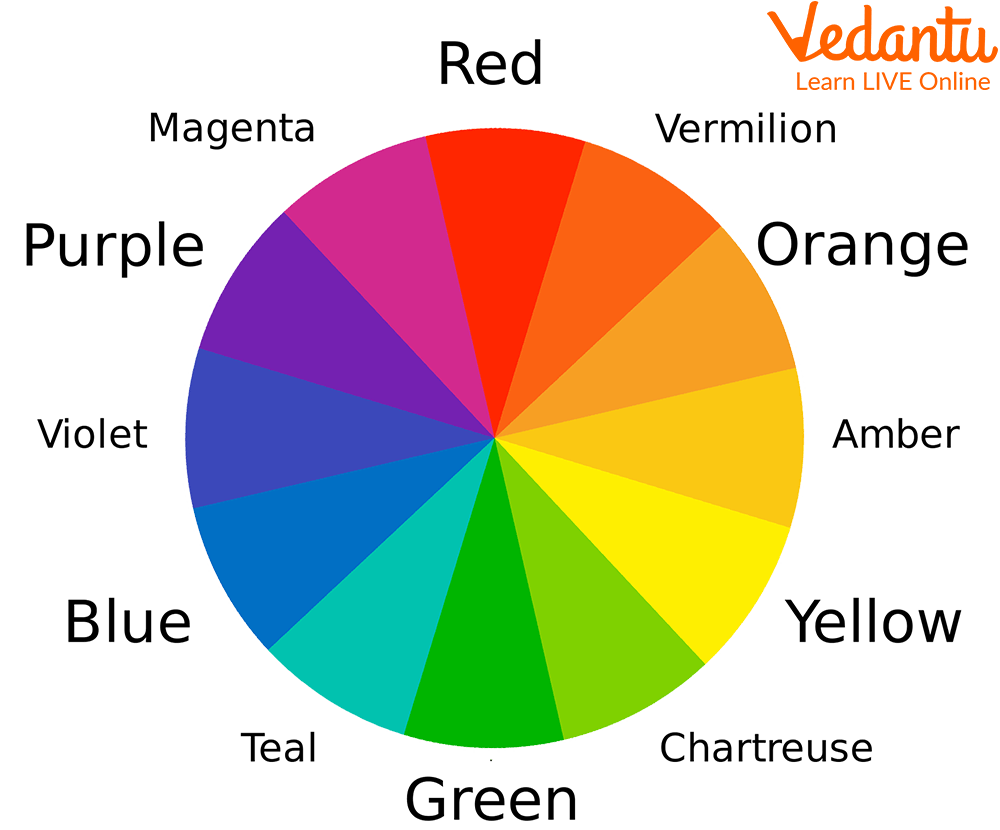
Colour Wheel
Let us know the basic colours first. They are as follows:
Red
Orange
Yellow
Green
Blue
Indigo
Violet
Purple
Pink
Silver
Gold
Beige
Brown
Grey / Gray
Black
White
Primary and Secondary Colours
There are 3 primary colours which are Red, Yellow and Blue. These are called primary colours because you can mix them with other colours to form new colours. Orange, Purple or Violet and Green are considered secondary colours since they are obtained by mixing the primary colours.
Using Colours in Sentences
Read out the following colour sentences and see if you can form a few more on your own.
My car is red in colour.
The black cat lives in this lane.
Yellow coloured flowers are beautiful.
The sky is blue today.
She gifted me a pink sweater.
Please Note: The word colour has two spellings - one is ‘colour’ which is used in British English while another is ‘color’ used in American English
Different Shades of Colour
Colours can be of different shades. There can be dark green, light green and even bright green. Suppose you are not sure of which colour it is but can guess it from its tone, then add a suffix -ish with it like -
Blackish, Yellowish, Orange-ish, Blueish.
If you enjoyed learning about colours, why not guess them? In the following section, we have presented a set of 6 questions in which you need to choose the correct colour.
Choose the Correct Colour Exercise
1. The first colour in a rainbow is called:
Red
Orange
Gold
Ans. Red
2. The colour of the healthy grassland is:
Green
Black
Grey
Ans. Green
3. A very dark blue colour is called
Pastel Blue
Navy Blue
Purple Blue
Ans. Navy Blue
4. What is the colour of fresh snow?
White
Beige
Green
Ans. White
5. A pale shade of grey is:
White
Beige
Silver
Ans. Beige
6. When you mix red and yellow you get:
Brown
Orange
Grey
Ans. Orange
Colour Poetry
Orange is a carrot
Yellow is a Pear
Green is the grass
Brown is the bear
Purple is the plum
Blue is the sky
Black is a witch’s hat
And red is the cherry pie
This poetry is interesting and will help the kids to understand the different colours related to different items.
Conclusion
With all the colour discussion we had here, we hope now you know a lot more about colours. To find more colours, look around you and keep learning about them. Try to find out the different variants of the same type of colour; for example, green, blue, pink, brown, etc.
FAQs on Learn Colours For Kids With Fun Examples and Activities
1. What are colours for kids?
Colours for kids are basic visual shades like red, blue, yellow, and green that children learn to identify and name. Learning colours helps children improve vocabulary and visual recognition skills.
- Examples of basic colours: red, blue, yellow, green
- Colours describe how things look.
- Example sentence: The apple is red.
2. What are the basic colours children should learn first?
The basic colours children should learn first are red, blue, yellow, green, black, and white. These colours are common in everyday objects and easy to recognize.
- Red – apple
- Blue – sky
- Yellow – sun
- Green – grass
- Black – night
- White – snow
3. How do you teach colours to kids in English?
You teach colours to kids in English by using visual objects, repetition, and simple sentences. Children learn faster when they see and say the colour names aloud.
- Show real objects: “This is a blue ball.”
- Use colouring activities.
- Sing colour songs.
- Ask questions: “What colour is this?”
4. What are primary colours for kids?
Primary colours for kids are red, blue, and yellow because they cannot be made by mixing other colours. These colours are the base for creating many other colours.
- Red + Yellow = Orange
- Blue + Yellow = Green
- Red + Blue = Purple
5. What are secondary colours?
Secondary colours are colours made by mixing two primary colours together. The three main secondary colours are orange, green, and purple.
- Orange = red + yellow
- Green = blue + yellow
- Purple = red + blue
6. How can kids use colours in simple English sentences?
Kids can use colours in simple English sentences by placing the colour word before a noun as an adjective. Colours describe how something looks.
- It is a green tree.
- I have a yellow pencil.
- The car is blue.
7. Why is learning colours important for kids?
Learning colours is important for kids because it improves vocabulary, observation skills, and early learning development. Colour recognition also helps with reading and describing objects.
- Builds English word knowledge.
- Improves memory and matching skills.
- Helps in art and creative activities.
8. At what age should a child learn colours?
Most children begin learning colours between 18 months and 3 years old. By age three, many children can name several basic colours correctly.
- Start with 2–3 basic colours.
- Use daily practice and repetition.
- Encourage pointing and naming activities.
9. What are some fun activities to teach colours to kids?
Fun activities to teach colours to kids include colour sorting, painting, games, and songs. Interactive learning helps children remember colour names easily.
- Sort toys by colour.
- Play “I Spy” with colours.
- Use colouring books.
- Sing colour learning songs.
10. What are common mistakes kids make when learning colours?
Common mistakes kids make when learning colours include confusing similar shades like blue and purple or red and orange. This confusion is normal during early learning.
- Mixing up light and dark shades.
- Forgetting rarely used colour names.
- Using the wrong colour word in a sentence.
