







What Are Mushrooms Types Benefits and Amazing Facts
You have seen mushrooms growing in woods or grassy regions where moisture is available in plenty. These are basically a common form of fungus. Some kinds of mushrooms are used in food but there are also some mushrooms that are poisonous. Therefore we are advised not to pick any mushrooms that grow in the wild and eat them as they can be poisonous. In this article, you will learn very interesting information about mushrooms for kids. Let’s read the article to know more about mushrooms.
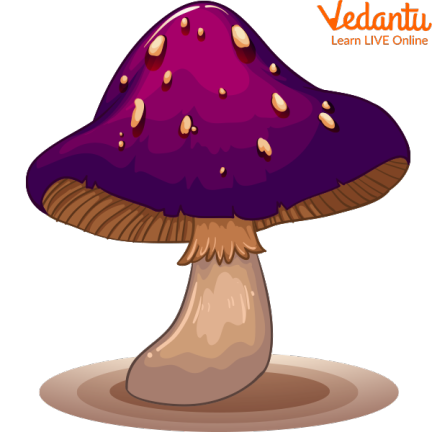
Mushroom
Interesting Facts about Mushrooms
Some interesting facts about mushrooms are given below that we need to know about mushrooms.
We know that mushrooms are a fungus and they are not like plants. The sunlight is not needed in mushrooms to make energy for themselves.
Mushrooms contain around 90% water.
Different species of edible mushrooms are a great source of vitamin B, essential minerals like potassium and copper. In mushrooms, salt content, carbohydrates and fat are very low. Therefore, they are considered a very nutritious food.
The mushroom is used to make tasty dishes in different cuisines throughout the world and it is referred to as the "meat" of the vegetable world.
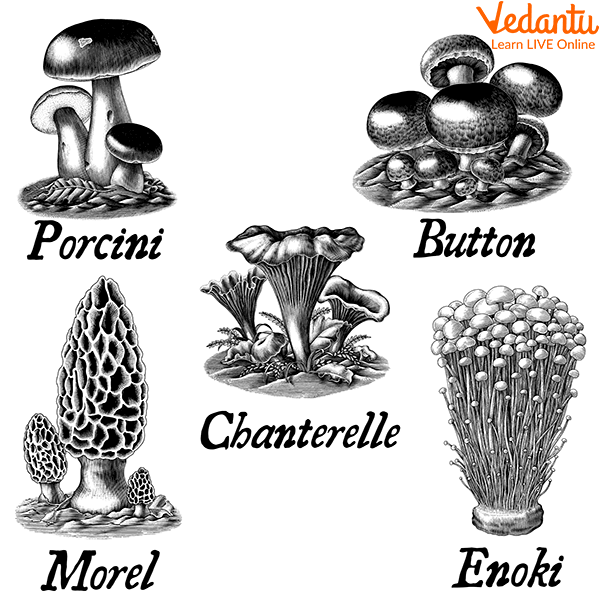
Different Edible Mushrooms
The medicinal properties of mushrooms have been used in traditional Chinese medicine for centuries.
China is the country where edible mushrooms are produced in the largest quantity in the world.
According to Modern studies, mushrooms can be useful for antioxidants, antibacterial and anti-inflammatories. Mushrooms are also helpful in reducing blood pressure, moderate blood sugar, reducing cholesterol, enhancing the immune system, reducing stress and helping in fighting many types of cancer.
A single Portabella mushroom which is a species of mushroom can contain more potassium than a banana.
There are around thirty species of mushrooms that glow in the dark. This happens because of bioluminescence which is a chemical reaction that produces a glowing light known as foxfire. Because of its lighting properties, people used these fungi to light their path in the forests.
Conclusion
The above article is very interesting. All the information is provided related to mushrooms for kids. Kids will get to know about different things about mushrooms that they haven't read before. The article discusses interesting facts about mushrooms.
FAQs on Interesting Information About Mushrooms and Their Unique World
1. What are mushrooms?
Mushrooms are the fruiting bodies of fungi that produce spores for reproduction. Unlike plants, mushrooms do not perform photosynthesis and belong to the kingdom Fungi.
- They grow from a network of thread-like structures called mycelium.
- They feed on organic matter such as soil, wood, or decaying plants.
- Some mushrooms are edible, while others are poisonous.
2. Are mushrooms plants or fungi?
Mushrooms are fungi, not plants. They differ from plants in several key ways:
- They lack chlorophyll and cannot make their own food through photosynthesis.
- Their cell walls contain chitin, not cellulose.
- They absorb nutrients from their surroundings instead of producing them.
3. How do mushrooms grow?
Mushrooms grow from microscopic spores that develop into a network called mycelium. The growth process includes:
- Spore lands on a suitable surface.
- Spore germinates and forms thread-like hyphae.
- Hyphae combine to create mycelium underground.
- Under the right moisture and temperature, a mushroom fruiting body appears above ground.
4. What are some interesting facts about mushrooms?
Mushrooms have several fascinating characteristics that make them unique organisms. Some interesting mushroom facts include:
- The largest living organism on Earth is a honey fungus in Oregon.
- Some mushrooms can glow in the dark, known as bioluminescent fungi.
- Certain species can break down plastic and toxic waste.
- They have been used in medicine for centuries.
5. Are all mushrooms safe to eat?
No, not all mushrooms are safe to eat, and some species are highly poisonous. For example:
- The death cap (Amanita phalloides) is extremely toxic.
- Some edible mushrooms closely resemble poisonous varieties.
- Wild mushrooms should only be eaten if identified by an expert.
6. Why are mushrooms important to the ecosystem?
Mushrooms are important because they act as decomposers that recycle nutrients back into the soil. Their ecological roles include:
- Breaking down dead plants and animals.
- Forming mycorrhizal relationships with tree roots.
- Improving soil health and nutrient absorption.
7. What is the difference between a mushroom and mold?
The main difference between a mushroom and mold is that a mushroom is a visible fruiting body, while mold is a microscopic fungus that grows in fuzzy patches. Key differences include:
- Mushrooms are often large and structured with caps and stems.
- Mold appears as soft, fuzzy growth on food or surfaces.
- Both belong to the kingdom Fungi but differ in form and growth pattern.
8. Can mushrooms glow in the dark?
Yes, some mushrooms glow in the dark due to a natural process called bioluminescence. This glow occurs because:
- Certain fungi produce light through a chemical reaction.
- The light is usually greenish in color.
- It may help attract insects to spread spores.
9. What nutrients do mushrooms contain?
Mushrooms are low-calorie foods rich in important vitamins and minerals. They typically contain:
- Vitamin D (especially when exposed to sunlight)
- B vitamins such as riboflavin and niacin
- Minerals like selenium and potassium
- Dietary fiber and antioxidants
10. How long do mushrooms live?
Most visible mushrooms live for only a few days to a couple of weeks, but their underlying mycelium can live for years. The lifespan depends on:
- Species type
- Weather conditions and moisture
- Environmental factors such as temperature
