







How to Give and Ask for Directions in English with Rules and Sample Sentences
The knowledge of directions is important to complete any long or short journey. When we are in a place where we are not familiar with the locations at some point during the trip, there are chances of getting lost even if we have a map. So it is required to have knowledge of asking and giving directions in English so that we can reach our destination. It’s also a great idea to give directions yourself to tourists or foreign travellers. In this article, some words and phrases are given that can help you in learning how to give directions and ask for them.
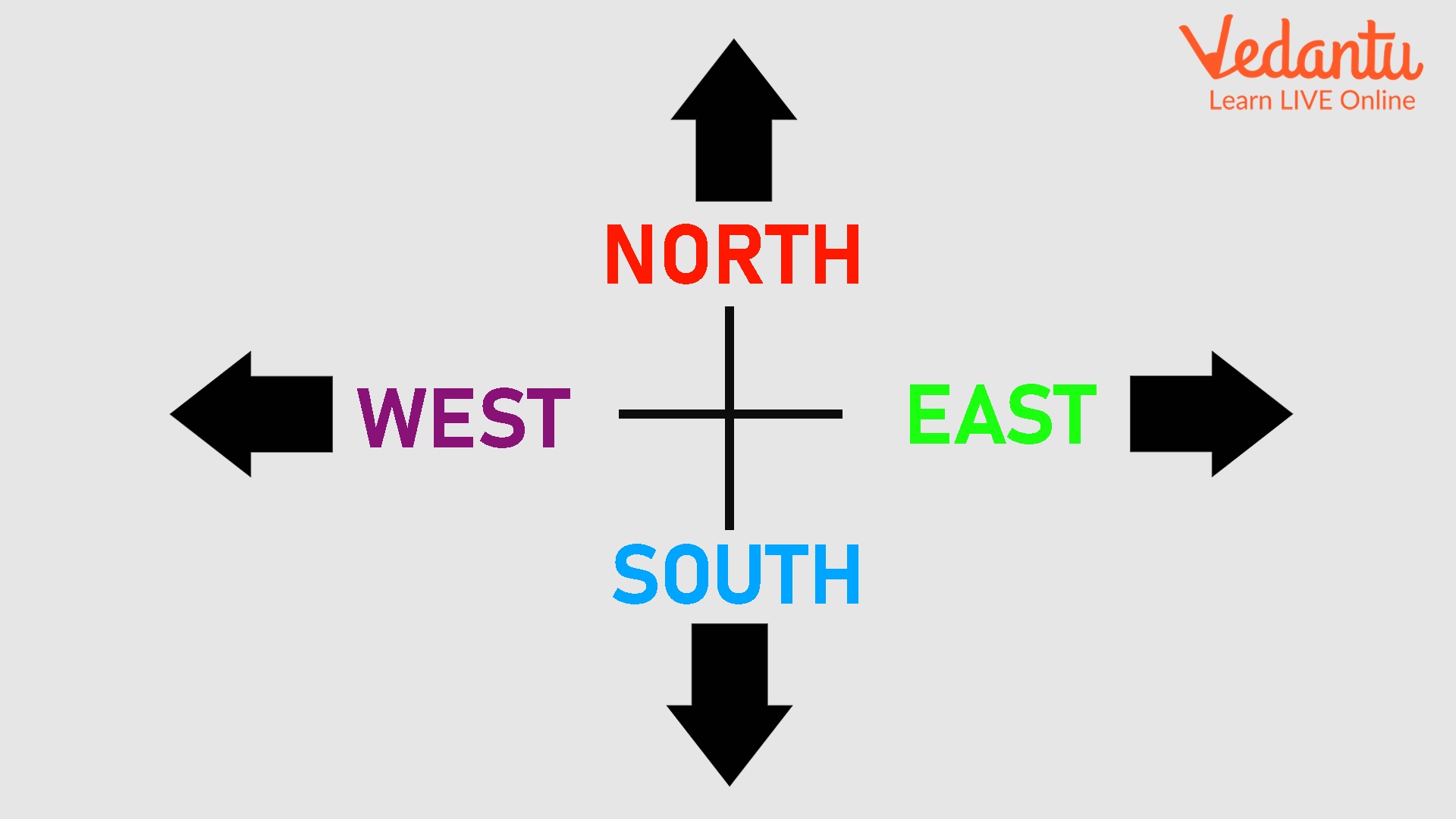
The four main directions - North, South, East and West
Basic Vocabulary of Directions
We need to know some basic vocabulary. The most important words and phrases are given below which are used in asking and giving direction.
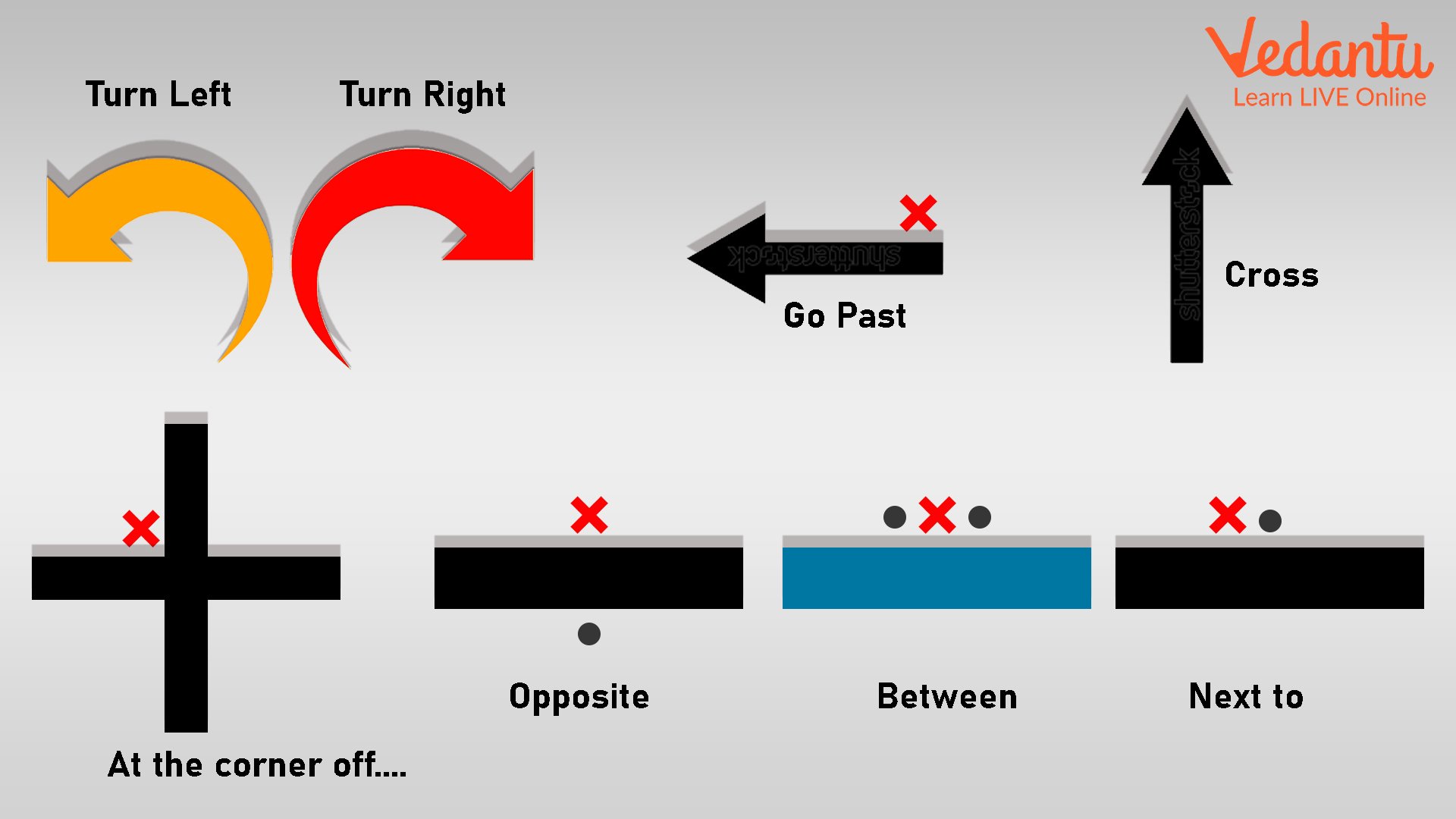
Basic vocabulary of directions
Asking for Directions
We can ask for directions very politely to someone using the following phrases.
Hey, can you help me, please?
Good evening, sir/ma’am. May I ask for some help?
Excuse me, ma’am! Could you please help me?
Once you get the attention of someone gently using the above sample phrases, you can ask for help to reach your destination. Some examples of phrases are given below.
Could you please tell me how to get to the railway station?
Do you know any good restaurants near to this location?
We are not able to find the subway station. Is it near here?
Where can we find a hotel nearby?
If you are still confused about the particular location, you can make sure by asking the following questions.
Are we on the right road to the railway station?
Is this the right way to the restaurant?
Which is the best route to go to the city centre?
Giving Directions
In the same way as we learnt about asking for directions, sometimes we need to guide someone who may ask us for directions. For that, some common phrases are given below that will help you in giving directions.
Pass the city centre road by going straight.
Go along that road.
Go straight and do not turn anywhere.
Go through the tunnel.
At the roundabout, take the first exit.
Turn left at the crossroads.
Take the right turn.
It is situated on your left.
It is located on the other side of the famous Shiva Temple.
You are going the wrong way.
Conclusion
The above article is useful for knowing the way of asking and giving directions in English as it is an important part of a journey or a trip whether the trip is long or short. Some words of the basic vocabulary of directions are also provided. Parents should not only teach their kids about directions but also encourage them to use them in conversation as often as possible so that they can form a strong sense of direction.
FAQs on Giving and Asking Directions in English with Useful Phrases and Examples
1. How do you ask for directions in English politely?
You can ask for directions politely in English by using expressions like "Excuse me" and modal verbs such as "could" or "can".
- Start with a polite opener: Excuse me or Pardon me.
- Use a question form: Could you tell me how to get to the station?
- End with appreciation: Thank you or I appreciate your help.
2. What are common phrases for giving directions in English?
Common phrases for giving directions in English include expressions like "go straight", "turn left", and "next to".
- Go straight ahead for two blocks.
- Turn right at the traffic lights.
- It’s next to the bank.
- It’s across from the supermarket.
3. What prepositions are used when giving directions?
The most common prepositions used in giving directions are "next to", "between", "behind", and "across from".
- Next to: The café is next to the library.
- Between: The pharmacy is between the bank and the post office.
- Behind: The parking lot is behind the hotel.
- Across from: The bus stop is across from the mall.
4. How do you respond when someone asks you for directions?
You respond to someone asking for directions by clearly explaining the route using imperatives and location words.
- Start with a helpful phrase: Sure or Of course.
- Use command forms: Go straight, Turn left, Walk past.
- Give clear landmarks: You’ll see a hospital on your right.
5. What is the difference between “turn left” and “on the left”?
The phrase "turn left" gives an action, while "on the left" describes a location.
- Turn left means change direction to the left side.
- On the left tells you where something is located.
6. Can you give an example of a short dialogue about asking and giving directions?
A short dialogue for asking and giving directions usually includes a polite request and clear step-by-step instructions.
- A: Excuse me, could you tell me how to get to the museum?
- B: Sure. Go straight ahead and turn right at the traffic lights. It’s next to the park.
- A: Thank you!
7. Why do we use the imperative form when giving directions?
We use the imperative form when giving directions because it gives clear instructions or commands.
- Examples: Go straight, Turn left, Cross the street.
- The subject "you" is understood but not spoken.
8. What are common landmarks used when giving directions?
Common landmarks used in giving directions include public places and easily recognizable buildings.
- Traffic lights
- Bus stop
- Bank
- School
- Park
9. How can I ask someone to repeat directions in English?
You can ask someone to repeat directions politely by using phrases like "Could you say that again?" or "Can you repeat that, please?".
- I’m sorry, I didn’t understand.
- Could you speak more slowly, please?
10. What are common mistakes when giving directions in English?
Common mistakes when giving directions include confusing left and right, misusing prepositions, and giving unclear instructions.
- Mixing up left and right.
- Incorrect prepositions: saying "in the corner" instead of "on the corner".
- Giving too many instructions at once without order.
