







What Is a Complex Sentence Definition Rules and Examples
Understanding complex sentences is essential for clear and effective communication. On this page, we’ll explain the meaning and structure of complex sentences, showing you how to combine different clauses to create more nuanced and detailed statements. We’ll also cover practical tips for using complex sentences and understanding how to make complex sentences in your daily conversations and written work. With straightforward complex sentence examples and easy-to-follow explanations, this guide aims to make learning about complex sentences both simple and enjoyable. Enhance your grammar skills and communicate more precisely.
 Table of Content
What are Complex Sentences?
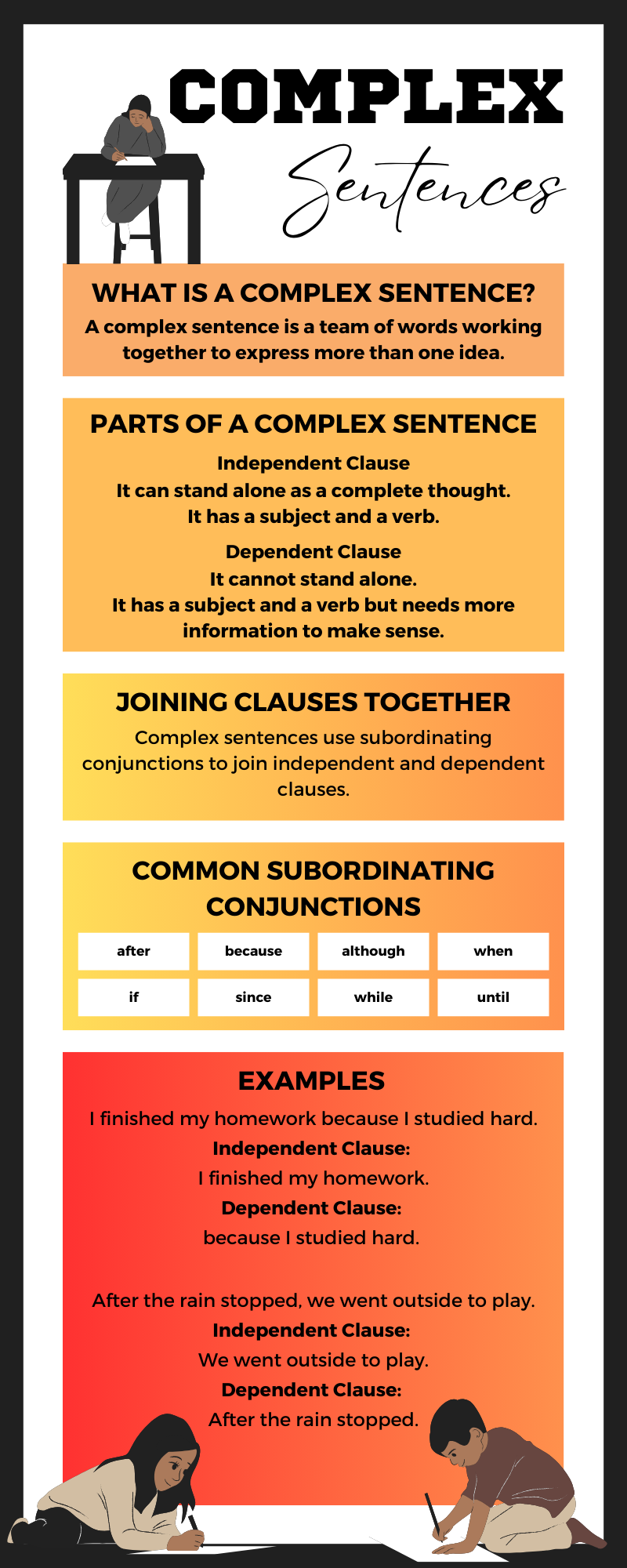
A complex sentence is a type of sentence that includes at least one independent clause and at least one dependent clause. These clauses are connected using subordinating conjunctions or relative pronouns. The independent clause can stand alone as a complete sentence, while the dependent clause cannot. By combining these clauses, complex sentences provide more detailed information and show relationships between ideas.
Definition of Complex Sentences
According to the Oxford Learner’s Dictionary, a complex sentence contains a main clause and one or more subordinate clauses. Collins Dictionary defines it as a sentence with at least one main clause and one subordinate clause. The Macmillan Dictionary describes it as a sentence consisting of an independent clause and one or more subordinate clauses. Now let’s understand how to make complex sentences:
Key Points to Remember When Forming Complex Sentences
Structure: A complex sentence must include at least one independent clause and one dependent clause.
Subordinating Conjunctions: Use subordinating conjunctions (e.g., "because," "although," and "if") to connect the clauses. If the conjunction is in the middle of the sentence, no comma is needed before it. If it starts the sentence, use a comma after the dependent clause.
Relative Clauses: You can use relative pronouns (e.g., "who," "which," "that") to create relative clauses, which are also subordinate clauses. These clauses add extra information and should be set off with commas if they provide non-essential information.
Complex Sentence Examples
1. Complex Sentences with Subordinating Conjunctions at the Beginning
Before I go to bed, I like to read a book.
(Dependent clause: Before I go to bed / Independent clause: I like to read a book)Although it was raining, we decided to go for a walk.
(Dependent clause: Although it was raining / Independent clause: We decided to go for a walk)If you finish your homework, you can watch TV.
(Dependent clause: If you finish your homework / Independent clause: You can watch TV)
2. Complex Sentences with Subordinating Conjunctions in the Middle
She finished the report, although she was feeling unwell.
(Independent clause: She finished the report / Subordinating conjunction: although / Dependent clause: she was feeling unwell)We can go to the beach if the weather is nice.
(Independent clause: We can go to the beach / Subordinating conjunction: if / Dependent clause: the weather is nice)He couldn’t attend the meeting, because he had a prior engagement.
(Independent clause: He couldn’t attend the meeting / Subordinating conjunction: because / Dependent clause: he had a prior engagement)
3. Complex Sentences with Relative Clauses
My friend, who lives in Paris, is visiting us next month.
(Relative clause: who lives in Paris / Independent clause: My friend is visiting us next month)The book, which was published last year, became a bestseller.
(Relative clause: which was published last year / Independent clause: The book became a bestseller)The restaurant, where we had our first date, has closed down.
(Relative clause: where we had our first date / Independent clause: The restaurant has closed down)
10 Complex Sentences
Below are the 10 Complex Sentences, each illustrating different ways to combine clauses:
1. Although it was Raining, We Decided to go for a Walk.
Dependent clause: Although it was raining
Independent clause: we decided to go for a walk
2. When She Finishes her Book, She will Start a New One.
Dependent clause: When she finishes her book
Independent clause: she will start a new one
3. Because He was Late for the Meeting, He Missed the Important Announcement.
Dependent clause: Because he was late for the meeting
Independent clause: he missed the important announcement
4. If You Need Any Help, Please Let me Know.
Dependent clause: If you need any help
Independent clause: please let me know
5. Even Though She was Tired, She Stayed up to Finish her Assignment.
Dependent clause: Even though she was tired
Independent clause: she stayed up to finish her assignment
6. While We were having Dinner, the Power went Out.
Dependent clause: While we were having dinner
Independent clause: the power went out
7. Since the Movie was Sold Out, We Decided to go to a Different Theatre.
Dependent clause: Since the movie was sold out
Independent clause: we decided to go to a different theatre
8. After the Concert Ended, Ee went to a Nearby Café for Coffee.
Dependent clause: After the concert ended
Independent clause: we went to a nearby café for coffee
9. Although he Practised Every Day, He didn’t Win the Competition.
Dependent clause: Although he practised every day
Independent clause: he didn’t win the competition
10. Unless You Submit the Form by Friday, You won’t be Considered for the Position.
Dependent clause: Unless you submit the form by Friday
Independent clause: you won’t be considered for the position
Common Mistakes with Complex Sentences
a. Misplacing Commas
Error: After we finish the project we will start the next one.
Correction: After we finish the project, we will start the next one.
b. Incorrect Use of Subordinating Conjunctions
Error: She will attend the meeting although she is busy.
Correction: Although she is busy, she will attend the meeting.
c. Run-On Sentences
Error: He didn’t study he failed the test.
Correction: He didn’t study, so he failed the test.
Complex sentences enrich your writing and speech by connecting ideas and providing more context. Understanding how to make complex sentences and use them effectively will enhance your communication skills and help you convey detailed information. Practise creating and identifying complex sentences to improve your understanding of this important grammatical structure.
Test Your Knowledge for Complex Sentences
Here are a few questions for you to answer:
1. Identify the Complex Sentence
Which of the following is a complex sentence?
a) She enjoys reading books.
b) She enjoys reading books, and she often visits the library.
c) Although she enjoys reading books, she doesn’t have much time to read.
d) She enjoys reading books every day.
2. Complete the Sentence
Complete the complex sentence with an appropriate subordinating conjunction:
If I finish my homework, ___________ I will watch a movie.
3. Identify the Dependent Clause
In the sentence below, identify the dependent clause:
"Because it was raining, we decided to stay indoors."
4. Correct the Error
Identify and correct the error in the following sentence:
"We will go to the park if it stops raining, but we will stay home if not."
5. Choose the Correct Punctuation
Which sentence is punctuated correctly?
a) I will call you when I arrive, and I will send a text if I am running late.
b) I will call you when I arrive and, I will send a text if I am running late.
c) I will call you when I arrive, and I will send a text if, I am running late.
d) I will call you, when I arrive and I will send a text if I am running late.
Test Your Knowledge: Correct Answers
Answer 1: c) Although she enjoys reading books, she doesn’t have much time to read.
Answer 2: then (e.g., If I finish my homework, then I will watch a movie.
Answer 3: Because it was raining
Answer 4: The sentence is correct.
Answer 5: a) I will call you when I arrive, and I will send a text if I am running late.
Takeaways from This Article
Definition: A complex sentence includes one independent clause and at least one dependent clause.
Conjunctions: Use subordinating conjunctions like "because," "although," and "if" to link clauses and show their relationship.
Relative Clauses: Add extra details about nouns using relative pronouns such as "who" and "which."
Punctuation: Place a comma after a dependent clause if it precedes an independent clause; no comma is needed if the dependent clause follows.
Usage: Complex sentences help make your writing and speech more detailed and nuanced.
FAQs on Understanding Complex Sentences in English Grammar
1. What is a complex sentence in English grammar?
A complex sentence is a sentence that contains one independent clause and at least one dependent clause. An independent clause can stand alone as a complete sentence, while a dependent clause cannot stand alone and begins with a subordinating word.
- Example: Although it was raining, we went for a walk.
- “We went for a walk” = independent clause.
- “Although it was raining” = dependent clause.
2. How do you form a complex sentence?
You form a complex sentence by joining an independent clause with a dependent clause using a subordinating word. The dependent clause usually begins with a subordinating conjunction or a relative pronoun.
- Step 1: Write a complete idea (independent clause).
- Step 2: Add a dependent clause starting with words like because, although, if, when, that, who, which.
- Example: She stayed home because she was sick.
3. What is the difference between a complex sentence and a compound sentence?
The main difference is that a complex sentence has one independent clause and at least one dependent clause, while a compound sentence has two or more independent clauses joined together. Compound sentences use coordinating conjunctions like and, but, or.
- Complex: I stayed home because I was tired.
- Compound: I was tired, so I stayed home.
4. What are some examples of complex sentences?
A complex sentence includes one main clause and at least one subordinate clause. Here are clear examples:
- When the bell rang, the students left the classroom.
- She smiled because she was happy.
- The book that you gave me is fascinating.
5. What are subordinating conjunctions in complex sentences?
Subordinating conjunctions are words that introduce dependent clauses in complex sentences and show relationships like cause, time, condition, or contrast. Common subordinating conjunctions include:
- because, since (cause)
- although, though, whereas (contrast)
- if, unless (condition)
- when, while, after, before (time)
6. Can a complex sentence start with a dependent clause?
Yes, a complex sentence can begin with a dependent clause, but it is usually followed by a comma before the independent clause. This structure is common in formal and academic writing.
- Example: If you study hard, you will pass the exam.
- Comma rule: Use a comma when the dependent clause comes first.
7. What is the function of a dependent clause in a complex sentence?
A dependent clause adds extra information to an independent clause but cannot stand alone as a complete sentence. It functions as an adjective, adverb, or noun in the sentence.
- Adverb clause: She left because she was tired.
- Adjective clause: The boy who won the prize is my friend.
- Noun clause: I know that he is honest.
8. What are the types of dependent clauses in complex sentences?
The three main types of dependent clauses in complex sentences are noun clauses, adjective clauses, and adverb clauses. Each type has a different grammatical function.
- Noun clause: Acts as a subject or object (e.g., What she said is true).
- Adjective clause: Describes a noun (e.g., The car that he bought is new).
- Adverb clause: Modifies a verb, adjective, or adverb (e.g., We left after the movie ended).
9. What punctuation rules apply to complex sentences?
In a complex sentence, use a comma after the dependent clause if it comes before the independent clause. If the independent clause comes first, a comma is usually not required.
- Dependent clause first: Because it was cold, we stayed inside.
- Independent clause first: We stayed inside because it was cold.
10. Why are complex sentences important in writing?
Complex sentences are important because they allow writers to connect ideas logically and show relationships like cause, time, contrast, and condition. They improve sentence variety and make writing more sophisticated.
- They combine related ideas smoothly.
- They prevent short, repetitive sentences.
- They are common in academic, formal, and advanced English writing.
