







What Is a Common Noun Definition Rules Types and Practical Examples
Understanding the basic building blocks of the English language is essential for effective communication. One of these fundamental elements is the common noun. Common nouns are the general names we use for a wide variety of people, places, things, and ideas. Unlike proper nouns, which are name specific entities, common nouns are more generic. They are the everyday words we use to describe the world around us.
 Table of Content
This article will explore the definition, examples, and usage of common nouns, providing you with a solid foundation to enhance your grammar skills. Whether you're a student aiming to improve your language abilities or someone looking to refine your writing, understanding common nouns is a crucial step.
A common noun is a vital concept in English grammar, representing general names for people, places, things, or ideas instead of specific ones. Mastering the distinction between common noun and proper noun is essential for writing accurately and clearly. This page will help you understand common noun definition, provide examples, and explain the differences with proper noun, using real-life contexts and sentences.
What is a Common Noun? Definition and Key Points
Common nouns are words that refer to non-specific items, people, or places, such as "city", "teacher", or "book". Unlike proper nouns, a common noun does not name anything unique or particular. For instance, while "India" is a proper noun, "country" is a common noun. Understanding this difference forms the foundation for clear sentence construction and effective communication.
Key points:
A common noun is always written in lowercase unless it starts a sentence.
It can refer to people, animals, objects, or places in a general way.
Common nouns are used in everyday conversations and writing.
More on Types of Nouns
Common Noun vs. Proper Noun: Understanding the Difference
The difference between common noun and proper noun is crucial. A proper noun specifically names a unique person, place, or thing (e.g., "Agra," "Sachin Tendulkar"), while a common noun refers to the general group ("city," "player"). Correct capitalization helps distinguish between the two in writing and avoids common errors.
Common Noun Examples: Lists and Sentences
Below are examples of common noun, covering people, animals, places, objects, and ideas. Explore these to deepen your understanding and spot common nouns in everyday use.
Table of Common Noun Examples vs. Proper Noun
| Common Noun | Proper Noun | Sentence Example |
|---|---|---|
| river | Ganga | I visited the river during summer. |
| city | Delhi | The city is famous for its history. |
| book | Harry Potter | I read a book last night. |
| teacher | Mrs. Sharma | Our teacher is very helpful. |
| festival | Diwali | The festival is celebrated across India. |
| planet | Mars | The planet appears red in colour. |
As shown above, a common noun names things generally, while a proper noun is always specific and capitalized. Practicing with such lists and examples helps students identify nouns correctly in reading and writing. For more exercises, visit Common and Proper Noun Exercises.
Rules for Using Common Nouns in English
Rules for using a common noun are clear and simple. They are written in lowercase unless they are at the start of a sentence. Do not capitalize them unnecessarily. In speech and writing, use articles such as 'a', 'an', or 'the' before most common nouns for grammatical accuracy.
Always write common nouns in lowercase unless beginning a sentence.
Use 'a' or 'an' as articles for singular nouns when discussing something general.
Capitalize only if the noun is part of a title or starts a sentence.
Learn About Articles and Determiners
Common Noun Examples in Sentences
Explore these common noun examples in sentences for practical context. Notice how they appear in different situations, representing general people, places, or things.
The boy played in the park.
She ate an apple during lunch.
Many children love cartoons.
The car stopped at the signal.
We live in a big city.
The teacher gave us homework.
Words Starting with C
50 Examples of Common Noun (List)
Here is a list of 50 common noun words often used in English:
dog
friend
house
doctor
computer
school
desk
teacher
garden
river
country
music
language
song
market
friendship
car
road
park
game
story
month
cousin
uncle
book
festival
uncle
door
father
holiday
monster
rain
sun
bottle
star
bird
mother
student
river
queen
shoe
computer
clothes
bus
pain
joy
table
lamp
mountain
More Lists for Kids
Common Noun Meaning in Hindi and for Kids
Common noun in Hindi: सामान्य संज्ञा (Sāmaanya Sangyā) – यह वे शब्द होते हैं जो व्यक्ति, स्थान, वस्तु या विचार के सामान्य नाम दर्शाते हैं, जैसे- लड़का, किताब, शहर, नदी। For kids, a simple definition is: “A common noun is any ordinary name – like ‘boy’, ‘apple’, or ‘school’.” Picture worksheets and fun exercises can make learning easy for children. Check Vedantu Worksheets for Kids for more activities.
How to Identify Common Nouns in Sentences
To find a common noun in a sentence, look for words naming a general person, place, thing, or idea. For example, in “The dog barked loudly,” ‘dog’ is a common noun. Practice by spotting such nouns in your daily reading or try making your own sentences.
Common Noun and Proper Noun Worksheet and Learning Activities
Worksheets on common noun and proper noun help reinforce learning and improve grammar skills. Students can sort words into categories, fill in missing nouns, or use pictures to identify the right noun types. Interactive tools and lists available on Vedantu enhance understanding for children and beginners. For more, visit Noun Worksheets and Learning Activities.
Practice Questions on Common Noun
Test your knowledge with these sample exercises. Can you pick out the common noun?
The student raised her hand.
We visited the museum on Sunday.
My mother baked a cake.
The tree was very old.
He is a good doctor.
Try More Noun Questions and Answers
A common noun is a basic building block in English grammar, helping us refer to people, places, and things in a general way. Distinguishing between common noun and proper noun clarifies writing and speaking. With rules, lists, and practical examples, this topic becomes easy to grasp. Practice often for confidence, and use Vedantu for more learning resources.
Common Noun Definition
Common Noun definition: A common noun is a type of noun that refers to a general, non-specific person, place, thing, or idea. Unlike proper nouns, which name specific entities and are capitalised, common nouns are not capitalised unless they start a sentence.
Examples of common nouns include words like "city," "dog," "book," and "idea."
Common Noun Examples
Here is a table with examples of common noun words for different category:
Examples of Common Noun Sentences
Here are some examples of common noun sentences:
Dog: The dog barked loudly in the backyard.
Book: She read a fascinating book about ancient civilizations.
City: The city was bustling with people and traffic.
Car: He drove his car to the office every day.
Teacher: The teacher explained the lesson patiently.
House: They bought a beautiful house in the countryside.
Restaurant: We had dinner at a fancy restaurant downtown.
Child: The child played happily in the park.
Friend: My friend and I went hiking over the weekend.
School: The school organized a science fair for the students.
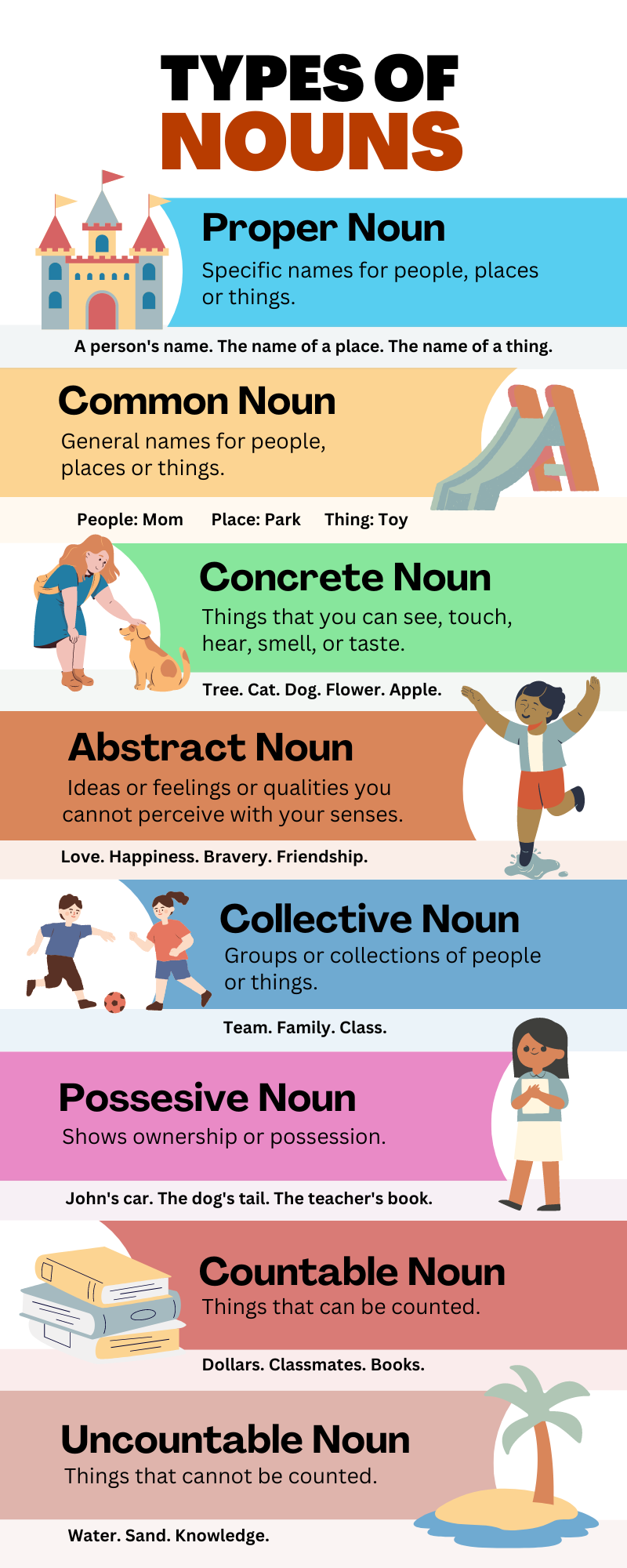
Types of Nouns
Here are the different types of noun with their explanations and examples.
Test Your Knowledge: Common Nouns
1. Which of the following is a common noun?
a) New York
b) city
c) Eiffel Tower
d) Africa
2. Identify the common noun in the following list:
a) Amazon
b) river
c) Mount Everest
d) Pacific Ocean
3. Choose the common noun:
a) Jupiter
b) planet
c) Milky Way
d) Orion
4. Which word is a common noun?
a) Einstein
b) scientist
c) Tesla
d) Beethoven
5. Identify the common noun:
a) Christmas
b) holiday
c) Thanksgiving
d) Easter
Find Out if You Got Them All Right From the Answers Below.
b) city
b) river
b) planet
b) scientist
b) holiday
Takeaways from this Page
Here are some key takeaways about common nouns:
Definition: Common nouns are general names for a person, place, thing, or idea. They are not capitalised unless they start a sentence or are part of a title.
Examples: Examples of common nouns include "dog," "city," "car," "happiness," and "book."
Contrast with Proper Nouns: Unlike proper nouns, which name specific people, places, or things and are capitalised (e.g., "New York," "Eiffel Tower," "Sarah"), common nouns refer to general items and are not capitalised.
Categories: Common nouns can be categorized into countable nouns (e.g., "apple," "cat") and uncountable nouns (e.g., "water," "information").
Usage: Common nouns are used in everyday language to refer to general items and concepts. They are the most basic form of nouns used in speech and writing.
A common noun is a word that names a general person, place, thing, or idea, rather than a specific one. For example, "city," "dog," and "school" are common nouns because they refer to general categories. Unlike proper nouns, which name specific entities (like "New York" or "Rover"), common nouns are used to talk about things in a broad way.
FAQs on Common Noun in English Grammar Explained Clearly
1. What is a common noun in English grammar?
A common noun is a general name for a person, place, thing, or idea rather than the specific name of one. It refers to ordinary items and is not capitalized unless it begins a sentence.
- Examples: teacher, city, book, river
- Sentence example: The teacher gave us a new book.
- Unlike proper nouns, common nouns do not name a specific person or place.
2. What is the difference between a common noun and a proper noun?
The main difference is that a common noun names something general, while a proper noun names something specific and is always capitalized. Proper nouns refer to unique names.
- Common noun: country → Proper noun: India
- Common noun: girl → Proper noun: Maria
- Rule: Proper nouns begin with capital letters; common nouns do not (unless at the start of a sentence).
3. Can you give 10 examples of common nouns?
Here are 10 examples of common nouns used in everyday English. These words name general people, places, or things.
- dog
- school
- car
- city
- teacher
- river
- computer
- child
- book
- food
4. How do you identify a common noun in a sentence?
You can identify a common noun by checking if the word names a general person, place, thing, or idea and is not capitalized as a specific name. It usually answers the question “What?” or “Who?”
- In the sentence: The boy kicked the ball, both words are common nouns.
- They are not specific names.
- They can often be made plural (boys, balls).
5. Are common nouns capitalized?
A common noun is not capitalized unless it appears at the beginning of a sentence. Capital letters are reserved for proper nouns.
- Correct: The dog barked loudly.
- Beginning of sentence: Dogs are loyal animals.
- Incorrect: I saw a Dog in the park. (Dog should not be capitalized.)
6. What are the types of common nouns?
The main types of common nouns include concrete, abstract, countable, and uncountable nouns. These categories describe how the noun functions in grammar.
- Concrete nouns: things you can see or touch (e.g., apple).
- Abstract nouns: ideas or feelings (e.g., happiness).
- Countable nouns: can be counted (e.g., books).
- Uncountable nouns: cannot be counted individually (e.g., water).
7. Is a common noun a naming word?
Yes, a common noun is a naming word because it names a general person, place, thing, or idea. In basic English grammar, all nouns are naming words.
- Person: doctor
- Place: market
- Thing: chair
- Idea: freedom
8. Can a common noun be singular and plural?
Yes, a common noun can have both singular and plural forms depending on the number it refers to. Most plural forms are made by adding -s or -es.
- Singular: cat → Plural: cats
- Singular: box → Plural: boxes
- Irregular example: child → children
9. What is the function of a common noun in a sentence?
A common noun functions as the subject, object, or complement in a sentence. It plays the same grammatical roles as any other noun.
- Subject: The teacher explained the lesson.
- Object: She bought a gift.
- Complement: He became a doctor.
10. What are common mistakes with common nouns?
A common mistake with common nouns is unnecessary capitalization or confusing them with proper nouns. Learners often capitalize general words by mistake.
- Incorrect: I visited the Museum. (museum is common unless part of a name)
- Correct: I visited the museum.
- Remember: Only capitalize if it is part of a specific name, such as National Museum.
