




What Are Beginning Consonant Blends With Examples and Printable Activities
By blending up two or three constants, they make up a new sound. For example, ‘bl’ in black, ‘ph’ in the phone, etc. A consonant blend is when two or three consonants are right next to each other, and each of them gives its own sound. For example, ‘pl’ in the word plate, ‘tr’ in the word tree, etc.
Questions:
1. Fill in the blanks with the correct blend.

an image of some objects
2. Write any 5 words that start with the blend ‘pr’.
3. Tick the correct beginning consonant blend.
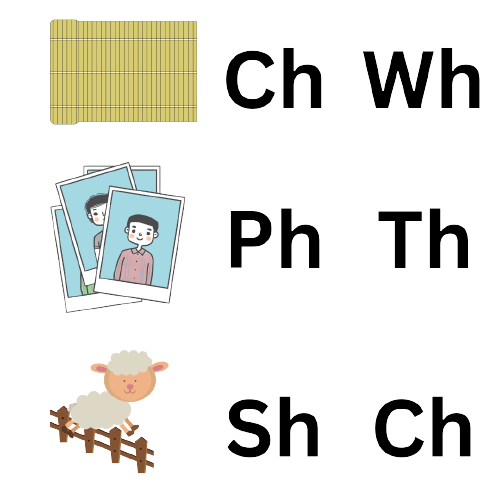
an image of some objects
4. Circle the correct beginning blend.
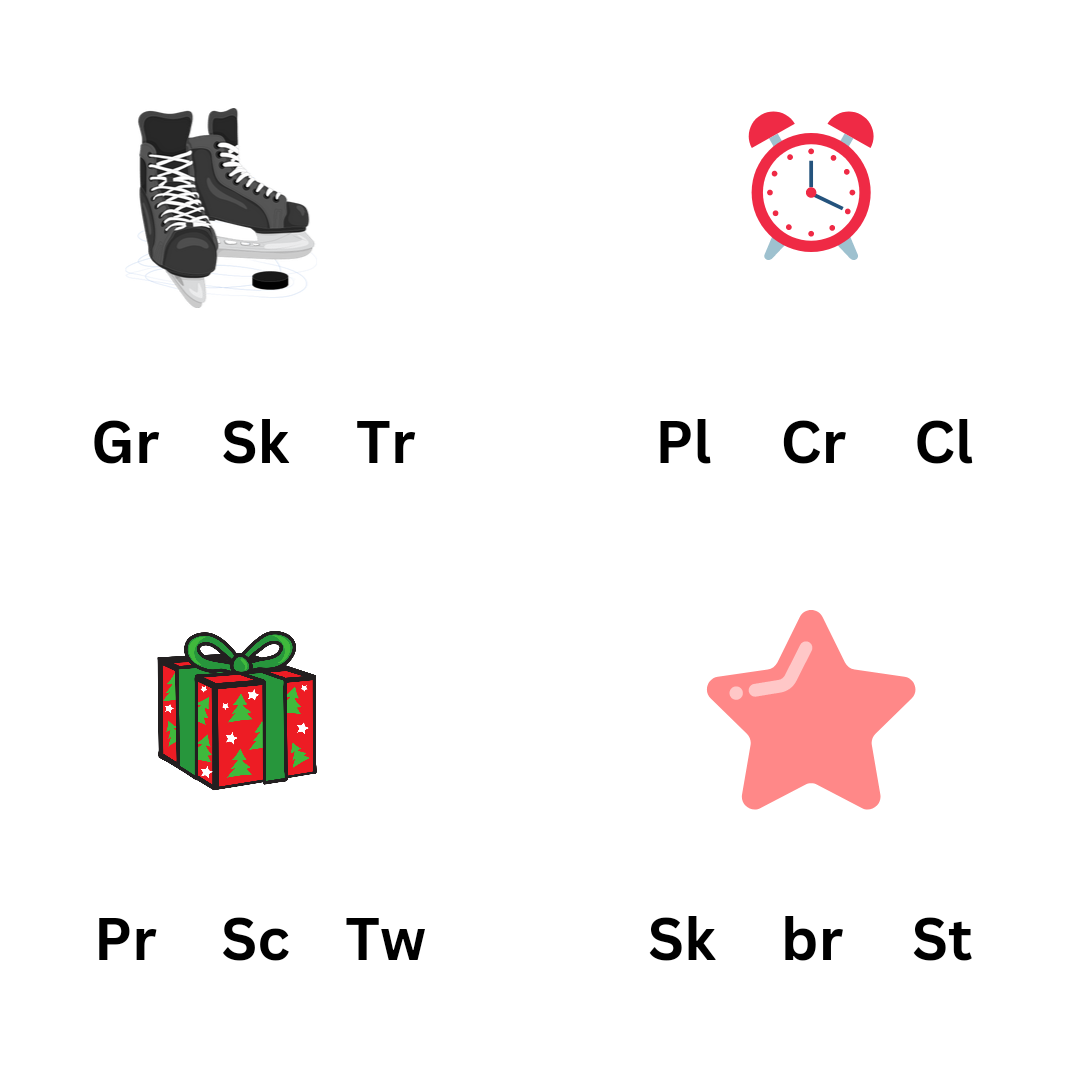
an image of some objects
5. Fill in the blanks with the correct blend.

an image of some objects
6. Write any 5 words that start with the blend ‘bl’.
7. Find beginning consonants and blend words from the given story.
A Leopard once slept in the jungle when a Mongoose started running up and down his body just to play. This disturbed the Leopard’s sleep, and he woke up very angry. He was about to eat the Mongoose when the Mongoose desperately requested the Leopard to leave him. “I promise you; I will be of great help to you someday if you save me.” The Leopard laughed at the Mongoose’s confidence and let him go. One day, a few hunters came into the jungle and took the Leopard with them. They tied him up against a tree. The Leopard was struggling to get out and started to whimper. Soon, the Mongoose walked past and noticed the Leopard in trouble. Quickly he came and nibbled on the ropes to set the Leopard free. Both of them leave the jungle.
8. Tick the correct beginning consonant blend.
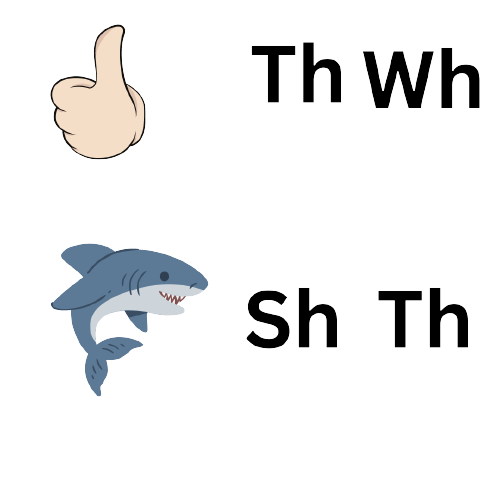
an image of some objects
9. Circle the correct beginning blend.
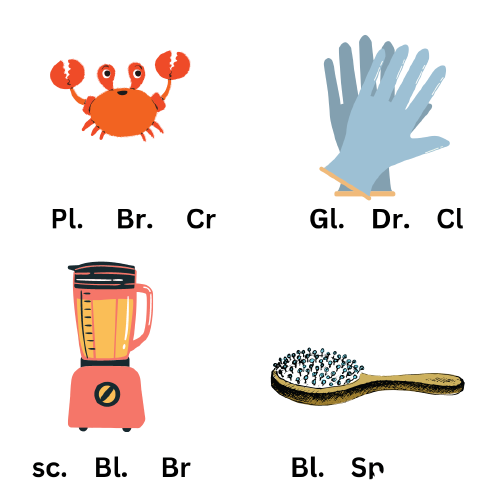
an image of some objects
10. Write any 5 words that start with the blend ‘str’.
11. Fill in the blanks with the correct blend.

an image of some objects
12. Circle the correct beginning blend.

an image of some objects
13. Write any 5 words that start with the blend ‘pl’.
14. Fill in the blanks with the correct blend.

an image of some objects
15. Tick the correct beginning consonant blend.

an image of some objects
Answers:
1.
Flame
Glow
2.
Product, press, problem, prince, proud, price, proof, print, prove, present, pride, prayer, prefer, prank, pretty, suppress, prone, pregnant, etc.
3.
Ch
Ph
Sh
4.
Sk Cl
Pr St
5.
Gloves Bread
Dragon Present
6.
Blame, blood, blanket, bloom, block, blink, blank, blue, black, blur, blind, blast, blow, blackboard, blade, etc.
7. Once, sleeping, jungle, when, started, playing, running, angry, about, promise, great, them, they, against, tree, struggling, whimper, trouble, quickly, free, etc.
8.
Th
Sh
9.
Cr Gl
Bl Br
10.
Strong, straw, stretch, stress, strap, street, strange, stray, strip, string, strike, stray, etc.
11.
Crab Truck
Ride Drum
12.
Sl Gl
Sl Gl
13.
Plug, plant, plus, plural, plate, pleasure, please, plain, place, plastic, player, plane, plenty, plot, plan, plucker, etc.
14.
Cloud
Block
15.
Wh
Ch
Importance of Consonant Blends Worksheets
Kids start learning simpler words first and then develop a proper foundation to move ahead to learn consonant blends. They will need a strong concept of how consonants and vowels are used to develop such words. In fact, they will also learn how to pronounce these words and figure out the spelling from the pronunciation.
This is where the worksheets for consonant blends can be perfectly used to teach the phonics of these words. From the phonics and pronunciation, kids will be able to figure out the consonants at the beginning of these words and answer the questions accurately. Hence, these worksheets give a brilliant practice ground to follow and learn these blended words to strengthen their vocabulary.
Benefits of Solving Blends Worksheets
Learning new words becomes a lot easier when you solve questions developed with them. Focus on how the questions have been formulated to find the words required and answer them precisely.
The worksheets come with proper solutions. Hence, students will resolve doubts on their own and go ahead with their preparation of consonant blends.
They will learn to use the phonics and pronunciation of the words and remember the spelling aptly.
Every worksheet developed by the experts is a treasure of new consonant blends. Kids will learn new words. They will also learn the meaning and apply them.
Solving this worksheet will enable kids to develop their English comprehension skills, vocabulary and skills to follow instructions.
Download Blending Sounds Worksheets PDF
Get the free PDF version of these worksheets for consonant blends. Understand the concepts well and focus on solving the questions composed by the experts. Develop your English language and comprehension skills by learning Blending Words Examples for Kindergarten. Find out the spelling and meaning of these words to strengthen your English vocabulary.
FAQs on Beginning Consonant Blends Worksheet for Phonics Practice
1. What are beginning consonant blends?
Beginning consonant blends are groups of two or three consonants at the start of a word where each sound is heard clearly. In a consonant blend, the letters keep their individual sounds.
- Examples: bl in black, st in star, tr in tree
- Each consonant sound is pronounced, unlike in a digraph
- Common in early phonics and reading lessons
2. What is the difference between a consonant blend and a digraph?
The difference is that a consonant blend keeps each letter’s sound, while a digraph combines letters to make one new sound. This is an important phonics rule for early readers.
- Blend example: sp in spin (both sounds are heard)
- Digraph example: sh in ship (one combined sound)
- Blends = separate sounds; digraphs = single new sound
3. Why are beginning consonant blends important in phonics?
Beginning consonant blends are important because they help children decode and read longer words more fluently. Understanding initial blends strengthens phonemic awareness and pronunciation skills.
- Improves early reading fluency
- Supports spelling development
- Builds confidence in sounding out unfamiliar words
4. What are some common beginning consonant blends?
Common beginning consonant blends include two-letter and three-letter combinations frequently used in English words. These are taught in most phonics worksheets and early grade lessons.
- bl, cl, fl, gl
- br, cr, dr, tr
- sc, sk, sl, sm, sn, sp, st, sw
- Three-letter blends: str, spl, scr
5. How do you teach beginning consonant blends to kids?
You teach beginning consonant blends by helping students say each sound separately and then blend them smoothly together. This step-by-step phonics strategy improves decoding skills.
- Step 1: Say each consonant sound (e.g., /s/ /t/)
- Step 2: Blend the sounds together: st
- Step 3: Add a vowel and ending: st + op = stop
- Use worksheets, flashcards, and reading practice
6. What is a beginning consonant blends worksheet?
A beginning consonant blends worksheet is a phonics activity sheet designed to help students identify, read, and write words with initial blends. These worksheets support early literacy and spelling practice.
- Matching blends to pictures
- Filling in missing blend letters
- Sorting words by blend type
- Reading and writing blend words in sentences
7. Can you give examples of words with beginning consonant blends?
Yes, words with beginning consonant blends start with two or three consonants pronounced together. These examples are common in early reading vocabulary.
- br: bread, brick
- cl: clock, cloud
- sp: spoon, sport
- str: street, strong
8. What are three-letter beginning consonant blends?
Three-letter beginning consonant blends are clusters of three consonants at the start of a word where each sound is heard. These are sometimes called triple consonant blends.
- str in street
- spl in splash
- scr in screen
- All three consonant sounds are pronounced
9. What are common mistakes students make with beginning consonant blends?
A common mistake with beginning consonant blends is dropping one of the consonant sounds while reading or spelling. This happens when students do not clearly hear each sound.
- Saying “poon” instead of spoon
- Writing “tar” instead of star
- Confusing blends with digraphs like sh or ch
10. How can I help my child practice beginning consonant blends at home?
You can help your child practice beginning consonant blends at home by using short daily phonics activities and reading practice. Consistent exposure improves fluency and spelling accuracy.
- Read simple books with many blend words
- Play word-building games using letter cards
- Complete printable beginning consonant blends worksheets
- Ask your child to identify blends in everyday words
