Personalized Strategies from Online Tutors to Excel in IB Assessments
Knowing an IB topic and demonstrating that knowledge in an assessment are different skills. One-on-one online tutors can help connect them by diagnosing gaps, explaining assessment criteria and guiding focused practice. For students in the IB Diploma Programme, this can make examinations and coursework more manageable without taking over the student’s work. The important choice is a tutor who understands your specific subject, level and assessment requirements—and helps you perform independently, not just answer questions during lessons.
Choose Your IB Home Tutoring for Success Check Our IB Online Tuition Classes
What IB Assessment Preparation Actually Involves
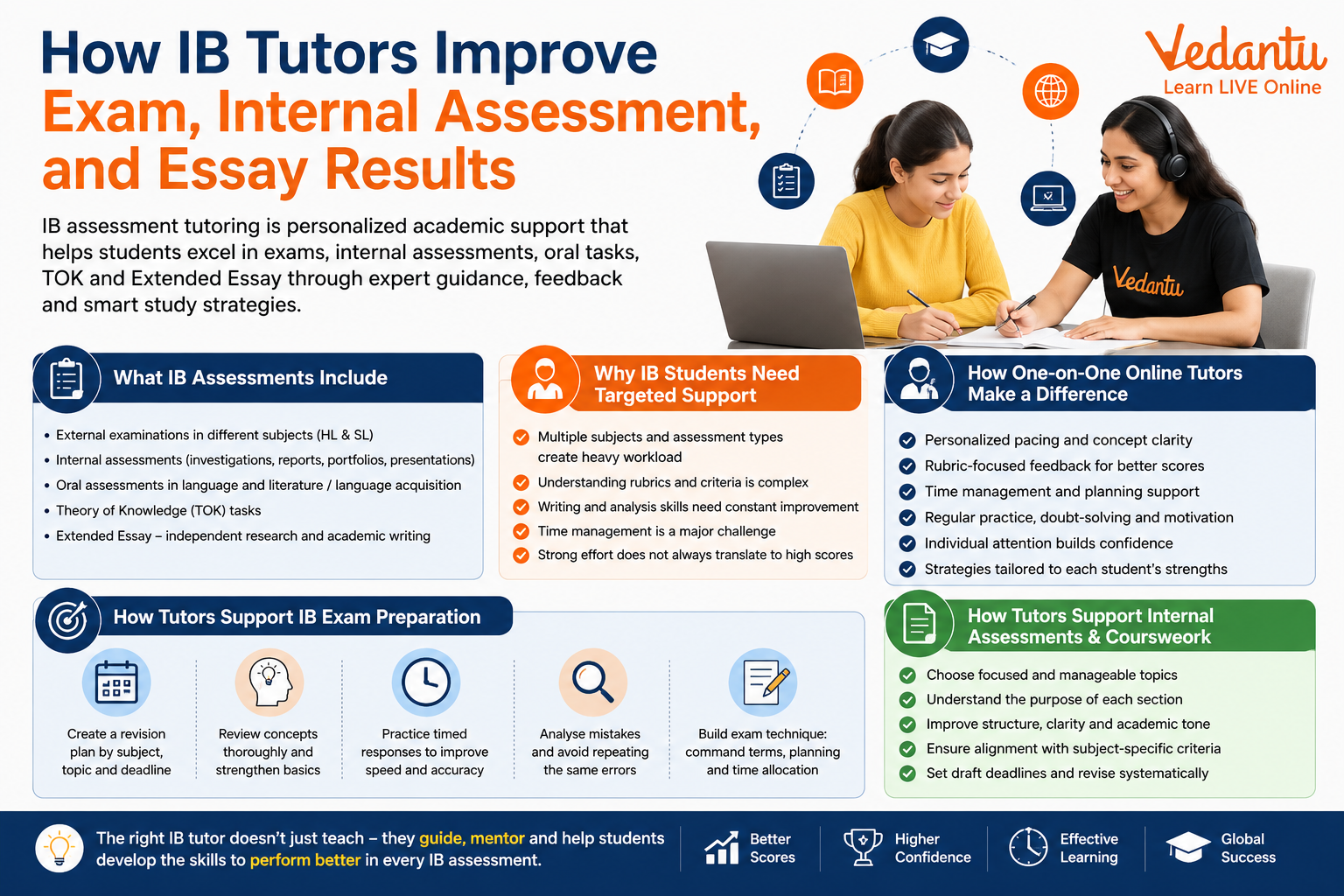
Assessment-focused tutoring goes beyond revising chapter content. It helps students decide what a question requires, select an appropriate method or argument and demonstrate their reasoning clearly. The examples below focus on the Diploma Programme; assessment arrangements vary by subject, Higher Level (HL), Standard Level (SL) and syllabus version.
| Assessment area | Skills students need | Useful tutoring focus |
|---|---|---|
| Written examinations | Recall, application, reasoning and time management | Timed practice, concept repair and analysis of lost marks |
| Internal assessments | Independent investigation and subject-specific communication | General research skills, criteria literacy and planning within school rules |
| Oral assessments, where applicable | Organised speaking, relevant evidence and responses to questions | Practice with non-assessed material and feedback on clarity |
| Theory of Knowledge (TOK) | Reasoning about knowledge, perspectives and justification | Discussion exercises and evaluation of arguments |
| Extended Essay | Independent research, sustained argument and referencing | Research-method and academic-writing instruction alongside school supervision |
An internal assessment is not simply a school assignment: it contributes to the qualification and is subject to IB assessment arrangements, including external moderation where applicable. Your school’s guidance and the relevant IB subject guide should therefore determine the requirements, rather than a generic essay template or an old practice paper.
How Individual Tutoring Turns Weak Areas into Targeted Practice
Start with the cause of lost marks
A useful first session includes a recent marked practice task and a short unfamiliar question completed without help. The tutor can then distinguish a knowledge gap from a difficulty interpreting the question, presenting reasoning or working under time pressure. These problems need different solutions.
For example, a science student may calculate a value correctly but struggle to explain what it means. Repeating calculations will not fix that weakness. The next practice task should ask the student to interpret the result, connect it to a scientific principle and discuss relevant limitations.
Make command terms and criteria usable
Instructions such as describe, explain, analyse and evaluate ask for different kinds of thinking. An explanation generally needs reasons or mechanisms; an evaluation requires a supported judgement that weighs relevant strengths, limitations or alternatives. The tutor should connect these distinctions to the subject’s own guidance and marking approach.
On practice work, feedback should identify the missing evidence rather than simply say “add detail”. In a humanities response, for instance, the tutor might show that the student has listed two interpretations but has not weighed their supporting evidence. The student then writes a fresh response independently to test whether the feedback has transferred.
Adjust support as independence grows
One-to-one teaching allows a tutor to change the pace immediately. A difficult method can be broken into smaller steps, while a secure topic can move straight to unfamiliar applications. However, prompts should gradually reduce: being able to follow a tutor’s solution is not the same as producing your own.
Students deciding whether their main difficulty is understanding content or applying it can explore Vedantu’s resource on one-on-one support for IB assessments. Use it alongside your marked work to identify the type of help you need.
Visit Our Vedantu Learning Centres Near You📍
A Practical Tutoring Cycle for IB Examinations
The most useful revision cycle is attempt, diagnose, repair and retest. Starting with a question reveals what you can actually do; reviewing notes first can sometimes make a topic feel more secure than it is.
- Attempt a suitable task independently. Use questions aligned with your current syllabus, level and paper format. Follow the relevant calculator and resource conditions.
- Classify the mistakes. Separate conceptual errors, incorrect methods, missing justification, misread instructions and unfinished answers.
- Repair one priority weakness. Revisit the underlying idea, then practise it in a short question before returning to a larger task.
- Attempt a different question. Repeating the same answer from memory does not demonstrate understanding.
- Retest after a gap. Include the skill in a later mixed or timed task to check retention and independent application.
Keep an error log with four entries: the question, the cause of the error, the correction and the retest result. If answers remain unfinished, record where time was spent before deciding whether the problem is slow recall, excessive writing or an inefficient method. This produces a more useful plan than simply doing more full papers.
Supporting Coursework Without Crossing Academic Integrity Boundaries
Tutoring must preserve the student’s authorship. For internal assessments, TOK submissions and the Extended Essay, the school’s teachers and supervisors remain responsible for the formal guidance process. Before involving an outside tutor in assessed work, ask your teacher or IB coordinator what assistance is permitted for that component.
- Teach transferable skills: source evaluation, citation, data analysis and argument construction can be taught using separate practice material.
- Support organisation: a tutor can help you reserve time for research, writing and independent review around school deadlines.
- Keep decisions with the student: the research choices, analysis, conclusions and submitted wording must genuinely be your own.
- Avoid taking over: a tutor should not write or rewrite submissions, fabricate evidence, provide ready-made analysis or conduct repeated editing of assessed drafts.
- Respect component-specific limits: do not assume that feedback allowed on an examination practice essay is also allowed on an assessed submission.
For the Extended Essay, a helpful starting point is learning how to judge whether a question can be researched with the available evidence and time. Vedantu’s resource on help with Extended Essays for IB students offers further reading on tutoring support; apply any advice within your school supervisor’s instructions.
What Subject-Specific Support Should Look Like
- Mathematics: ask the tutor to examine method selection, notation and interpretation—not just the final answer. Practise recognising when a familiar technique applies in an unfamiliar context.
- Sciences: combine concepts with graphs, data interpretation and evaluation of methods. Explain why a limitation matters and how a proposed improvement addresses it.
- Humanities: practise turning evidence into an argument. Each example should support a claim, and the judgement should answer the actual question.
- Languages and literature: connect interpretations to precise textual evidence. For oral practice, work on clear organisation and responding thoughtfully rather than relying on a memorised script.
- TOK: examine why a claim is justified, where its limitations lie and how another perspective might change the judgement. Avoid treating TOK as a general opinion essay.
A tutor’s fit needs to be specific: experience in mathematics generally does not automatically establish familiarity with your IB mathematics course. Vedantu’s discussion of one-on-one tuition for IB mathematics and science is a relevant next read when comparing subject-focused support.
Make Online Sessions Fit Around School and Independent Study
Online tutoring removes the journey to a tuition centre and can make written work easier to discuss through screen sharing or a shared writing surface, where the tutor’s setup supports these tools. Scheduling still depends on tutor availability and time zones. A stable connection, readable working and a quiet space matter more than an elaborate setup.
The following is an illustrative weekly cycle, not a required lesson frequency. Adjust it around school workload and assessment deadlines.
- Before the session: complete a short independent task and send the tutor your working, doubts and relevant teacher feedback.
- During the session: diagnose the main weakness, practise the underlying skill and finish with an unprompted question.
- Later in the week: complete a short retrieval task followed by a new application question.
- At the next review: compare independent performance and decide whether to revisit the skill or move on.
Track fewer repeated mistakes, stronger explanations and better completion under timed conditions—not just the number of sessions attended. When deadlines overlap, Vedantu’s resource on overcoming common IB challenges with tuition can support a student-parent discussion about workload and priorities.
Choosing Between Tutoring, Group Classes and Self-Study
One-on-one tutoring is particularly useful when you need someone to inspect your reasoning closely and adapt the next task. Group classes may suit students who benefit from peer discussion and a shared pace. Self-study or recorded lessons can work well for revisiting familiar content, but they do not by themselves provide individual feedback on why your answer lost marks.
Vedantu’s linked IB reading resources can support self-study planning and help families prepare questions for a prospective tutor. They serve a different purpose from live individual teaching: reading about assessment strategy cannot replace feedback on your own performance. If considering tuition through Vedantu, confirm current availability for your exact IB subject, level and assessment session, along with lesson arrangements and coursework-support boundaries, before enrolling.
In an initial discussion with any tutor, ask them to explain how they would diagnose a weakness from a practice answer and test improvement later. Look for specific feedback and a plan that includes independent work. A promise of a particular grade is less useful than a clear explanation of what you will practise and how progress will be measured.
Summary
One-on-one online tutoring can strengthen IB assessment preparation by connecting subject knowledge with criteria, focused practice and independent performance. Choose support that matches your course and level, measures progress through unfamiliar tasks and respects academic integrity. Vedantu’s IB reading resources provide a useful starting point for understanding support options and planning questions for a tutor. Begin with one marked practice task, identify the main cause of lost marks and build a manageable practice cycle around it.
FAQs on How One-on-One Online Tutors Can Help You Master IB Assessments
1. How can one-on-one online tutors help me prepare for IB assessments?
One-on-one online tutors offer personalized strategies to master IB assessments by tailoring lessons to your specific needs. Key benefits include:
- Focused attention on individual strengths and weaknesses
- Customized study plans based on current IB syllabus and marking schemes
- Clarification of difficult concepts through real-time interaction
- Practice with past IB papers and targeted feedback
- Flexible scheduling for consistent and effective preparation
2. What are the main advantages of personalized IB tutoring online?
Personalized IB tutoring online maximizes student success through:
- Individualized instruction aligned to IB curriculum
- Immediate doubt resolution for complex topics
- Interactive sessions that build exam skills and confidence
- Progress tracking and adaptation of learning speed
3. Do online tutors help with Internal Assessments (IA) and Extended Essay (EE) in IB?
Yes, online IB tutors can guide you through Internal Assessments and the Extended Essay by:
- Providing topic selection guidance and research strategies
- Offering feedback on drafts according to IB criteria
- Helping structure, analyze, and edit written work
- Ensuring your submissions meet assessment standards
4. How do online IB tutors align lessons with the latest IB exam pattern?
Online IB tutors stay updated with the official IB syllabus and exam format for the relevant exam year. They:
- Integrate current IB papers and specimen questions
- Drill time management techniques for paper timings
- Review marking schemes and examiner expectations
- Adapt lessons for both SL and HL requirements
5. Can I schedule sessions with my IB tutor as per my learning pace?
Yes, one-on-one IB tutoring provides flexible scheduling so you can:
- Choose convenient times based on your study routine
- Adjust session frequency during busy periods, such as before mock exams or assessments
- Allocate more sessions to subjects and topics that need extra attention
6. What subjects can I get help with for IB assessments?
Online IB tutors support a wide range of subjects, including:
- Mathematics: Analysis & Approaches, Applications & Interpretation
- Sciences: Physics, Chemistry, Biology
- Humanities: History, Economics, Psychology
- Languages: English, French, Spanish and more
7. How do I track my progress with a one-on-one online tutor?
With personalized online IB tutoring, you can track progress through:
- Regular assessments and quizzes
- Session-wise feedback and performance analysis
- Goal setting and periodic progress reviews
- Adjustments to your study plan based on strengths and areas for improvement
8. Do online tutors provide help with IB Past Papers?
Yes, IB online tutors use official past papers to:
- Familiarize you with question formats and exam expectations
- Offer detailed solutions and strategies for each paper
- Identify frequently tested topics and weak areas for focused revision
9. How can online tutoring boost my confidence for IB exams?
One-on-one tutoring builds exam confidence by:
- Providing a judgment-free environment for questions and mistakes
- Improving subject knowledge with consistent guidance
- Offering exam simulation and stress management techniques
10. What technology is needed for effective online IB tutoring?
To maximize benefits from online IB tutoring, you'll need:
- A reliable internet connection
- A computer, tablet, or smartphone
- Audio and video capability for live interaction
- Access to digital learning tools (whiteboards, resources, and study materials)
11. Can I receive exam tips and time management strategies from my online IB tutor?
Yes, online IB tutors provide:
- Exam-specific tips for each subject based on IB requirements
- Advice on how to allocate time for different sections
- Practice with timed mock tests to improve speed and accuracy